
Redbanded seabream
Redbanded seabream is a sparid of the eastern Atlantic and southwestern Mediterranean, from Portugal to Angola, including Madeira and the Canaries. It lives shallower than 170 m in subtropical water, reaches 80 cm SL and 3 kg, and feeds on crustaceans, fish and molluscs. Its season runs January to February.
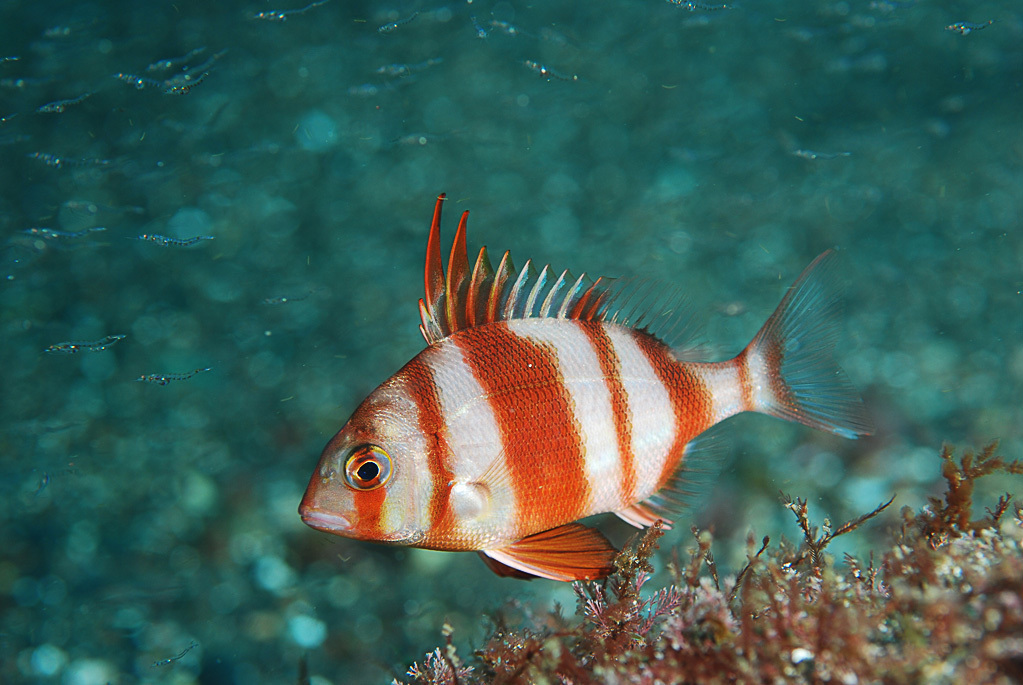
Redbanded seabream (Pagrus auriga) is a fish of the family Sparidae. FishBase gives its range as: Eastern Atlantic: Portugal to Angola, including the southwestern Mediterranean, Madeira, and the Canary Islands. It is recorded shallower than 170 m, in subtropical water. The recorded maxima are 80 cm SL, 3 kg. Diet includes crustaceans, fishes and molluscs. IUCN status: Least Concern (LC). Chinese name: .
Eighty and thirty
The size block puts 80 cm SL at the top and 30 cm SL as the typical fish. Both are standard lengths, so the comparison is at least consistent: the largest fish on record is a little over two and a half times the typical one.
That ratio is the whole argument. In a species where the maximum is 1.3 times the common length, the record fish is an outlier you may never see. At 2.6 times, the record fish belongs to a different size class of experience, and the common fish is the one that defines tackle, bait and expectation. Treat the 80 as a ceiling that exists, not as a target that is realistic.
The weight that does not match the length
The record also gives a top recorded weight of 3 kg. It does not say that the 3 kg fish was 80 cm, and the two figures come from different references.
That matters because the two numbers are frequently quoted together, as if they described one animal. A reader who does the arithmetic in their head will picture something heavier than 3 kg at 80 cm SL; a reader who does not will simply accept the pair. The record offers no third measurement to settle it. Use the length for length decisions and the weight for weight decisions, and do not build a length-to-weight expectation from the pairing.
No maturity number
First maturity is empty. There is no length at which the record says this fish has spawned, and no range to bracket it.
This is the single most consequential blank on the page, because it removes the release line. The two remaining anchors are 30 cm SL, which is the common length, and 80 cm SL, which is the maximum; neither is a maturity estimate, and treating the common length as one would be an invention. A 30 cm fish may be mature or not; the record does not say. Where a local regulation supplies a minimum, that number has to come from the regulation, not from this page.
A Canary Islands study fills that blank without touching the FishBase record: 50% maturity was reached at 38.7 cm total length in females and 53.3 cm in males, from fish sampled between 2003 and 2004. The female figure is the one to carry as a release line; it is total length, not the standard length used elsewhere on this page, so do not compare it directly with the 30 cm SL common length. A 38.7 cm TL fish is the point at which half the females had spawned, not a guarantee that every fish below it is immature.
The depth starts nowhere
The depth field gives a maximum of 170 metres and no minimum. There is therefore no floor, no usual band, and no way to say whether the fish is a shallow-rock species that occasionally goes deep or a deep species that occasionally comes shallow.
What survives is the habitat pair: rocky and coastal. A coastal rock fish with a 170 m ceiling is most plausibly worked from the shore outward and downward, but the page does not support a specific depth. Sound the mark, and treat the absence of a minimum as a reason to start shallow rather than as permission to assume shallow.
Two months of spawning, one record
Spawning is recorded for January and February only, from a single entry covering "eastern Atlantic and Mediterranean seas". That is the shortest spawning window in this batch, and iNaturalist holds only 168 observations, a low figure for a fish that is not often recorded.
It is also the least useful for planning. A single record cannot distinguish a genuinely short season from a sampling gap, and the entry does not say where in a range that runs from Portugal to Angola the observation was made. If the fish spawns earlier in the south and later in the north, one two-month entry would miss both ends. Treat January and February as a documented window, not as the window.
The same Canarian study recorded spawning from September to February, with a peak in October–November. That does not replace the FishBase January–February entry; it widens it. The two statements now read as a long southern season and a short northern entry, which is exactly the sampling gap this section warned about. If you fish the Canaries, plan for the autumn peak; if you fish Portugal or the Mediterranean, the January–February record remains the only one on this page.
Aquarium trade and the small fish
The use line reads minor commercial, gamefish yes, and aquarium trade commercial. The aquarium entry is unusual among the sparids in this set and it changes the pressure on small fish.
A 30 cm common fish is a large aquarium fish, and a juvenile is a marketable one. When a species has both a sport fishery and a trade in live small specimens, the size classes are removed for different reasons: big fish for food and sport, small fish for tanks. The record gives no size limit for either use, so the only defensible line remains the missing maturity figure, which is to say no line at all from this page.
Murudai and the names
English entries are Redbanded seabream, Red-banded sea bream and Murudai. The Chinese table gives and , while the expansion list uses .
Murudai is a local name that does not describe the fish, and is a colour comparison that the other two Chinese names do not make. None of the three is a size or depth claim, and none of them separates this species from the other red sparids on the same coast. The binomial does, and the country table — 36 entries from Portugal and Spain down to Angola and Namibia — is where the range is fixed.
GBIF's five declarations narrow that country and territory list to country-level records in Spain (Doñana, breeding), Greece and Israel, plus a European-waters entry and a global IUCN entry. If you need a local minimum, those three are the jurisdictions with a named record; the other 33 countries and territories in the FishBase table are range statements without a matching distribution declaration.
Rigging for the thirty
Scale the tackle to the common fish, not the maximum. A 30 cm SL sparid on rock and coast is a light-to-medium outfit fish; the 80 cm ceiling is a reason to carry a heavier leader, not a reason to fish heavy all day.
Because there is no maturity figure, the release decision has to come from outside this page. Use whatever minimum the local authority sets, and if there is none, use the common length as a caution rather than a rule: a fish at 30 SL is the typical animal, and the 80 cm fish is the one worth photographing and returning.
Where these facts come from
Check these pages before you rely on a size, range or protection status.
- FishBase — Pagrus auriga — FishBase · T2
- GBIF — Pagrus auriga occurrence records — GBIF · T2
- IUCN Red List — Pagrus auriga — IUCN · T1
- Photo record — iNaturalist — iNaturalist · T3
Fish in the same water
These fish live in the same place.
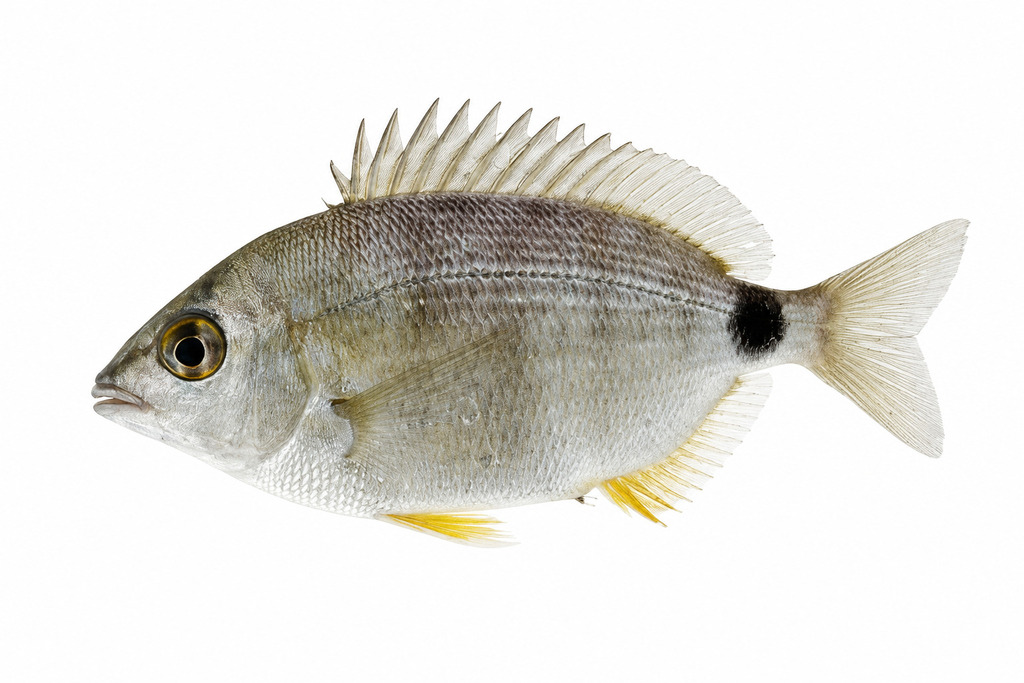
Annular seabream
- Family
- Sparidae
- Depth
- 0–90 m
- Season
- Jan, Feb, Mar, Apr, May, Jun, Jul, Aug, Sep
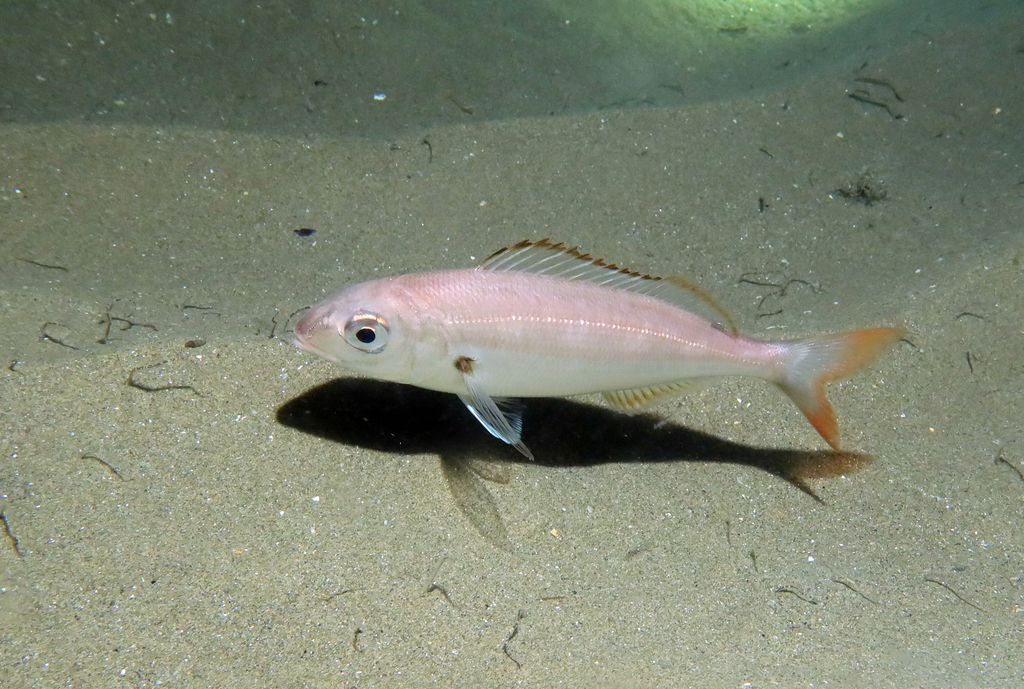
Axillary seabream
- Family
- Sparidae
- Depth
- 0–500 m
- Season
- Jan, Feb, Mar, Apr, May, Jun, Jul, Aug, Sep, Oct, Nov, Dec
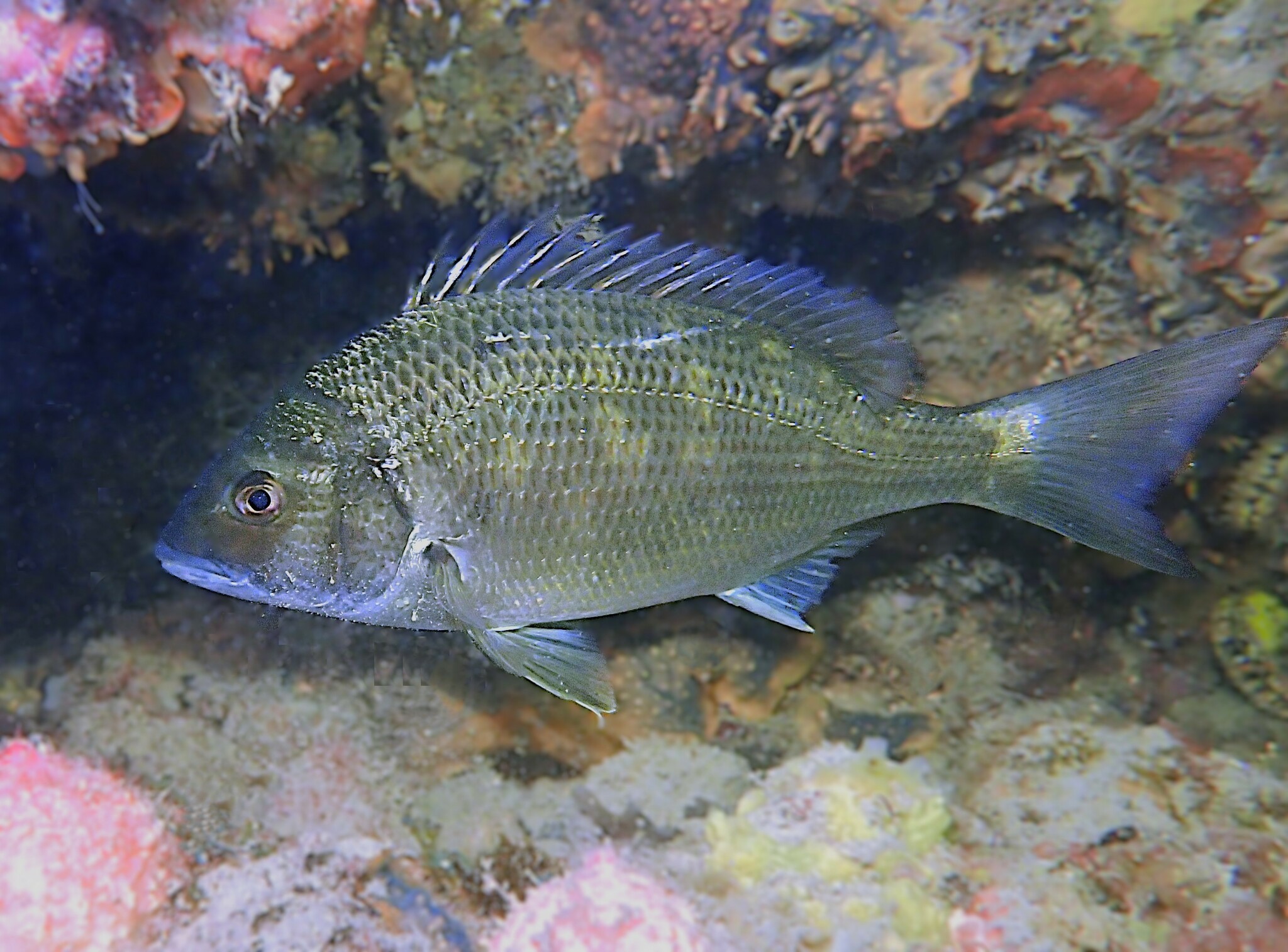
Black bream
- Family
- Sparidae
- Season
- Jan, Feb, Jul, Aug, Sep, Oct, Nov, Dec
Guides for this water
Technique, gear and safety guides that fit Redbanded seabream.