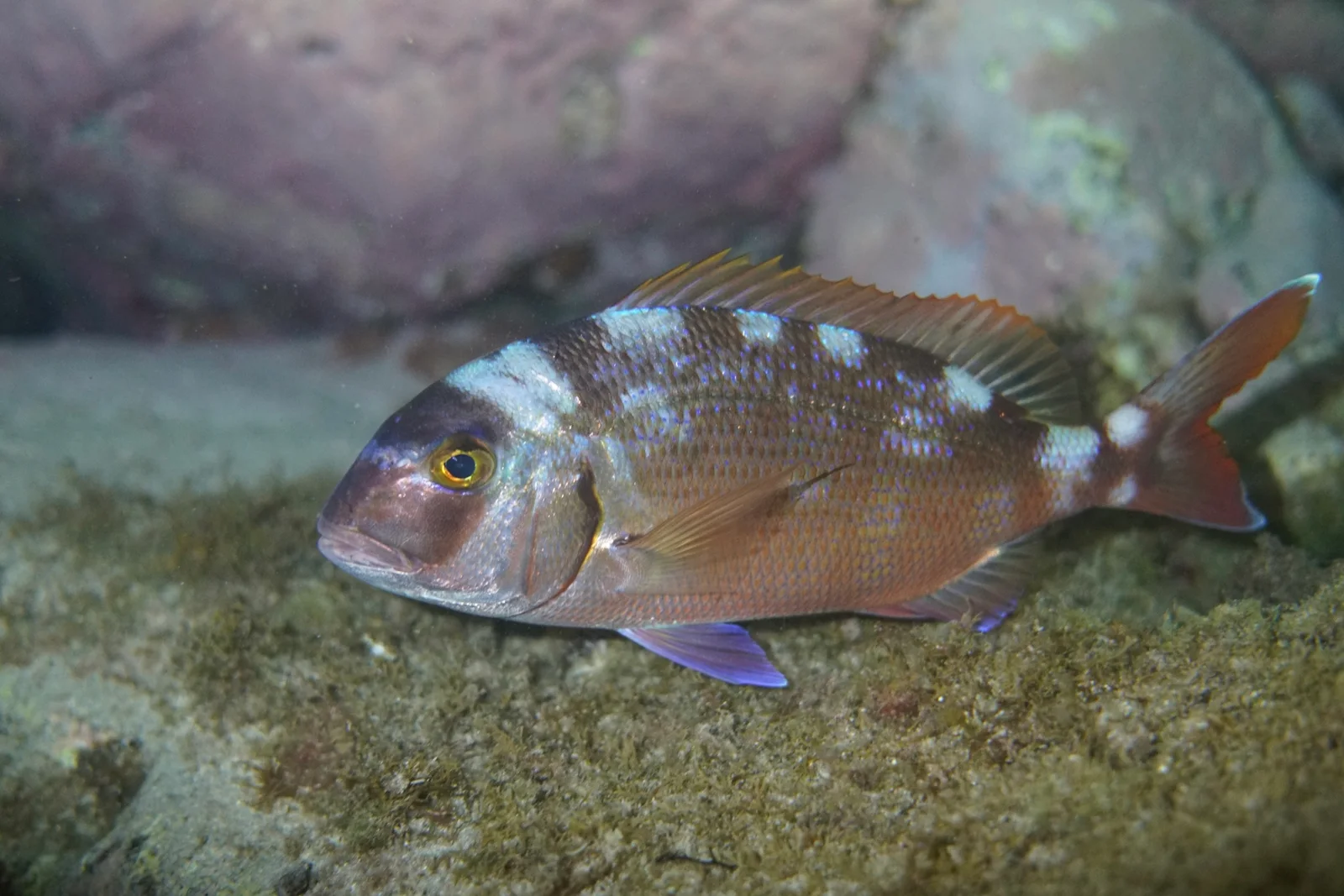
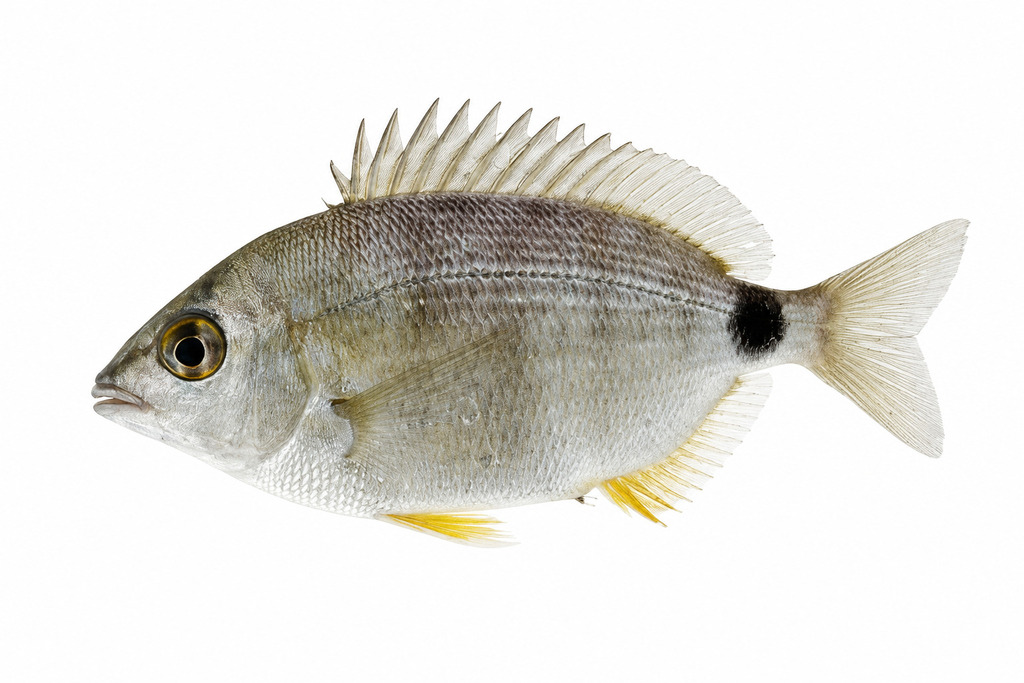
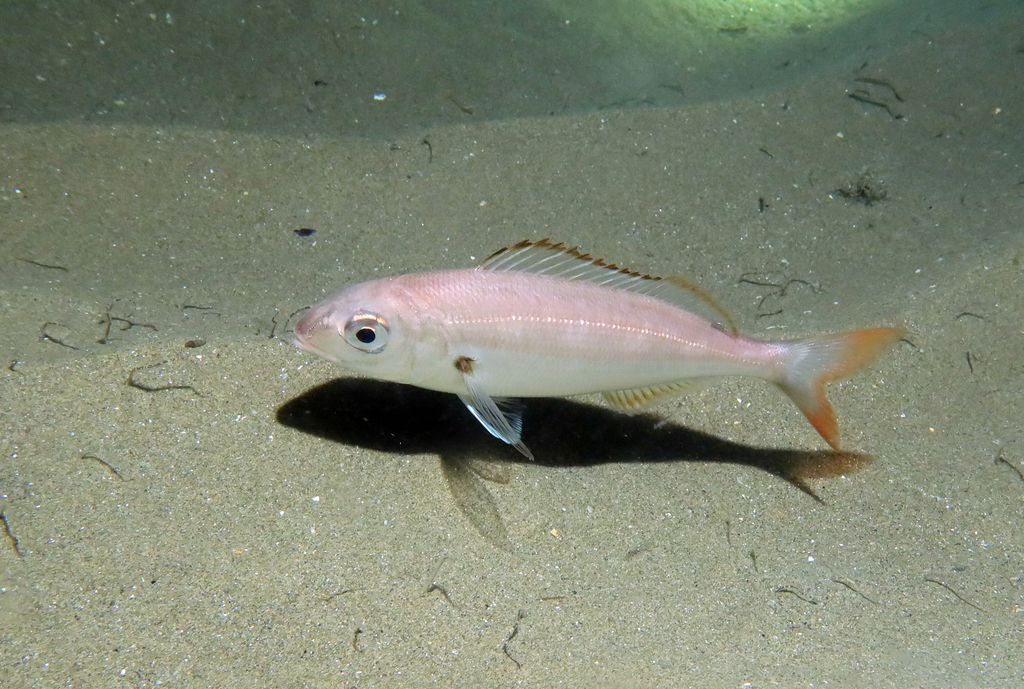
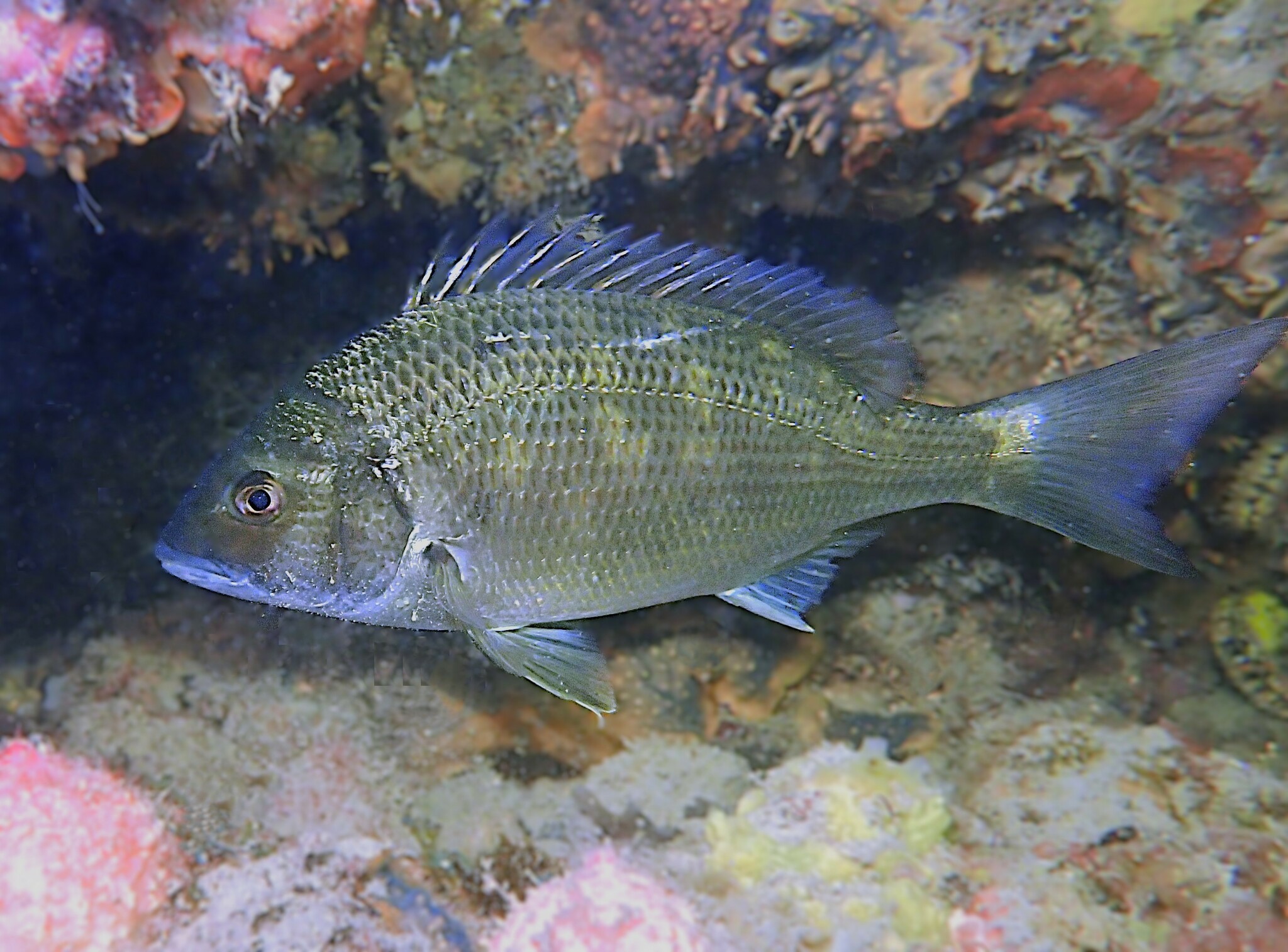
Red porgy (Pagrus pagrus) is a fish of the family Sparidae. FishBase gives its range as: Eastern Atlantic: Strait of Gibraltar to 15°N (rare southward 20°N), including Madeira and the Canary Islands; Mediterranean and northward to the British Isles. Western Atlantic: New York, USA and northern Gulf of Mexico to Argentina, including the continental coast of the Caribbean Sea. It is recorded from 0 to 250 m, in subtropical water. The recorded maxima are 91 cm TL, 7.7 kg, 26 years. Diet includes crustaceans and fishes. IUCN status: Least Concern (LC). Chinese name: .
What the bottom means for a cast
A rock edge snags rigs and holds fish against it; a sand flat takes a bait dragged along the bottom; a seagrass bed keeps its prey inside the weed, so fish its fringe rather than the middle; and the shelf marks where a boat is needed. Rock and sand are what the bait touches, while coast and shelf decide how far you cast.
The record calls the fish benthopelagic, which places it near the bottom but not necessarily on it. That sets the presentation: a bait just off the bottom, over sand or along a rock edge, not one pinned to the deck. The shelf fixes the range; the rest say where on the shelf to look.
Fifteen north, twenty south
The distribution sentence gives the eastern Atlantic range as the Strait of Gibraltar to 15°N, then adds, in the same sentence, "rare southward 20°N". Fifteen and twenty are different latitudes, and the parenthetical does not say whether the second figure replaces the first or qualifies it.
The difference is real on a chart: 15°N runs through Senegal and the Cape Verde region, 20°N runs through Mauritania. A reader planning a trip on the strength of "to 15°N" and a reader planning on "rare southward 20°N" are planning different coastlines. The record offers no third statement to settle which is the boundary. Keep both numbers; do not average them into 17.5.
A January-to-September table with a July record from Brazil
The spawning table runs from January to September, assembled from five entries: the eastern Atlantic in April to June, the Mediterranean in April to June and again in June to September, the Canary Islands in January to March, and São Paulo in Brazil in July and August.
The table is internally possible and geographically strange. Four of the five entries are northern-hemisphere records; the fifth is Brazilian, and it is the only one from the western Atlantic. A single table that runs January to September can hold both because the months do not clash, but the seasons they describe are opposite. A July spawn in Brazil and a June spawn in the Mediterranean are not the same event in the life of the species.
The practical consequence is that the table cannot be read as one calendar. Use the entry from the region you fish, and if your region has no entry, treat the table as a list of what has been observed elsewhere.
Ciguatera on a Least Concern fish
The threat field records reports of ciguatera poisoning, and the IUCN assessment is Least Concern. Those two labels are often read as contradictory and are not: Least Concern describes extinction risk, and ciguatera describes a hazard to the person eating the fish.
The pairing is still a warning about labels. A green status is not a food-safety statement, and a ciguatera report is not a conservation statement. This species is fished commercially and farmed commercially, which means it reaches plates in quantity; the hazard label applies to the fish, not to the stock.
A one-character Chinese name
FishBase's Chinese table gives as a name, alongside and . The expansion list uses . The English table is crowded too: Red porgy, Common seabream, Common sea bream, Couch's sea bream and Couch's sea-bream. is also the character used for the family as a whole, so the name is a category rather than an individual.
That is a naming problem with practical consequences: a Chinese-language search for returns every sparid, and a report that says only has not identified anything. The longer names are more useful, but they are not standardised across sources, and is used for other red fishes outside the family. For matching, the binomial is again the only stable key.
Wild range and farmed supply
The distribution spans the eastern Atlantic from the British Isles and the Mediterranean south to 15°N, and the western Atlantic from New York and the northern Gulf of Mexico to Argentina. The country table carries 51 entries across both basins. The same record lists aquaculture as commercial.
A species with a two-ocean wild range and a commercial farmed supply is unusual in this set. It means a fish on a market slab may be wild-caught or farmed, and the label on the slab will not usually say which. For the angler the wild range is the relevant part; for anyone reading market data, the aquaculture entry is the reason a supply figure cannot be read as a catch figure.
GBIF's 66 declarations spread across 45 countries and territories and both ocean basins, from Argentina, Brazil and Uruguay through the Gulf of Mexico and the United States to Spain, Portugal and Greece. A minimum size or a daily bag is jurisdiction-specific: the same fish can be legal on one coast and undersized on the other; a closed season is a separate question.
Ninety-one centimetres and 7.7 kilograms
The size block gives a 91 cm maximum, a 35 cm common length, 7.7 kg maximum weight, first maturity at 26.6 cm and a maximum age of 26 years. Two different 26s sit in that list — a length and an age — and they are not related.
The spread is the point. A 35 cm common fish against a 91 cm maximum is a factor of 2.6, the same wide spread as the other large sparid here. The 26-year lifespan explains why the big end matters: a 91 cm fish is not an old outlier but a fish that had time, and removing it removes decades of spawning. The 26.6 cm maturity figure is the release line, and it sits below the common length, which is the more usual arrangement than the one seen in Cheimerius nufar.
Which label to trust on the water
Trust the measurements and distrust the categories. The measurements — 26.6 cm maturity, 35 cm common, 91 cm maximum, 10–80 m usual depth — are specific and usable. The categories — the habitat list, a two-ocean range, a status colour, a one-character name — each cover more than one thing. iNaturalist holds 1,122 observations, which is enough to confirm the fish is regularly seen but not enough to resolve any of the labels.
Wikipedia's revision 1365338360 adds two facts the FishBase record does not spell out: it feeds on or near the seabed, and most individuals start life as females and later change sex to males. The first supports the off-bottom presentation; the second means a very large fish is likely male, so protecting the big females is not the same as protecting the biggest fish.
For a trip, use the usual depth band as the starting point, the rocky and shelf words as the structure to look for, and the maturity figure as the release line. For everything else, keep the record's contradictions visible rather than resolving them on the fish's behalf.
Regulations before you keep it
These are the published regulations for this fish. Read the number first. The notice below it is the actual regulation.
Minimum size5
The minimum size for Red porgy in Spain is ≥15 cm.
| Pargo (Pagrus pagrus) | 15 |
The minimum size for Red porgy in Spain is ≥18 cm.
| Pargo (Pagrus pagrus) | 18 |
≥28 cm
Spain — Canary Islands · ES-CN
The minimum size for Red porgy in the Canary Islands is ≥28 cm.
ANEXO III — Tallas mínimas autorizadas para el caladero canario: Pargo (Pagrus pagrus), Bocinegro — 28 cm.
The minimum size for Red porgy in France is ≥18 cm.
| PAGRE COMMUN | Pagrus pagrus | 18 cm |
The minimum size for Red porgy in Portugal is ≥20 cm.
Pargo-legítimo (Pagrus pagrus) | 20 cm
Every record above names its source and the date it was retrieved. See the regulation register for the full list, or how to read these regulations.
Where these facts come from
Check these pages before you rely on a size, range or protection status.
-
FishBase — Pagrus pagrus
— FishBase · T2
-
GBIF — Pagrus pagrus occurrence records
— GBIF · T2
-
IUCN Red List — Pagrus pagrus
— IUCN · T1
-
Photo record — iNaturalist
— iNaturalist · T3