
European perch
The European perch belongs to the family Percidae and is widespread across nearly all of Europe and northern Asia, from lowland lakes to rivers draining to the Arctic, and it has been widely introduced beyond that range. It is a demersal freshwater fish of 1–30 m, usually 3–4 m, at 10–22 °C. Anglers value it as a genuine sport fish, while commercial fisheries class it as highly commercial.
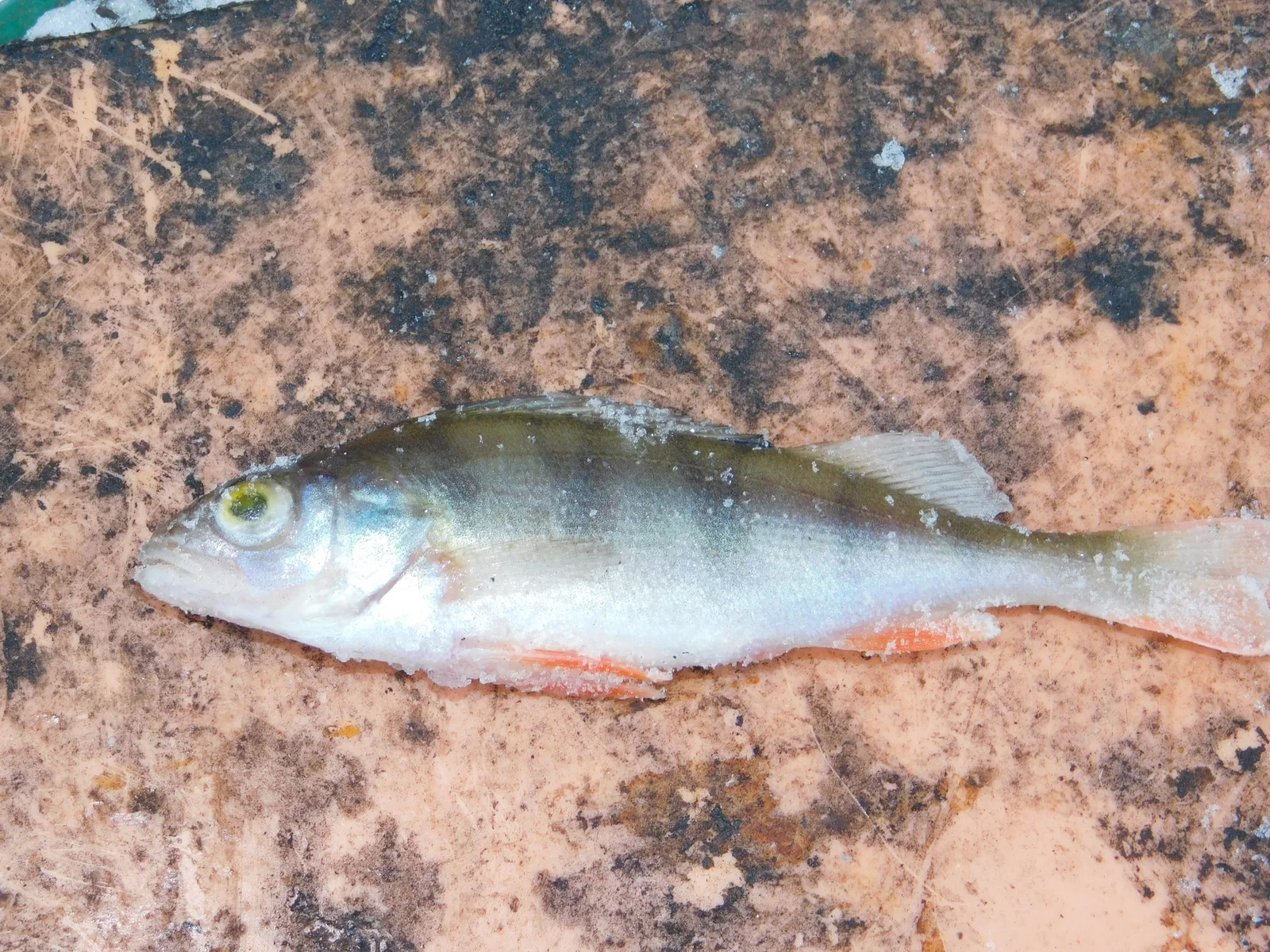
The European perch belongs to the family Percidae and is widespread across nearly all of Europe and northern Asia, from lowland lakes to rivers draining to the Arctic, and it has been widely introduced beyond that range. It is a demersal freshwater fish of 1–30 m, usually 3–4 m, at 10–22 °C. Anglers value it as a genuine sport fish, while commercial fisheries class it as highly commercial. Recorded maxima are 60 cm standard length, 4.8 kg and 22 years, against a common length of 25 cm.
The genus is named after this fish
Perca is the genus, and this species is its type. The dimensions describe a long-lived predator rather than a specimen: 60.0 cm standard length, a common length of 25.0 cm total length, 4.8 kg and 22 years. The two lengths are not in the same unit — 60 cm is SL, 25 cm is TL — so dividing one by the other overstates the spread. First maturity is 16.3 cm, with a recorded range of 11–23.4 cm.
The fin counts are broad: 14–20 dorsal spines, 13–16 dorsal soft rays, two anal spines, 7–10 anal soft rays and 39–42 vertebrae. A spine count that spans six numbers will not settle an identification on its own. Body shape is fusiform and the cross-section compressed.
European perch is the principal name; the American Fisheries Society list uses Eurasian perch, Australian lists add redfin perch, English perch and Reddie, British lists add river perch and plain perch, and the Chinese FAO entry is . iNaturalist prefers European Perch.
Holes in the native map become the introduced list
The native text runs from Europe to the northernmost tip of Scandinavia, excluding the Iberian Peninsula, central Italy and the Adriatic basin, with Aegean drainages, the Aral basin and Siberian rivers reaching the Kolyma. Ten countries are marked introduced: Australia, the Azores, China, Cyprus, Italy, Morocco, New Zealand, Portugal, South Africa and Spain. Two excluded zones return there — Iberia as Portugal and Spain, Italy as Italy.
The country table carries 52 entries, 42 native and 10 introduced, but its granularity is coarser than the text: the prose excludes central Italy while the table marks the whole country introduced. The sentence about adverse ecological impact is also incomplete as captured — "after ." with no object; context points to introduction, but the page does not say it.
GBIF holds 117 distribution rows against 12,081 iNaturalist observations. Thirteen rows carry no country; the rest are led by Belgium 7, Spain 7, Portugal 7, Ireland 6, South Africa 5 and Norway 4. Those counts are checklist sources, not abundance. The coordinates 74°N–38°N and 91°W–168°E include a western longitude with no matching country in the table, and should not be read as a North American range.
Three or four metres is the usual depth
Depth is given as 1–30 m, usually 3–4 m. The maximum is the outlier; most of the described water column sits within the first few metres. Water is freshwater to brackish, pH 7.0–7.5, hardness 8–12 dH, temperature 10–22 °C, and the species is demersal and anadromous. The anadromous label sits oddly on a fish whose range is mainly fresh water; it probably reflects coastal Baltic populations moving through salinity zones rather than the species default. 74°N reaches northern Scandinavia, 38°N the Aegean and Türkiye.
Open water against a demersal label
The habitat keyword is open-water and the diet is fishes and zooplankton, while the environment line calls the fish demersal. The two labels disagree about where the animal is: open water describes where its prey collects, demersal describes where it is recorded. A compressed body can work in both. Twenty-two years is a long life for a fish with a 25 cm common length, and a 16.3 cm maturity means most of those years are spent as an adult.
Spawning follows latitude
Seventeen rows are carried. Scottish lochs give March–April at Davan and Kinord and April–May at Leven; France March–June; Schleswig-Holstein March–May; the Vistula Lagoon April; Finland and the Enisey May–June; Lake Agios in Greece March–April; Lake Doirani all twelve months; a northern-hemisphere summary February–July; a southern-hemisphere summary August–October.
The useful reading is the lag: roughly two to three months between Scottish and Finnish or Siberian records. The hemisphere rows are labels rather than places, and Doirani's twelve-month row is an anomaly, not a local rule. A spring calendar copied from one latitude will miss at another.
Twenty-two years and a 4.8 kg ceiling
The maxima are 22 years, 4.8 kg and 60.0 cm SL. They need not belong to the same individual; FishBase fields are assembled from different specimens. At a first maturity of 16.3 cm, a 60 cm fish is roughly three and a half times the maturity length. No growth curve was captured, so the route from 16 cm to 60 cm cannot be dated from this record.
Commercial, farmed, and a gamefish
Three separate ticks sit on the human-use line: fisheries highly commercial, aquaculture commercial, gamefish yes. Only the last concerns angling; the first two explain the species' presence in markets and ponds. IUCN lists it as Least Concern, the assessment dated 27 May 2022; that is a worldwide judgement, not a statement about any local stock. Wikipedia calls it a popular quarry and notes introductions beyond the native range, which matches the ten introduced countries, though again without a method.
Where to look
Start at 3–4 m rather than at the 30 m maximum; work water of 10–22 °C and pH 7.0–7.5. Open-water and demersal remain competing labels, so treat both as possible positions rather than a contradiction to resolve. No method is recorded; the gamefish tick is the only angling endorsement in the capture, and the page can supply depth and temperature but not a technique without inventing one. No regulation is carried either; rules on size and season are national or regional and must be looked up. Least Concern is a conservation category, not a bag limit.
Where these facts come from
Check these pages before you rely on a size, range or protection status.
- FishBase — Perca fluviatilis — FishBase · T2
- GBIF — Perca fluviatilis occurrence records — GBIF · T2
- IUCN Red List — Perca fluviatilis — IUCN · T1
- Photo record — iNaturalist — iNaturalist · T3
Fish in the same water
These fish live in the same place.
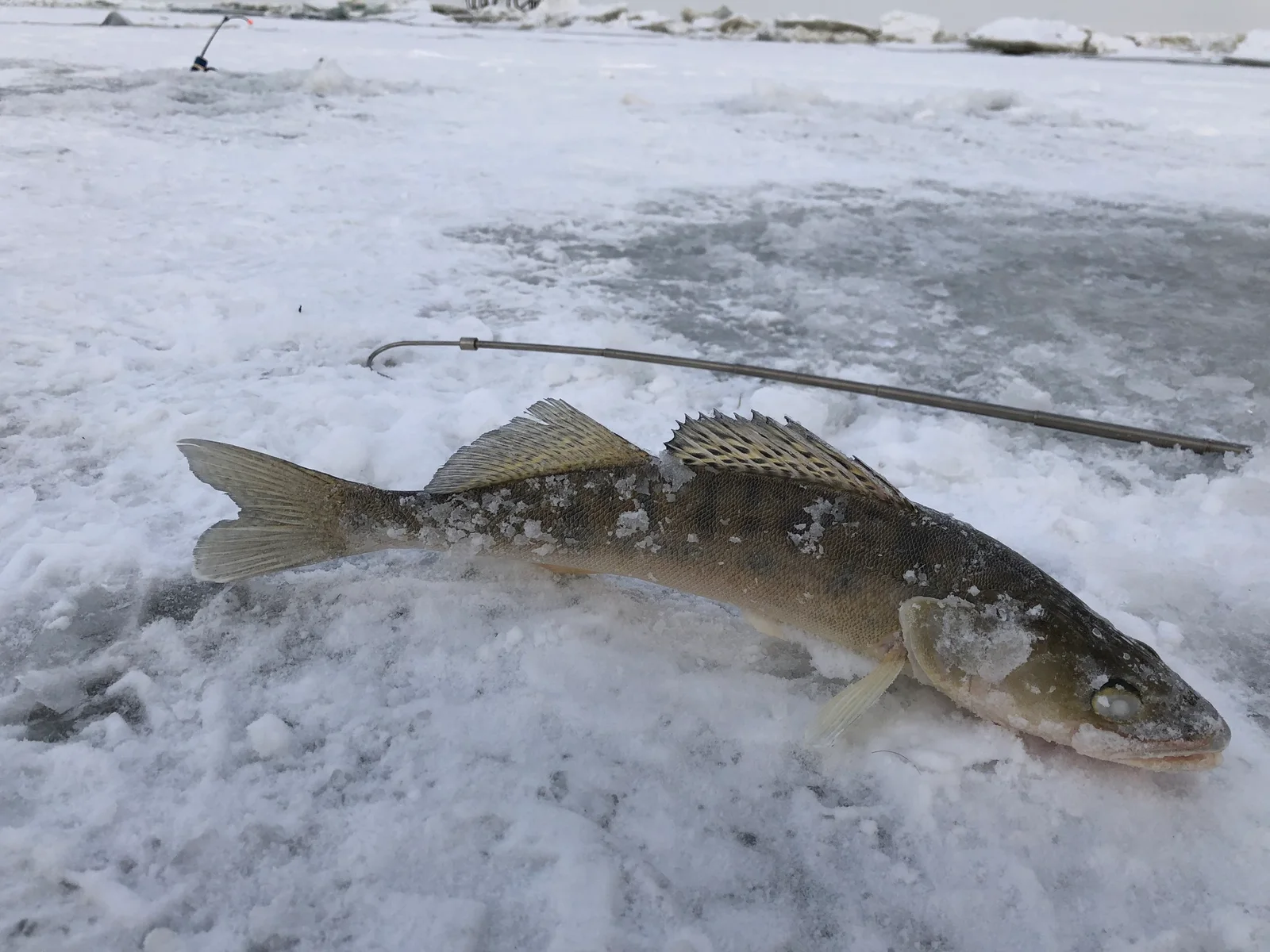
Pike-perch
- Family
- Percidae
- Depth
- 2–30 m
- Season
- Jan, Feb, Mar, Apr, May, Jun, Jul, Aug, Sep, Oct, Nov, Dec

Acoupa weakfish
- Family
- Sciaenidae
- Depth
- 1–20 m
- Season
- Jan, Feb, Mar, Apr, May, Jun, Jul, Aug, Sep, Oct, Nov, Dec

American angler
- Family
- Lophiidae
- Depth
- 0–800 m
- Season
- Mar, Apr, May, Jun
Guides for this water
Technique, gear and safety guides that fit European perch.