
Rock gunnel
The rock gunnel is an eel-shaped fish of the family Pholidae that lives in the intertidal zone, often under stones or in rock pools left by the tide. Its range runs from the Kanin Peninsula and Iceland south to La Rochelle, and from Labrador to Delaware Bay. FishBase records it from the surface to 100 m, usually within 0–30 m.
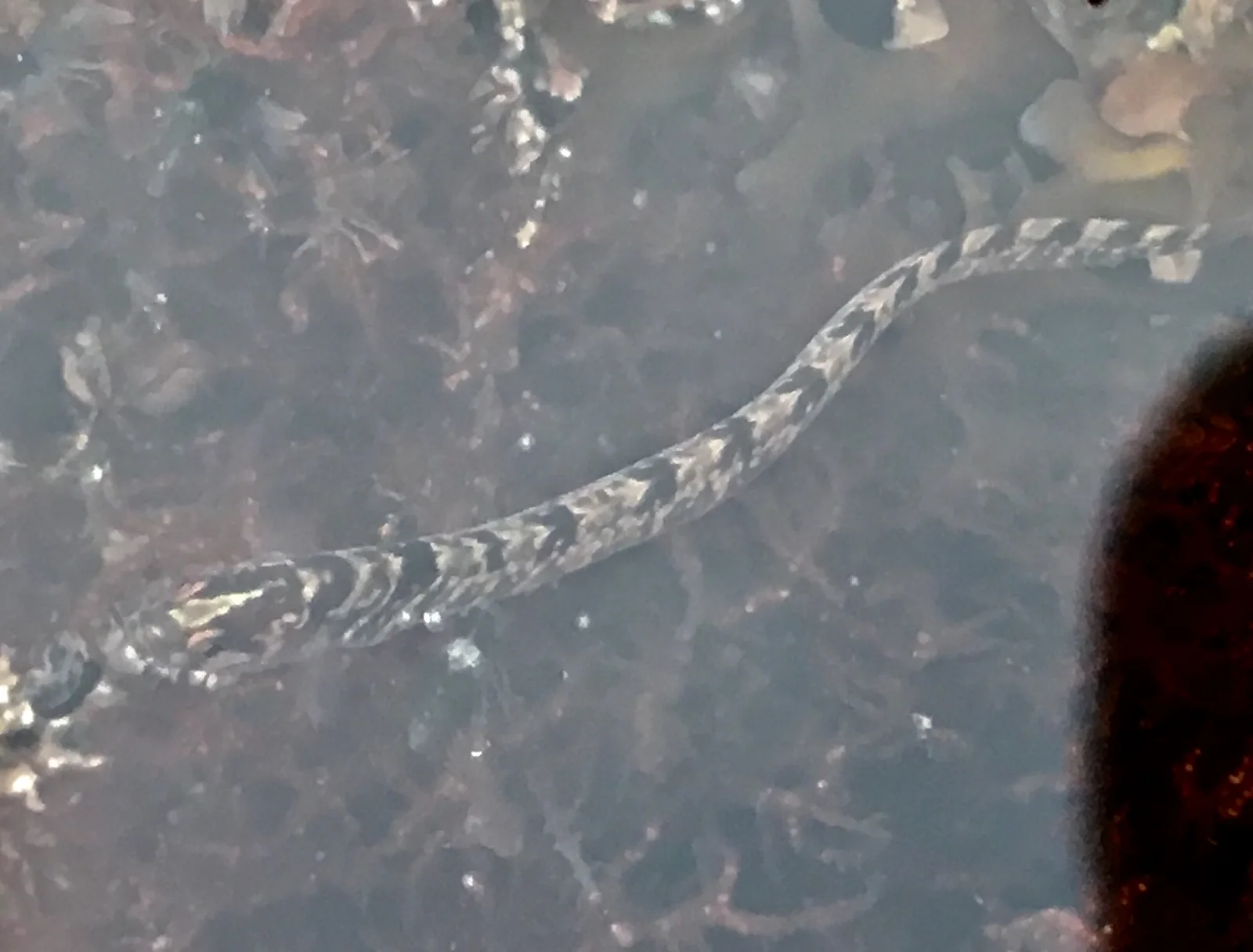
The rock gunnel is an eel-shaped fish of the family Pholidae that lives in the intertidal zone, often under stones or in rock pools left by the tide. Its range runs from the Kanin Peninsula and Iceland south to La Rochelle, and from Labrador to Delaware Bay. FishBase records it from the surface to 100 m, usually within 0–30 m. It is not fished: the fisheries entry reads "of no interest" and the only use is the aquarium trade. At a maximum of 25 cm standard length it is a species to observe and release rather than to pursue, and it has never been assessed by IUCN.
Identification
A rock gunnel is most often met after the tide has left it: under a stone or in a rocky pool, still alive in the air. That habit is the clearest identifying trait here, because nearly every measured character is missing. The capture has no dorsal or anal spine counts, no soft-ray counts, no vertebral count, no body shape and no cross-section; only an eel-like outline and an intertidal address survive. The names do not narrow it either. FishBase's English list runs Rock gunnel and Gunnel through Butterfish, Butter-fish, Crinkly dick, Nine-eyes, Salt-water snake, Tansy and Tissy. Chinese has no FishBase name, so this page keeps the Latin binomial rather than coining one. Wikipedia uses the same two names and assigns the fish to Pholidae, the gunnels.
The size line is short: 25.0 cm SL maximum for a male or unsexed fish, and a maximum reported age of five years. No common length, weight or maturity point is given. The maximum is a standard length, so it cannot be converted for comparison with total-length figures elsewhere.
Habitat and distribution
FishBase describes a North Atlantic range: from the Kanin Peninsula south to La Rochelle, taking in the White Sea, the North Sea and the Baltic, plus Iceland, but not eastern Greenland, Spitsbergen or Novaya Zemlya; in the western Atlantic from Labrador to Delaware Bay. All 21 country rows in the accompanying table are native, with no introduced entry.
FishBase records the species as marine and brackish, demersal, non-migratory, 0–100 m with a usual band of 0–30 m, polar, 72°N–43°N and 76°W–45°E. "Polar" is a climate label, not a latitude claim: the same record reaches the Baltic and the English Channel. Non-migratory matters more for a shore angler than any depth figure, because the fish does not leave its ground. The habitat field names rock; the diet lists crustaceans, fishes, molluscs, algae and worms.
The GBIF distribution file holds 31 rows: eleven without a country code, the Netherlands five, Belgium four, Norway three, France and Sweden two each, and Denmark, the United Kingdom, Ireland and Poland one apiece. Only three rows state an establishment means, all native. iNaturalist holds 2,614 observations, a high count for a fish nobody fishes for.
Season and fishing approach
Spawning is recorded in a single row, from the west coast of Iceland between January and February. No temperature threshold accompanies it, and no other locality contributes a month. For a non-migratory fish present all year, the missing months describe the record's coverage, not the animal's behaviour; the page can date one breeding window and cannot generalise from it.
FishBase's human-use entry is "of no interest" for fisheries, with commercial aquarium use and no gamefish flag. The fish is neither landed for sale nor promoted as a sport target; its value lies in display. The capture supplies no bait, method or tide advice.
Access follows from the depth line: it begins at zero, and the habitat is rock, so low tide exposes the ground. The record stops there.
Edibility and regulations
No food-use field is carried, and neither FishBase nor Wikipedia adds a culinary note. Aquarium demand is the only use recorded, and it does not imply the fish is eaten.
No IUCN assessment exists: the category is Not Evaluated, with no date. Neither a size, season nor bag limit appears. "Of no interest" describes fisheries statistics, not permission; anyone collecting a gunnel for a tank or a meal should check the rule on the shore where it is taken.
Where these facts come from
Check these pages before you rely on a size, range or protection status.
- FishBase — Pholis gunnellus — FishBase · T2
- GBIF — Pholis gunnellus occurrence records — GBIF · T2
- IUCN Red List — Pholis gunnellus — IUCN · T1
- Photo record — iNaturalist — iNaturalist · T3
Fish in the same water
These fish live in the same place.

Acoupa weakfish
- Family
- Sciaenidae
- Depth
- 1–20 m
- Season
- Jan, Feb, Mar, Apr, May, Jun, Jul, Aug, Sep, Oct, Nov, Dec

American angler
- Family
- Lophiidae
- Depth
- 0–800 m
- Season
- Mar, Apr, May, Jun

American eel
- Family
- Anguillidae
- Depth
- 0–464 m
- Season
- Jan, Feb, Mar, May, Jun, Jul
Guides for this water
Technique, gear and safety guides that fit Rock gunnel.