
Greater forkbeard
By day it sits in a hole on the slope, and after dark it comes out to hunt. Fishing for the greater forkbeard is less about chasing fish than about putting a bait at the mouth of the hole and waiting for the light to go; that single behaviour explains more than any change of bait.
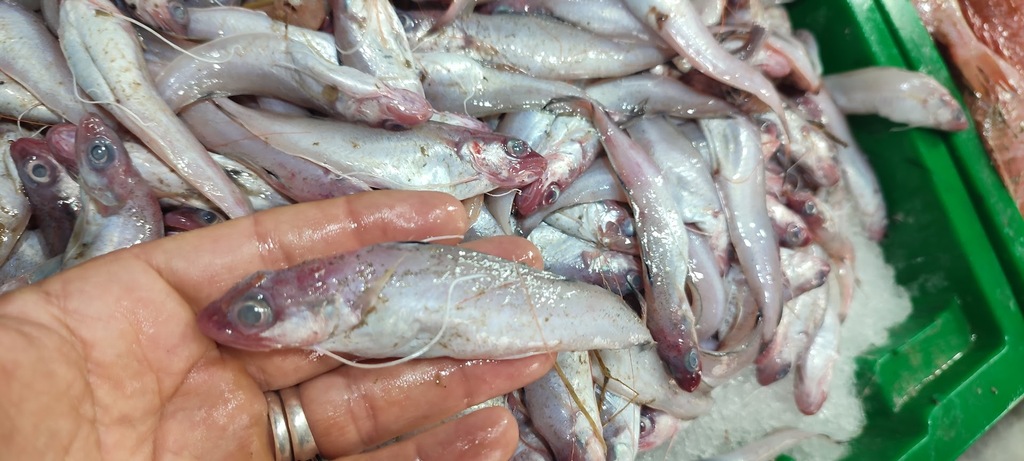
By day it sits in a hole on the slope, and after dark it comes out to hunt. Fishing for the greater forkbeard is less about chasing fish than about putting a bait at the mouth of the hole and waiting for the light to go; that single behaviour explains more than any change of bait.
Long pelvic rays and a tall first dorsal
The most reliable feature is underneath: the pelvic fin rays are extremely elongated and reach well past the origin of the anal fin, hanging like two thin whiskers. The first dorsal fin carries one obviously elongate ray, the body is fusiform with an oval cross-section, brown to red-grey above and paler below. Phycis phycis, the close relative, has a smaller eye and a lower body, and the snout proportions differ. At the boat, check whether the pelvic rays pass the anal-fin origin, then look for the long dorsal ray. Colour is unreliable in deep light, so do not identify the fish on shade alone.
Shelf nurseries, slope adults
FishBase records the species from Norway and Iceland to Cape Blanc in West Africa, including the Mediterranean. It lives over sand, mud and rocky slope, benthopelagic, recorded from 10 to 1351 m but usually between 100 and 450 m, with eastern Ionian records down to 1047 m. Young fish stay coastal on the shelf and adults move along the slope, so shallow catches are mostly small. The ground worth working is the mud-sand bench at the top of the slope, crevices in rocky slope and any break in gradient, where there is both shelter and prey. Most fish taken are under 45 cm.
A nocturnal fish with a weak calendar
FishBase gives a maximum age of 20 years and maturity at about 20 cm, with no spawning table. The species is nocturnal: it hides by day and comes out to hunt after sunset, and that habit shapes the fishing more than the season does. Through spring and summer the fish are more spread out, while autumn and winter concentrate them deeper and improve the relative odds on a deep boat trip. No source here names a preferred temperature. In practice, the hours after dark and before dawn are best, with the bait near a hole rather than on open ground; daylight fishing needs a much more precise drop.
Bait at the hole, then wait for dark
Deep boat fishing with a bait on the bottom is the dependable method: a squid strip or fish chunk taken to the slope and parked near a hole, ready for the fish to come out at night. A slow drift covers the slope but snags on rocky ground, so the lead should be one that pulls free. A slowly worked iron, lifted and dropped just off the bottom, imitates a damaged fish. The diet is crustaceans and fish, so prawn, squid and fish chunks all work, and the bait does not need to be large. A hooked fish heads for its hole, so turn it away from structure on the first move or the leader will be cut.
Boat gear for rocky deep ground
Use a 6 to 7 ft boat rod with a 4000 to 6000 spinning reel or a small electric reel, 20 to 30 lb braid, a 40 lb fluorocarbon leader and a 2/0 to 4/0 wide-gap hook. On rocky slope, run the leader long so the braid does not rub, and use a breakaway lead that can be sacrificed when it snags. Do not lock the drag: the fish drives with its tail and a hard pull tears the hook hold. Fish from deep water often arrive with pressure damage, so decide before winding whether to keep one. Long pliers help with a slippery fish, and support the belly rather than gripping the gills.
French 30 cm, no EU size, and a name to explain
The flesh is white and wet; bleed and ice it, then skin the thick hide and fry, steam or soup it. On the rules: at EU level, Regulation (EU) 2019/1241 Annex IX sets no minimum size for forkbeards, and Article 2(2) means those MCRS do not automatically bind recreational anglers; Regulation (EC) 1967/2006 Article 17 bans selling recreational catch. France needs no permit but requires RecFishing registration from 16, and the arrêté of 26 October 2012, Annex I section II for the Mediterranean, sets 30 cm for “Mostelles (Phycis spp.)”, which covers this species and applies directly to recreational fishing. Spain requires a regional licence from shore and boat under RD 347/2011, and RD 560/1995 Annex II has no entry for it. Italy requires the annual MASAF communication; Greece has no licence and a 5 kg daily limit; Croatia requires a licence with a 5 kg limit plus one heavier fish. Turkey's 2024/21 table was not retrieved. The species is Not Evaluated, which is not the same as no risk, and a country without a size rule still has gear limits and a sale ban. Check current notices before you go.
Evidence limits and the naming trail
The 110 cm maximum total length, 3.5 kg maximum weight, 20-year maximum age, 10 to 1351 m depth range and Not Evaluated status come from FishBase, as does the note that most fish are under 45 cm and the split between shelf juveniles and slope adults. The French 30 cm comes from the Mediterranean section of the 2012 arrêté and the Phycis spp. group, which explicitly covers this species. The seasonal section has no monthly data behind it and rests on nocturnal behaviour. The Chinese name follows FishBase, with the traditional-character variant noted.
How to catch it
Boat bottom fishing
Fished with the listed approach, matched to the recorded depth and size.
Bottom fishing
Fished with the listed approach, matched to the recorded depth and size.
Where these facts come from
Check these pages before you rely on a size, range or protection status.
- FishBase — Phycis blennoides — FishBase · T2
- GBIF — Phycis blennoides occurrence records — GBIF · T2
- IUCN Red List — Phycis blennoides — IUCN · T1
- Photo record — iNaturalist — iNaturalist · T3
Fish in the same water
These fish live in the same place.

Forkbeard
- Family
- Phycidae
- Depth
- 13–614 m
- Season
- Jan, Feb, Mar, Apr, May, Jun, Jul, Aug, Sep, Oct, Nov, Dec
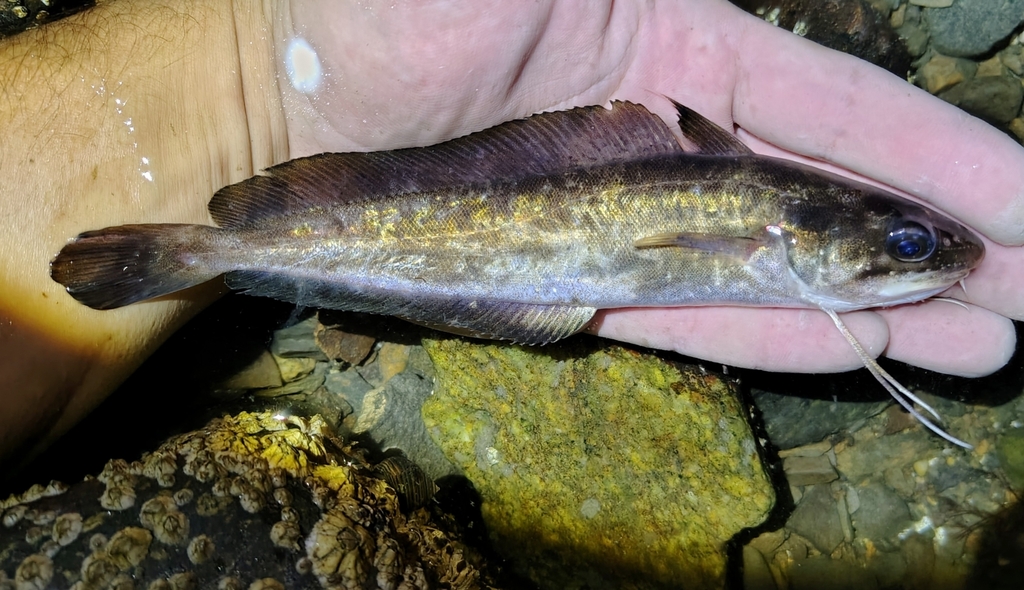
Red hake
- Family
- Phycidae
- Depth
- 35–1152 m
- Season
- Mar, Apr, May, Jun, Jul, Aug, Sep, Oct, Nov

White hake
- Family
- Phycidae
- Depth
- 100–1000 m
- Season
- Apr, May, Jul, Aug, Sep
Guides for this water
Technique, gear and safety guides that fit Greater forkbeard.