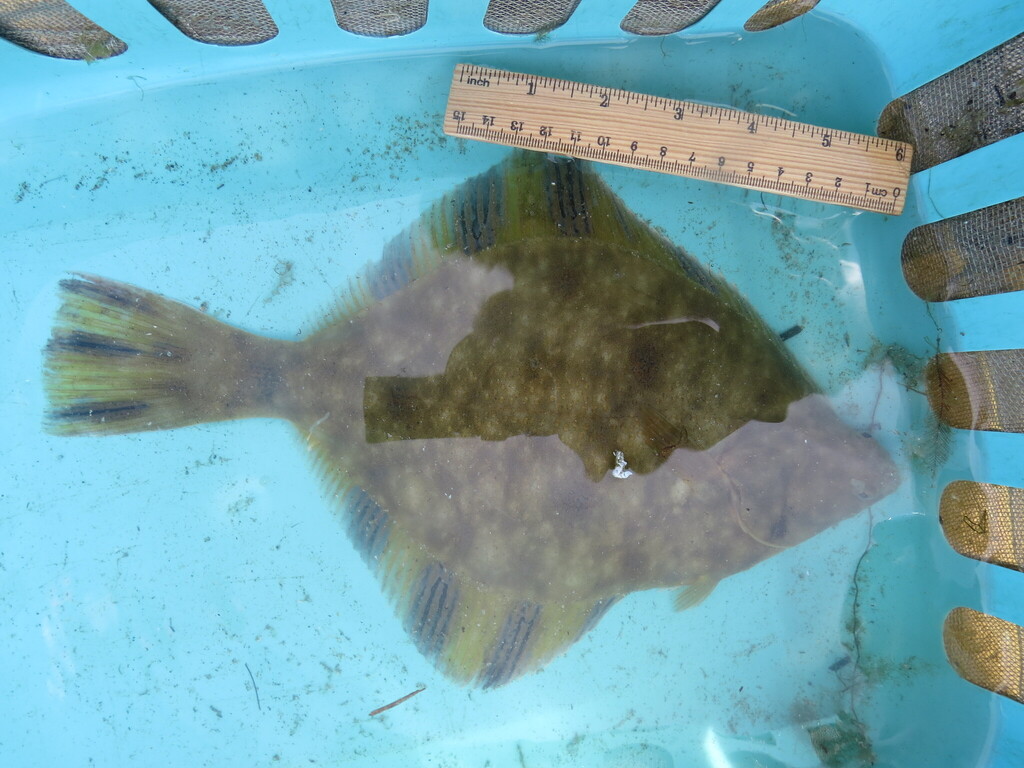
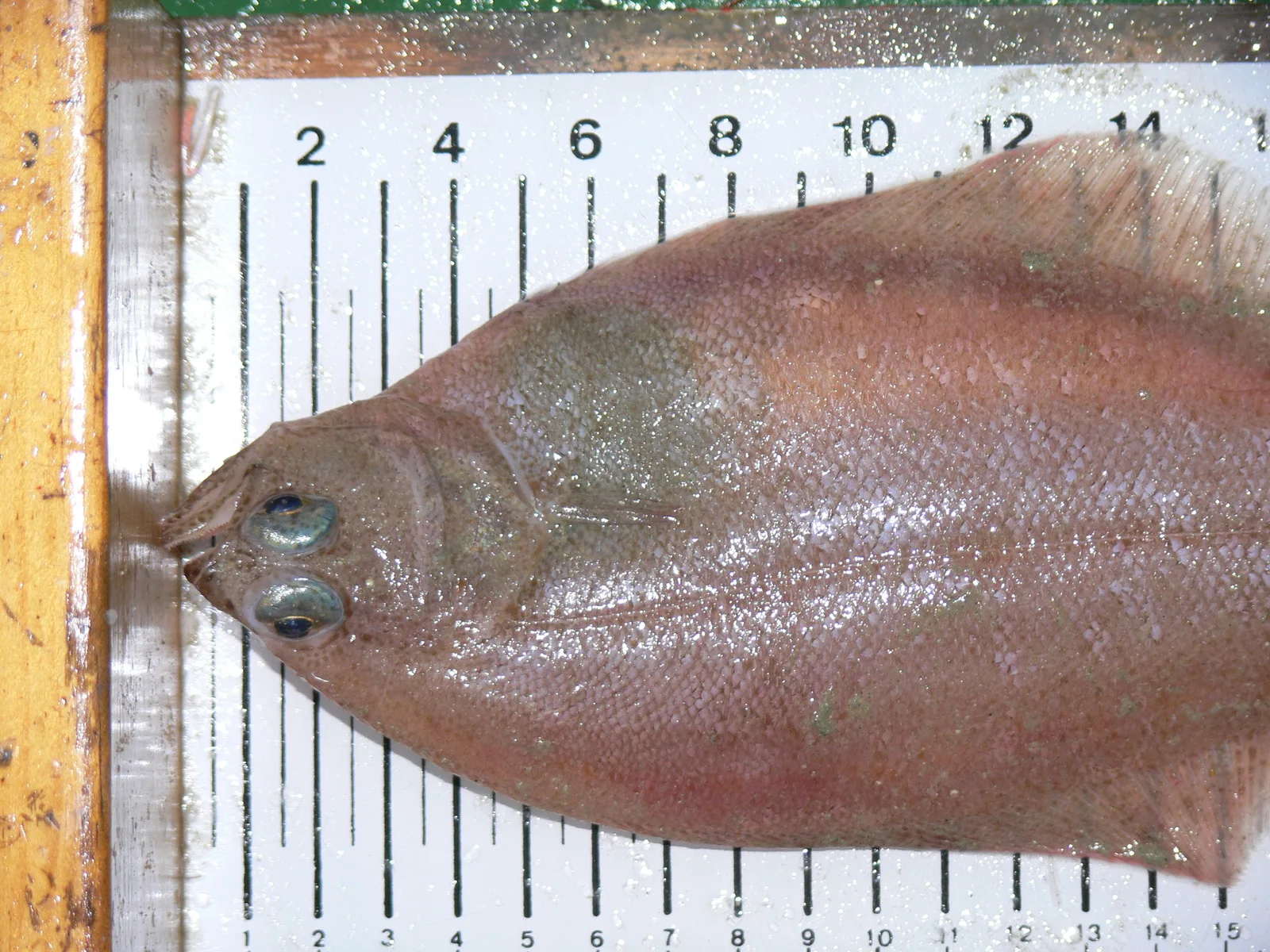
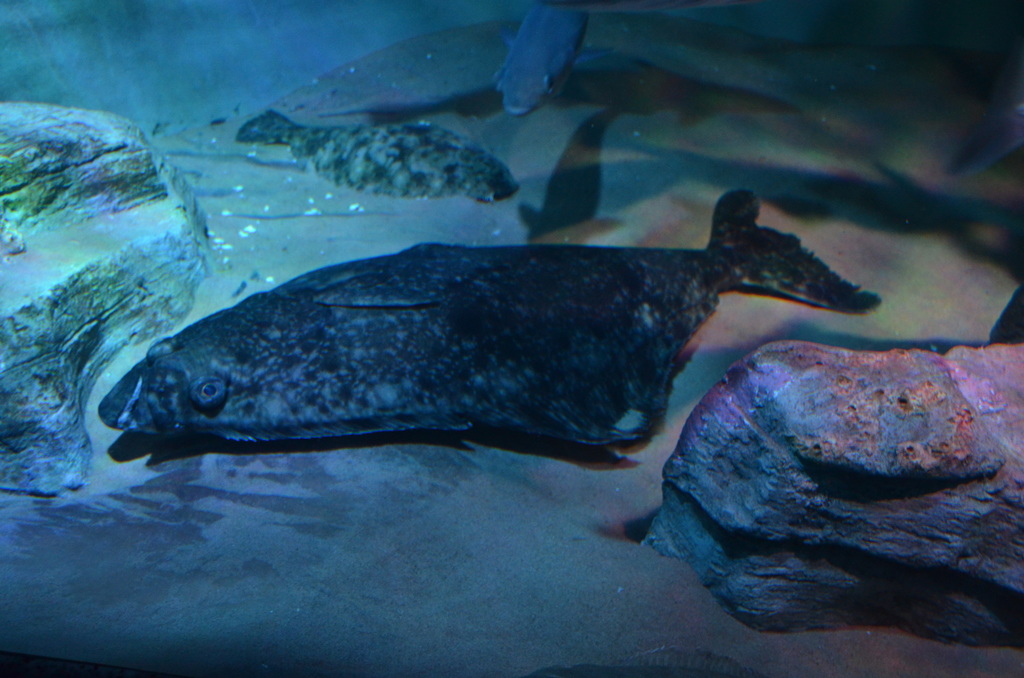
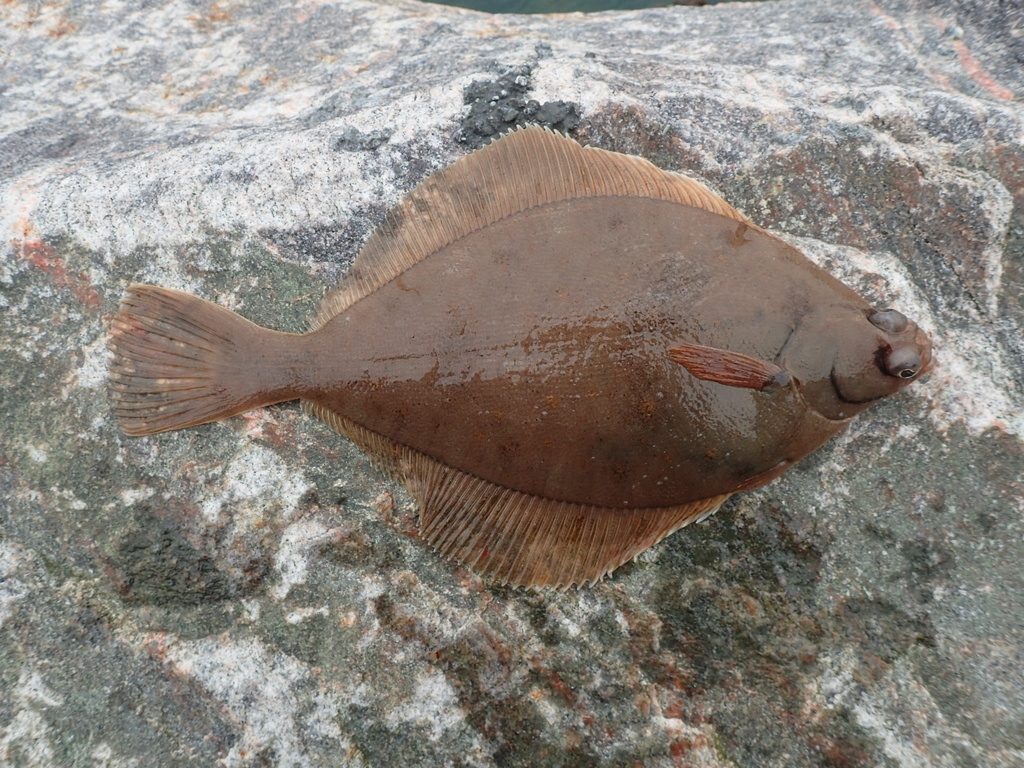
Both eyes sit on one side of the head. The dorsal fin has 52–66 soft rays, the anal fin one spine and 38–47 soft rays, and the vertebral count is 34–37. The stellate bony tubercles scattered over the body are the quickest field mark, backed by four to seven dark bars on the dorsal fin, four to six on the anal fin, and three or four dark longitudinal bars on the rear of the caudal fin. The eyed side runs dark brown to nearly black; the blind side is white to creamy. Piebald individuals occur. The blind side stays white and the fish lies flat, so a quick look at the eyed side is usually enough on deck.
Habitat and behaviour
FishBase gives the range from the Yellow Sea and the Korean Peninsula through the Russian Far East and Japan, across the Bering Sea to the Chukchi and Beaufort seas, and south to California. It is demersal, recorded from the surface down to 375 m, in a polar climate. Shallow coastal water, estuaries and sand-mud bottoms hold most fish, and juveniles often enter low-salinity estuaries. GBIF holds 8766 occurrences, led by the United States with 5700, Canada with 1772 and Japan with 825. Country totals are distribution clues, not marks.
Seasonal window
Spawning records fall in January to April and November to December, with a further June to July signal, so the season is long and differs by region. No reliable water-temperature series is available here; the practical window comes from open seasons. Washington's coastal bottomfish season runs from the second Saturday in March to the third Saturday in October, British Columbia is open year round, and Alaska does not list the species separately. Early spring fish sit in estuaries and shallows; late autumn fish move a little deeper. That last point is an editorial reading.
Gear and approach
Use a medium-length spinning rod from shore, fine braid as the main line, a soft fluorocarbon leader, a small circle or wide-gap hook, and the lightest sinker that still holds. From a boat, a slightly stiffer rod and a running sinker let the line run free on the take. The theme is light lead, soft leader and a slow pace; distance is not the goal. Keep the rod tip low and follow the drift rather than striking at the first tap. A soft rod also protects a light leader when a fish surges at the net, and a rod holder helps when two baits soak in slow current. In strong current a heavier sinker beats a longer cast; control matters more than range.
Edibility and regulations
Flesh is white and fine, good fried, grilled or cut into fillets. Bleed, gill and ice the fish promptly; the difference in flavour is clear. IUCN status is LC, assessed in 2020, and CITES has not evaluated the species.
Alaska: not listed separately, no daily limit.
British Columbia: flounders and soles combined, eight per day.
Washington: within the coastal bottomfish season, five additional flatfish per day.
California: the recreational limit was not confirmed in the public summary; check the current notice.
Where to look
Morphology and distribution come from the FishBase summary, occurrences from GBIF, and image candidates from iNaturalist. The spawning months are a pooled FishBase record and vary widely between regions, so they are not a single run. Methods and gear are editorial advice based on size, depth and bottom type, without local catch data. California limits and the Puget Sound detail in Washington still need confirmation against the current annual notice.
How to catch it
Shore casting
Fished with the listed approach, matched to the recorded depth and size.
Boat bottom fishing
Fished with the listed approach, matched to the recorded depth and size.
Regulations before you keep it
These are the published regulations for this fish. Read the number first. The notice below it is the actual regulation.
Bag limit1
Open year-round, all depths · no bag limit · no size limit
United States — California · US-CA
California has no bag or size limit for starry flounder and the recreational fishery is open year-round at all depths.
The no-limit rule does not override MPAs, Cordell Bank, the Groundfish Exclusion Areas or the vessel descending-device requirement.
The recreational fisheries for petrale sole (*Eopsetta jordani*) and starry flounder (*Platichthys stellatus*) are open year-round, at all depths. There are no bag or size limits for petrale sole or starry flounder.
Every record above names its source and the date it was retrieved. See the regulation register for the full list, or how to read these regulations.
Where these facts come from
Check these pages before you rely on a size, range or protection status.
-
FishBase — Platichthys stellatus
— FishBase · T2
-
GBIF — Platichthys stellatus occurrence records
— GBIF · T2
-
IUCN Red List — Platichthys stellatus
— IUCN · T1
-
Photo record — iNaturalist
— iNaturalist · T3