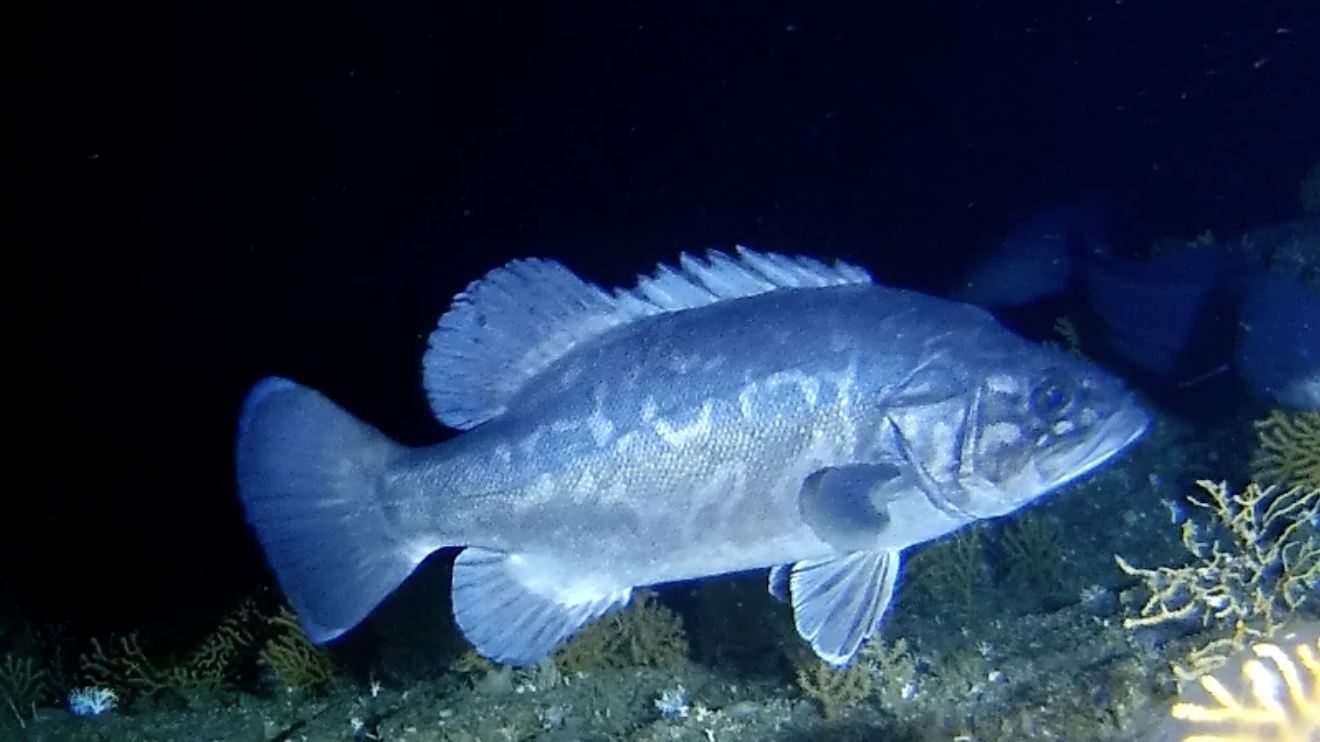
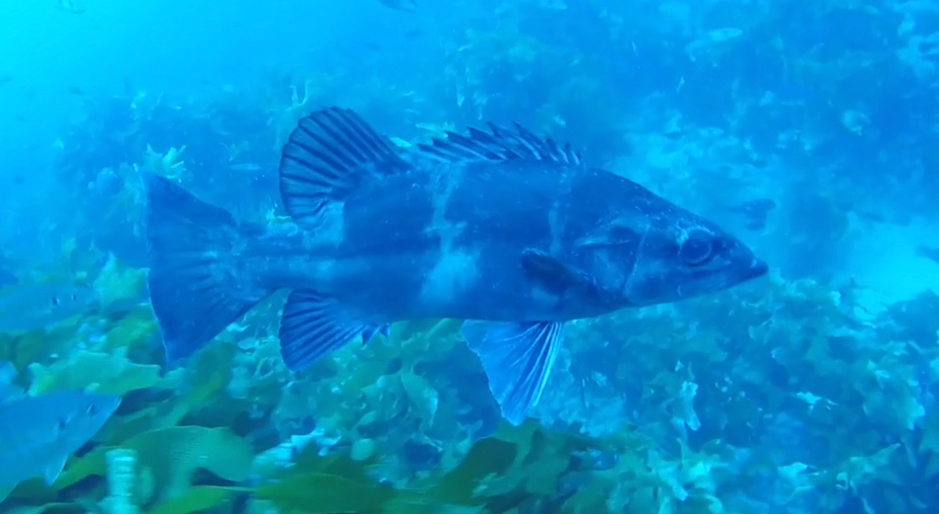
Wreckfish is a depth fish before it is a wreck fish. The name points to rocky ledges and wrecks, but the number that shapes the fishery is 560: the vertical distance between the 40 m record and the 600 m limit of the documented range.
The band is 560 metres wide
The documented vertical envelope is 40–600 m; the band that most records occupy is 100–200 m. The full envelope and that core band are not the same fishery. A wreckfish at 40 m and a wreckfish at 600 m are both inside the record, but most captures fall between 100 and 200 m.
The arithmetic is simple and worth keeping visible: 600 minus 40 is 560. That is the vertical span the page documents. The hundred-metre core is what a drift plan can be built on.
40 metres is a record, not a mark
The shallow record sits at 40 m, and the environment line places the species in subtropical water from 70°N to 55°S. The same line gives a longitude span of 180°W to 180°E, which is the whole ocean rather than a single basin. That latitude span crosses the equator and both temperate zones, which is consistent with the worldwide, disjunct distribution described by Wikipedia.
A 40 m capture is a data point, not a fishing mark. No count is given for captures at that depth, and no evidence says they form a resident population. The usual band starts two and a half times deeper than the shallow record, at 100 m.
210 cm, 100 kg, 80 years
The species tops out at 210 cm TL; the ordinary fish is 80 cm TL; the heaviest specimen on record weighed 100 kg; the oldest individual reached 80 years. The common length is less than 40 percent of the maximum, which is a very wide spread: the ordinary fish measures 80 cm, and the record fish is more than two and a half times that length.
An 80-year maximum is the figure the page publishes. It does not publish a growth curve, so the age figure cannot be converted into a size-at-age table. The implication is that a large wreckfish may be older than the angler catching it.
Maturity at 77.9 cm
The maturity estimate is 77.9 cm, but the published range opens with a question mark and closes at 90 cm. There is no lower bound, so the figure cannot be used as a release line. What it does support is a caution: an 80 cm fish, the common size, sits at the estimate rather than safely above it, and only at 90 cm does the page place a fish above the whole range. If the choice is between keeping an 80 cm fish and releasing it, the page gives no biological reason to keep it.
The habitat field is empty
The page names no substrate, so the only ground clue comes from the name and from divers: stone bass and wreckfish both point to hard structure. The environment line still calls it bathydemersal, and iNaturalist's summary explains the name "stone bass" by saying the fish inhabits rocky ledges and wrecks. Wikipedia describes it as bathydemersal and oceanodromous.
That is a working hypothesis rather than a survey. A deep, wide-ranging fish with no habitat keyword cannot be assigned to rock, sand or mud from the FishBase record alone. The iNaturalist summary supplies ledges and wrecks, but that is a name explanation, not a substrate map.
Oceanodromous, and disjunct by ocean
Wikipedia describes the distribution as worldwide but disjunct, across the Atlantic, Pacific and Indian Oceans. FishBase's environment line calls the species oceanodromous. iNaturalist adds that Polyprion moeone, the bass groper, is now recognised as a junior synonym.
GBIF's distribution statement covers the western Atlantic, the Gulf of Maine, the Azores, South Africa, the New Zealand exclusive economic zone, Greek and Israeli Mediterranean waters, a long run of Brazilian native records, two Wimereux entries marked DOUBTFUL and one Swedish entry marked IRREGULAR. The qualified rows are as informative as the present ones: a disjunct range accumulates doubtful edges.
June to October
The spawning table marks June through October, with two regional rows: the Mediterranean in June–August and southern Brazil in July–October. The union is five months; the regional records are shorter and do not overlap completely.
June in the Mediterranean and July in southern Brazil suggest two spawning clocks, and the cause of the offset is unrecorded. The page records the months and the regions, and stops there.
Data deficient, gamefish, 74 observations
Human uses list commercial fisheries and gamefish. Its Red List entry is DD, dated 30 April 2003. No CITES or CMS assessment is recorded. The 74 iNaturalist observations are too few to map a range that spans three oceans; they show encounters, not distribution.
Data Deficient is not a synonym for unthreatened; it means the assessment could not be completed. For a fish that reaches 100 kg and 80 years, that is a notable gap. The practical response is the same as the depth response: fish the 100–200 m band, keep the depth and the substrate with the record, and do not treat a 40 m capture as a pattern.
Regulations before you keep it
These are the published regulations for this fish. Read the number first. The notice below it is the actual regulation.
Minimum size2
The minimum size for Wreckfish in Spain is ≥45 cm.
| Cherna (Polyprion americanus) | 45 |
The minimum size for Wreckfish in France is ≥45 cm.
| CERNIER ATLANTIQUE | Polyprion americanus | 45 cm |
Every record above names its source and the date it was retrieved. See the regulation register for the full list, or how to read these regulations.
Where these facts come from
Check these pages before you rely on a size, range or protection status.
-
FishBase — Polyprion americanus
— FishBase · T2
-
GBIF — Polyprion americanus occurrence records
— GBIF · T2
-
IUCN Red List — Polyprion americanus
— IUCN · T1
-
Photo record — iNaturalist
— iNaturalist · T3