
Sharptooth jobfish
Between forty and a hundred and twenty metres nobody sees the reef. The sharptooth jobfish lives down there, in schools, over hard, rocky, uneven ground, feeding on bottom invertebrates and small fish. That sentence is the whole article. The species is not tied to a coastline, a season or a landmark you can photograph; it is tied to a texture.

Between forty and a hundred and twenty metres nobody sees the reef. The sharptooth jobfish lives down there, in schools, over hard, rocky, uneven ground, feeding on bottom invertebrates and small fish. That sentence is the whole article. The species is not tied to a coastline, a season or a landmark you can photograph; it is tied to a texture. The only instrument that reports that texture is the sinker, and the only skill worth practising is reading what the rod says between the moment the lead leaves the surface and the moment it stops. A depth sounder helps, but it draws a line, not a surface.
Red that fades, filaments that stay
On deck the fish is rosy red, with brownish-yellow vermiculated lines and spots across the top of the head and wavy yellow lines on the dorsal fin. Colour is the least reliable character in the file. It darkens quickly after death, and deep-caught specimens lose it fastest. The counts survive: ten dorsal spines and eleven or twelve soft rays, three anal spines and eight soft rays, the bases of both fins bare of scales, the last soft ray of each drawn out into a short filament, pectoral fins long enough to reach the anus, and the scale rows on the back running parallel to the lateral line. Those five details, not the red, separate it from the other jobfish on the same grounds.
A range with a warning inside it
FishBase puts the species in the eastern Indian Ocean and the Andaman Sea, and in the western Pacific from New Guinea to Sumatra, north to the Ryukyu Islands, with Australian records from the North West Shelf to Tweed Heads. Then, in the same paragraph, it adds that records from the western Indian Ocean need verification. That clause changes how the country list should be read. Maldives, Sri Lanka and India sit in this page's regional brief, but the source does not confirm them. Treat the three as provisional: a fish caught there may be this species, or a congener with a red back and a long pectoral fin. The same caution applies to any photograph-only identification from the region: without the fin counts and a clear view of the pectoral fin, a red jobfish from a hundred metres is a guess wearing a name, and a guess is a poor basis for a fishing plan.
Fishing a slope you cannot see
Set the boat uptide and let the lead run down with the current instead of straight below the rod. Hard ground announces itself as a change in feel: the line goes tight, then grating, then the rod stops loading evenly. Soft ground gives the opposite, the lead keeps sinking and the line keeps paying out with nothing to stop it. Mark the hard patch and go back over it rather than trolling along a contour. Once you are on it, stop moving. Lift the bait a metre or two, let it fall back, and wait at the bottom; most bites come on the fall. Baits are whole small fish, squid strips or fish chunks, hooked so the point stays clear. The take is slow and heavy, so wait until the rod tip is pulled down and stays down before lifting. If two drifts produce nothing but soft bottom, move a hundred metres and repeat; the hard patches are small and scattered.
Tackle sized to four kilos
The published ceiling is 70 cm total length, 4.2 kg and eleven years. Maturity comes at 28 cm, so the ceiling is two and a half times the size at which the fish first spawns. That gap matters more than the maximum: a 70 cm fish is an old animal on a slow-growing stock, and a 30 cm fish is already mature. Use braid thin enough to cut the current, a leader that survives contact with rock, and a rod with a soft tip so a deep bite is not swallowed by the blank. Above a hundred metres most fish come up with a swollen swim bladder; vent them or send them back on a release weight rather than dropping them over the side. A fish that cannot swim down is a fish that will not survive the release, however carefully it was handled on deck.
Minor landings, slow recovery
Commercial interest is listed as minor. The Red List category is Least Concern, assessed on 5 March 2015. The threat-to-humans field says harmless, and no ciguatera report is attached to the species. Growth is the part worth carrying ashore: resilience is low, with a minimum population doubling time of 4.5 to 14 years, a maximum age of eleven and a fecundity of about 760,000 eggs. Fishing vulnerability is 39 out of 100, which the source calls moderate. A school on a hard patch is not a renewable tap; removing it takes a decade to undo, longer than most of us keep a boat. The file gives no spawning month, so there is no closed season to hide behind either.
How to catch it
Boat bottom fishing
Fished with the listed approach, matched to the recorded depth and size.
Slow pitch jigging
Fished with the listed approach, matched to the recorded depth and size.
Where these facts come from
Check these pages before you rely on a size, range or protection status.
- FishBase — Pristipomoides typus — FishBase · T2
- GBIF — Pristipomoides typus occurrence records — GBIF · T2
- IUCN Red List — Pristipomoides typus — IUCN · T1
- Photo record — iNaturalist — iNaturalist · T3
Fish in the same water
These fish live in the same place.
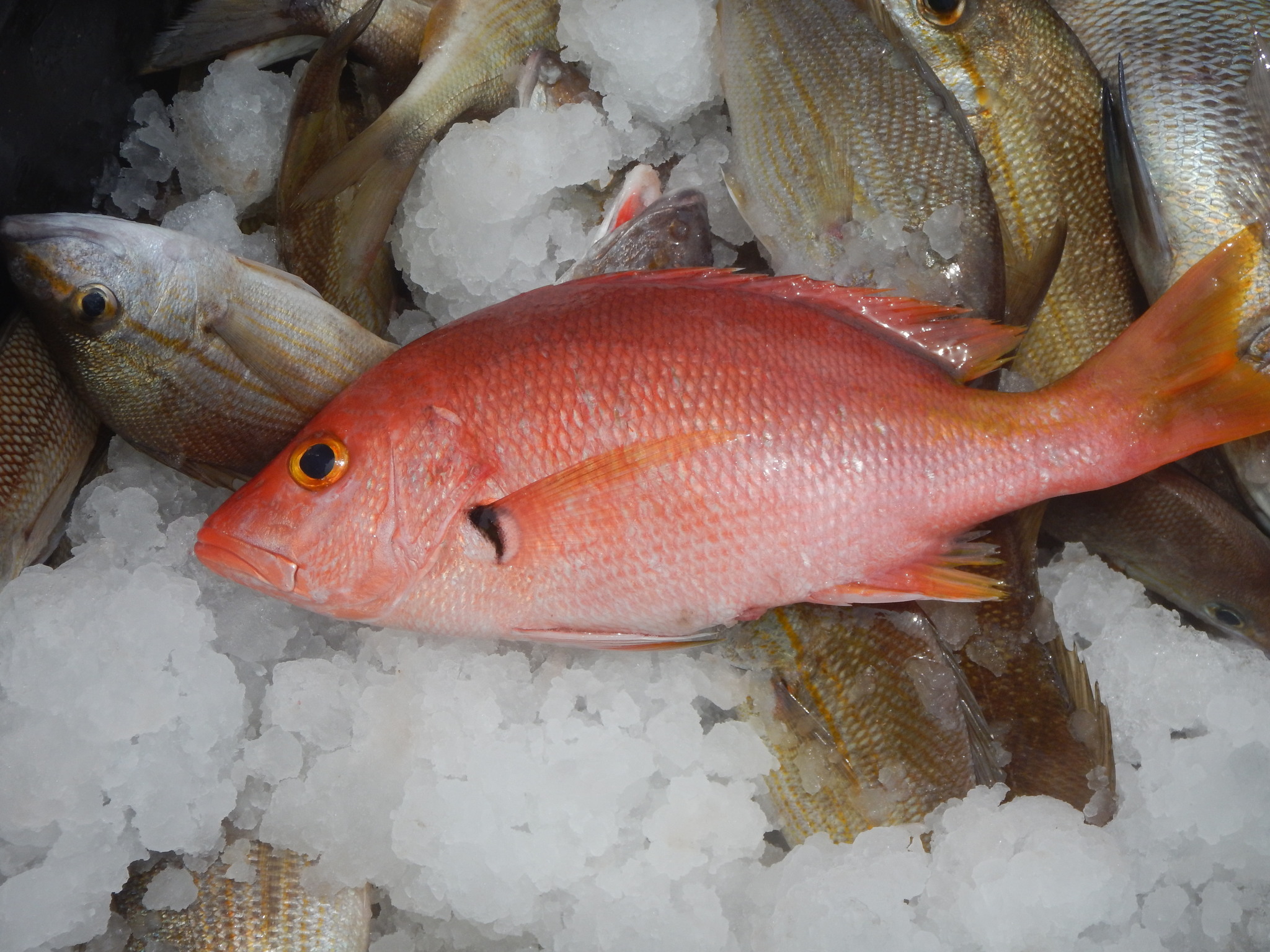
Blackfin snapper
- Family
- Lutjanidae
- Depth
- 20–200 m
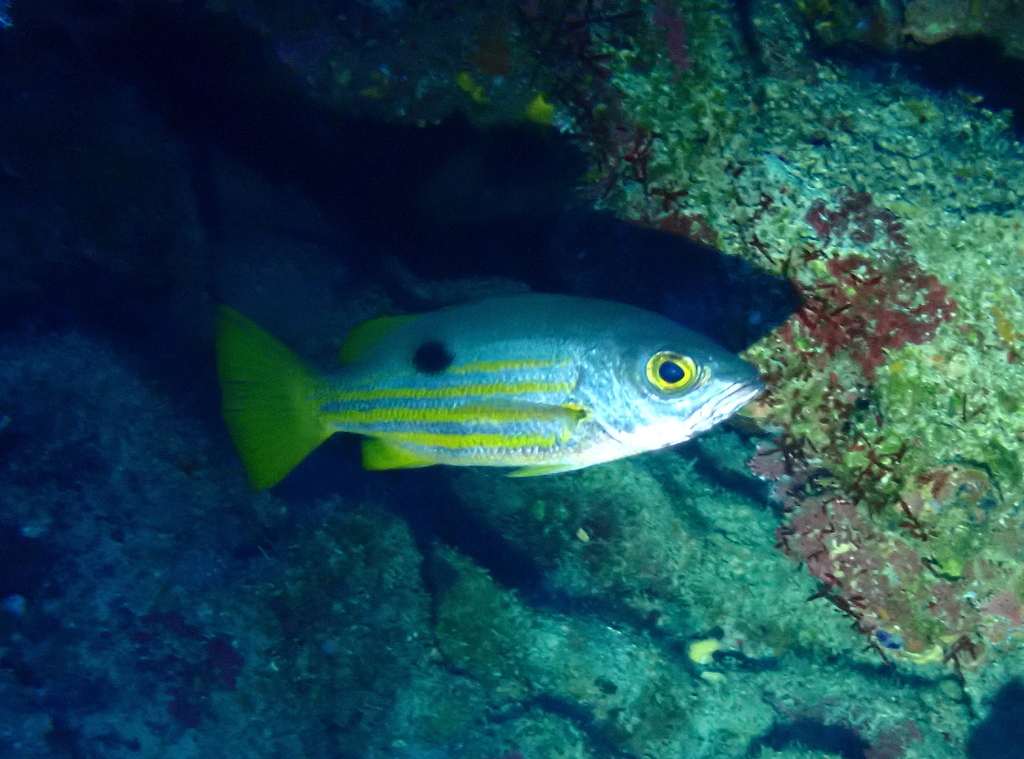
Blackspot snapper
- Family
- Lutjanidae
- Depth
- 5–20 m
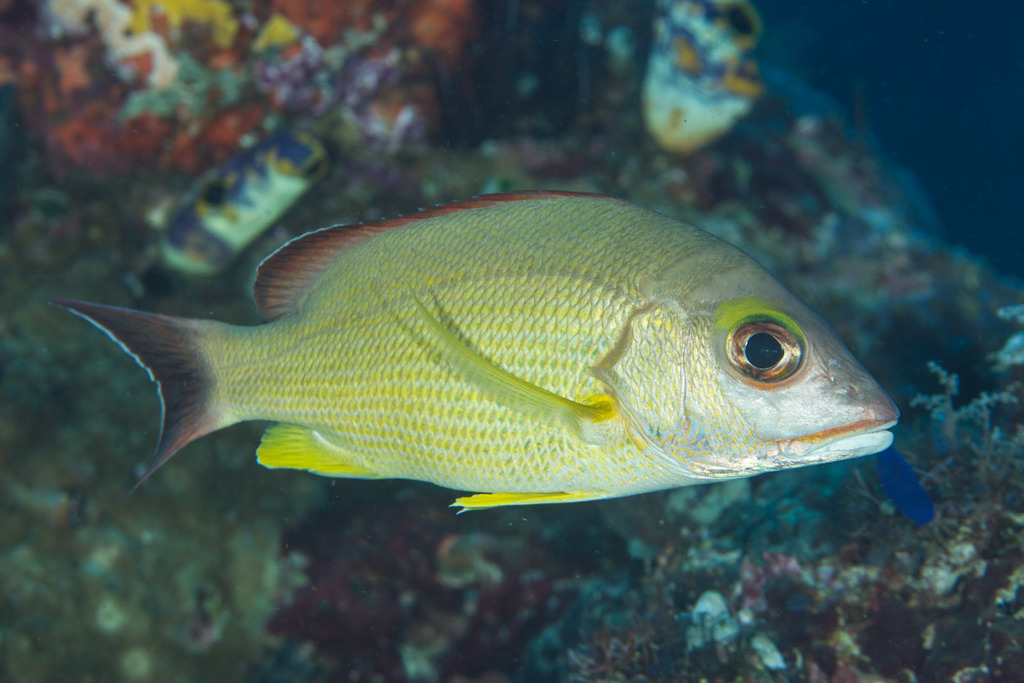
Blacktail snapper
- Family
- Lutjanidae
- Depth
- 1–80 m
- Season
- Jan, Feb, Mar, Apr, May, Jun, Jul, Aug, Sep, Oct, Nov, Dec
Guides for this water
Technique, gear and safety guides that fit Sharptooth jobfish.