
Pacific sand sole
Sand sole is a right-eyed flounder: both eyes on the right side, a flat body that all but disappears against sand. It is not a fish you find by sight, and the fishing follows from that. A bait that moves slowly along the bottom beats any clever action. California and federal rules both put it in a general flatfish bag, and the federal Other Flatfish category carries no size limit.
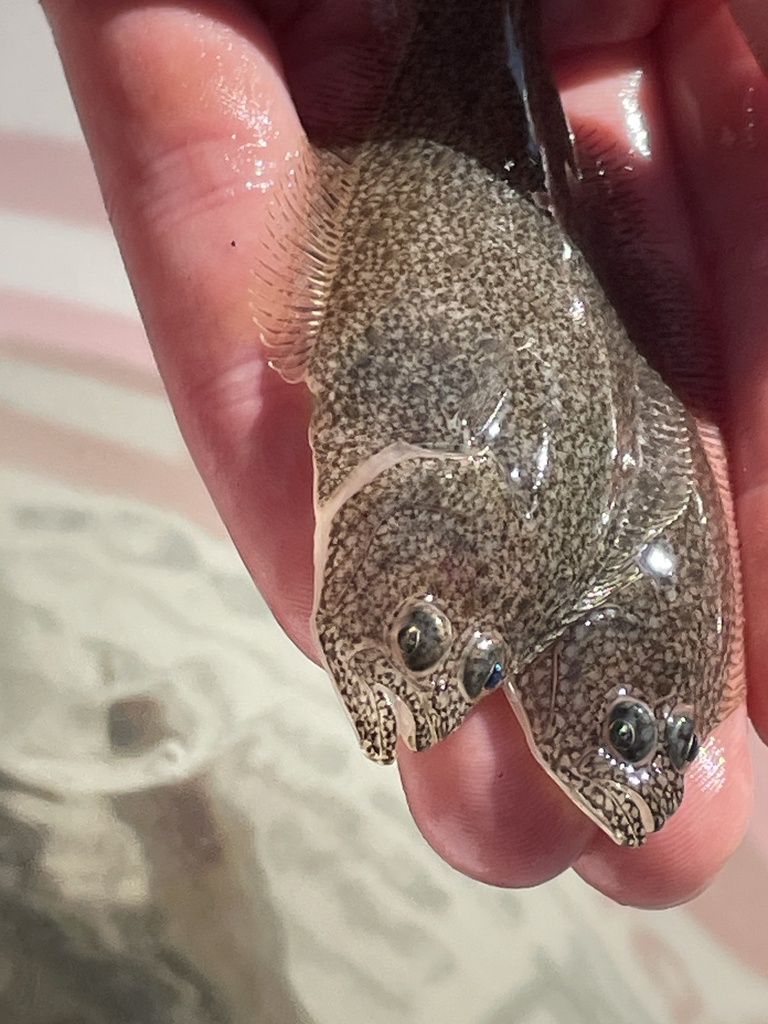
Sand sole is a right-eyed flounder: both eyes on the right side, a flat body that all but disappears against sand. It is not a fish you find by sight, and the fishing follows from that. A bait that moves slowly along the bottom beats any clever action. California and federal rules both put it in a general flatfish bag, and the federal Other Flatfish category carries no size limit.
Both eyes on the right, and a rounded tail
Both eyes sit on the right side of the head, the family-level split among the flatfish. The body is flat and the soft rays of the dorsal and anal fins run all the way to the tail base. Colour is sand brown with dense small dark speckles, the tail is rounded rather than forked, and the pectorals are small. FishBase gives 72 to 88 soft dorsal rays with no spines, 53 to 66 anal rays and 37 to 39 vertebrae, with the dorsal fin starting above a point in front of the eye. Nobody counts rays at the rail; the useful combination is that dorsal origin and the rounded tail.
A cold-water flounder at the southern edge
FishBase runs the range from the Bering Sea coast of Alaska and the Aleutians down to Redondo Beach in Southern California. This is a cold-water species, and Southern California is the southern end of its range. It lives over sand from 1 to 325 m, inshore and across the shelf, so the local catch is scattered: some fish come from shallow sand, more from deeper sand, and the numbers thin toward the south. If you go looking, work sand rather than reef, and do not treat Redondo Beach as a stable southern mark. It is a point on a map, not a destination.
Cool months and deeper sand
FishBase gives no month-by-month spawning table, and no spawning months appear in the public record, so this entry does not invent any. For Southern California, the cooler months and somewhat deeper sand are the better bet, with fewer chances close inshore in summer; that is local experience rather than survey data. The southern range limit sits at Redondo Beach, and the gap between a warm year and a cold one may matter more than the calendar. Treat depth as the variable when planning: on the same stretch of coast, a few tens of metres of depth can produce a completely different day.
Drifting a bait along the bottom contour
Drift fishing from a boat is the main method. The boat moves slowly over sand, the rig carries one to three ounces of lead, and the bait drags along the bottom; when the sounder shows a ridge or a dip, feed line and let the bait settle into it. Baits are squid strips, whole anchovies or chunks of sardine, threaded so the hook point stays clear. The diet covers fish, worms, crustaceans and molluscs, so the bait does not need to be fussy. From shore, a Carolina rig cast over clean sand and retrieved slowly works the same edge. Takes are light, so keep a slight tension all the way in.
A medium rod, a narrow hook, and a lead that reads the sand
A seven-foot medium boat rod with a 3000 to 4000 reel, 20-pound braid and a 15-pound fluorocarbon leader. Hooks run from 1/0 to 2/0 in a wide gap, and the sinker is flat or bullet-shaped so it does not tumble across the sand. Because the mouth is small, too wide a gap produces missed fish; keep the point exposed. Sand does not abrade line, but a lead that sinks into soft mud kills the feel, so lift the rod tip now and then to check. Flatfish do not fight hard at the surface, so a locked drag buys nothing and a steady retrieve loses fewer fish.
State 20/10 and federal Other Flatfish
The flesh is white, mild and fine-textured, good pan-fried, steamed or baked whole; quality drops fast, so bleed and ice the fish immediately. In state waters California applies the general bag in 14 CCR § 27.60: 20 fish of all species combined, no more than 10 of one species, no size limit and no closed season. In federal waters the species falls under Other Flatfish, which carries the same 20-fish aggregate, the same 10-fish single-species cap and no size limit (50 CFR 660.360). State waters, generally 0 to 3 nautical miles, and federal waters from 3 to 200 can differ, and stretches of Southern California sand lie inside marine protected areas. Check the current CDFW notice and the MPA map.
Where the fin counts stop being useful
The 63 cm maximum, the 1 to 325 m depth, the Bering Sea to Redondo Beach range, the sand habitat, the fin and vertebra counts and the diet all come from FishBase; no maximum weight or age is listed. The state 20/10 figures come from 14 CCR § 27.60, and the federal Other Flatfish classification and numbers from 50 CFR 660.360. IUCN rates the species Least Concern, assessed in 2020. Separation from similar right-eyed flounders stops at check the field guide here: this entry gives no scale counts and no lateral-line pore counts. The month-by-month pattern is local experience, not a range conclusion.
How to catch it
Drift fishing
A slow drift with one to three ounces of lead, feeding line whenever the bottom rises or drops.
Shore casting
A long cast over clean sand, then a slow retrieve that keeps the bait dragging the surface of the bottom.
Lift and drop over a hole
Stop on a depression and lift and drop the bait so it sits in the hole a few seconds longer.
Where these facts come from
Check these pages before you rely on a size, range or protection status.
- FishBase — Psettichthys melanostictus — FishBase · T2
- GBIF — Psettichthys melanostictus occurrence records — GBIF · T2
- IUCN Red List — Psettichthys melanostictus — IUCN · T1
- Photo record — iNaturalist — iNaturalist · T3
Fish in the same water
These fish live in the same place.
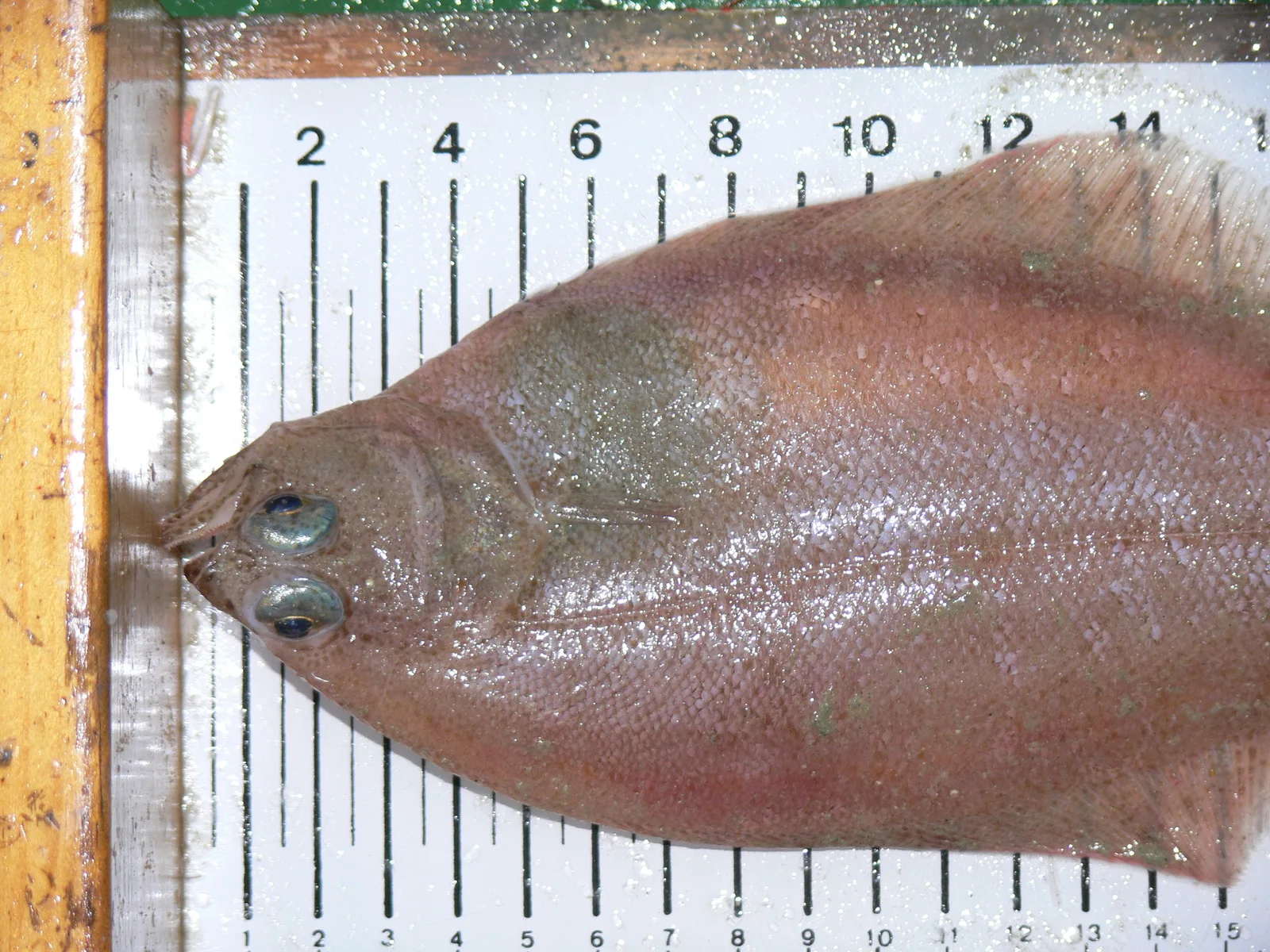
American plaice
- Family
- Pleuronectidae
- Depth
- 10–3000 m
- Season
- Mar, Apr, May
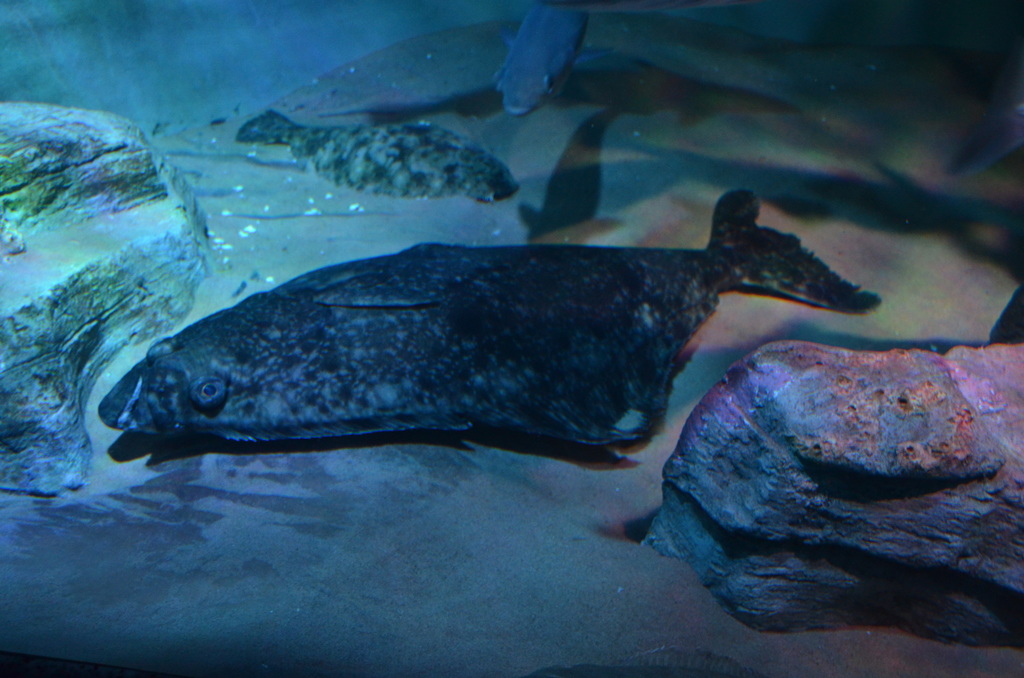
Atlantic halibut
- Family
- Pleuronectidae
- Depth
- 50–2000 m
- Season
- Jan, Feb, Mar, Apr, Dec
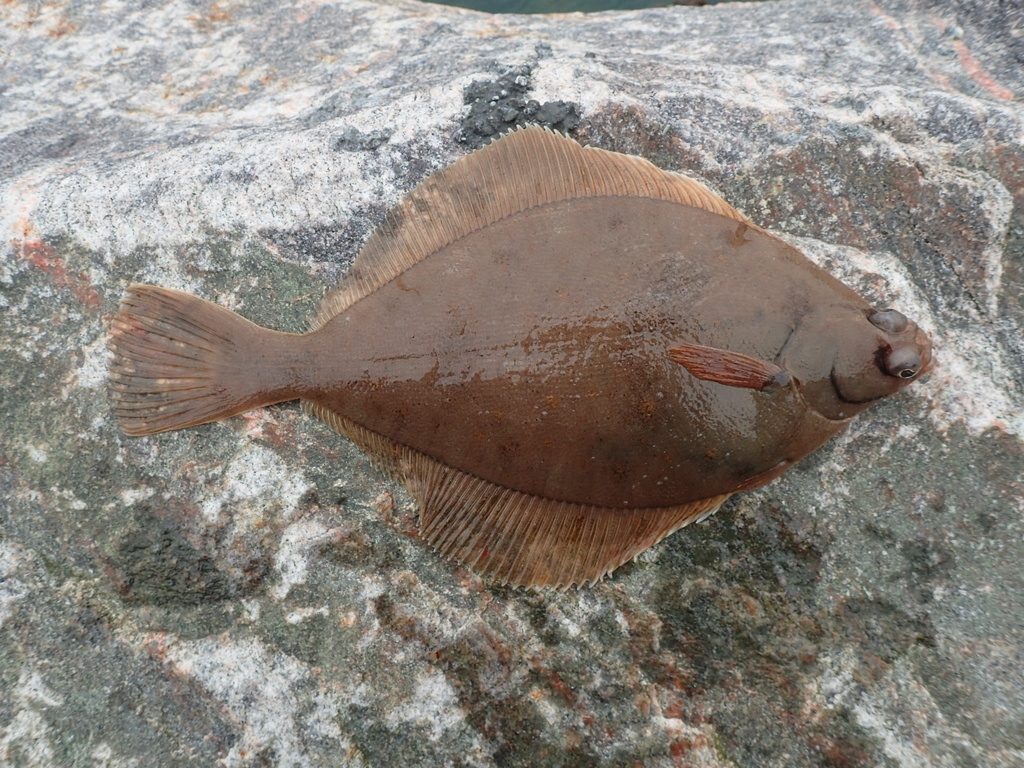
Common dab
- Family
- Pleuronectidae
- Depth
- 20–150 m
- Season
- Jan, Feb, Mar, Apr, May, Jun, Jul, Aug
Guides for this water
Technique, gear and safety guides that fit Pacific sand sole.