
Shovelnose guitarfish
The disc is broad and longer than wide, with a dorsal surface that is smooth apart from a single row of thorns around the eyes that continues along the back and tail. The snout is long and pointed with a rounded tip, and the teeth are small, rounded and pebble-like.
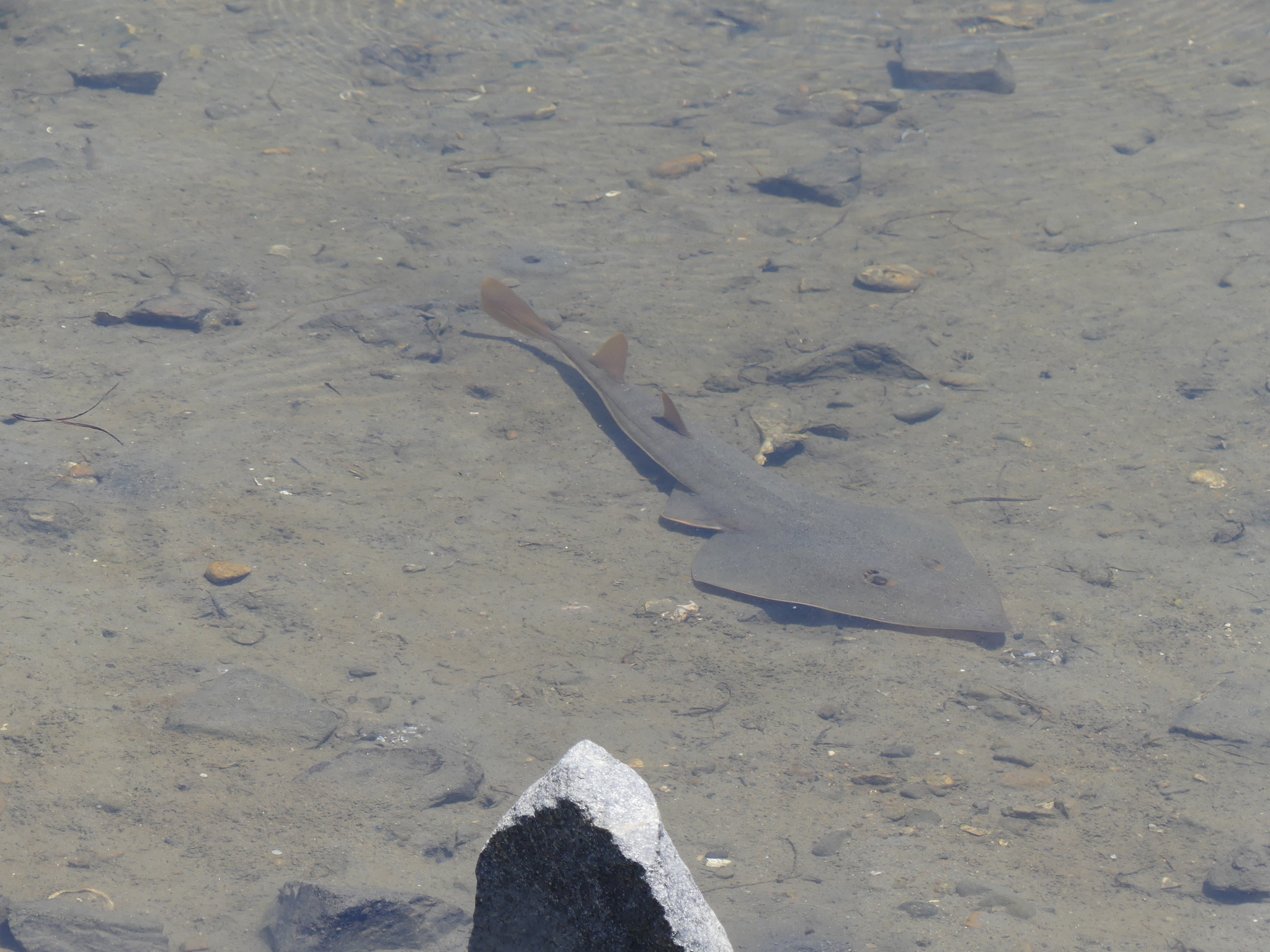
The disc is broad and longer than wide, with a dorsal surface that is smooth apart from a single row of thorns around the eyes that continues along the back and tail. The snout is long and pointed with a rounded tip, and the teeth are small, rounded and pebble-like. The first dorsal fin originates closer to the pelvic-fin base than to the caudal-fin origin; the tail is thick and the caudal fin moderately large without a distinct lower lobe. Tooth counts are recorded as 102–112/98–117 and spiral valve counts as 8–10. Against other local guitarfish, the long pointed snout plus the single thorn row is the practical combination.
Habitat and behaviour
This is an eastern Pacific endemic, recorded from San Francisco to the Gulf of California and possibly to Mazatlan. It is demersal, recorded from 1 to 91 m and usually from 1 to 13 m, which places it firmly in shallow sand. By day it often lies buried; at night it feeds over sand and around estuary mouths, so soft-bottom bays and river mouths are the key ground. GBIF holds 38720 occurrences, 38248 from the United States and 435 from Mexico. Records cluster heavily around southern California and Baja California. The flat disc lets the fish bury quickly, so a dragged bait often works better than a stationary one.
Seasonal window
FishBase records no spawning months. The California recreational limit was not confirmed in the public summary, and the Mexican limit was not verified either; both follow the current notice. By habit, night and the rising tide are the main windows, and shallow water is more productive in the warm half of the year. That is an editorial reading. In winter the fish move a little deeper and activity at estuary mouths drops. Stained water after a swell is often better than clear water, because the fish can hunt without exposure.
Gear and approach
Use a medium-length spinning rod from shore, fine braid, an abrasion-resistant fluorocarbon leader, a circle hook and a sinker chosen for the current. From a boat, a light boat rod and the simplest possible rig reduce snagging. The disc is wide, so land the fish in a large net and never grab the tail; the thorns can injure a hand. Release the fish onto sand and let it swim off on its own. A sand spike keeps the rod high and the line clear of the wash, and a headlamp with a red filter avoids spooking fish in the shallows.
Edibility and regulations
Flesh is white and firm, good fried or grilled; bleed and ice the fish promptly. IUCN status is NT, assessed in 2014, and the species is listed on CITES Appendix II, so international trade is monitored.
California: the recreational limit was not confirmed in the public summary; check the current notice.
Mexico: not verified; check the current notice.
British Columbia: the species does not occur there, so local limits do not apply.
Where to look
Morphology, distribution and tooth counts come from FishBase, occurrences from GBIF and images from iNaturalist. The CITES Appendix II listing is the hardest international constraint on the species, and it concerns cross-border trade rather than local recreational fishing. The California and Mexican limits are both unverified, and the methods and gear here are editorial advice based on shallow sand habitat. Read the local notice before every trip, because the gaps are real.
How to catch it
Shore casting
Fished with the listed approach, matched to the recorded depth and size.
Boat bottom fishing
Fished with the listed approach, matched to the recorded depth and size.
Where these facts come from
Check these pages before you rely on a size, range or protection status.
- FishBase — Pseudobatos productus — FishBase · T2
- GBIF — Pseudobatos productus occurrence records — GBIF · T2
- IUCN Red List — Pseudobatos productus — IUCN · T1
- Photo record — iNaturalist — iNaturalist · T3
Fish in the same water
These fish live in the same place.

Acoupa weakfish
- Family
- Sciaenidae
- Depth
- 1–20 m
- Season
- Jan, Feb, Mar, Apr, May, Jun, Jul, Aug, Sep, Oct, Nov, Dec

American angler
- Family
- Lophiidae
- Depth
- 0–800 m
- Season
- Mar, Apr, May, Jun

American eel
- Family
- Anguillidae
- Depth
- 0–464 m
- Season
- Jan, Feb, Mar, May, Jun, Jul
Guides for this water
Technique, gear and safety guides that fit Shovelnose guitarfish.