≥25 cm
New Zealand — South East · NZ-SE
New Zealand sets a 25 cm minimum length for red cod.
Red cod | 10 | 25 | 100

Red codling is a slim, white-fleshed morid of the southwest Pacific, found around New Zealand and southern Australia from Sydney to Adelaide and around Tasmania. It works 26 to 700 m in subtropical water and feeds on crustaceans, fish and molluscs. Adults reach 90 cm TL. The season is short, July and August, which puts it in the southern winter.
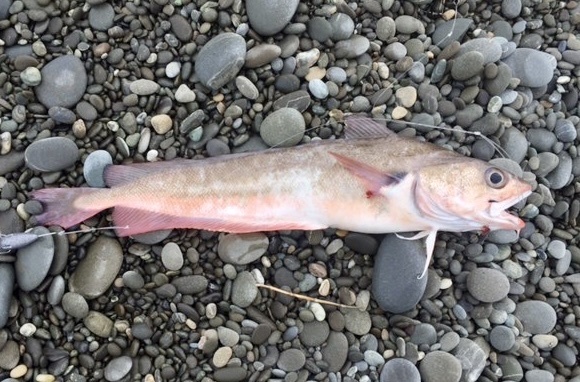
Red codling (Pseudophycis bachus) is a fish of the family Moridae. FishBase gives its range as: Southwest Pacific: New Zealand and around Australia, at least from Sydney to Adelaide, and around Tasmania. Often confused with Pseudophycis barbata. It is recorded from 26 to 700 m, in subtropical water. The recorded maximum is 90 cm TL. Diet includes crustaceans, fishes and molluscs. IUCN status: Not Evaluated (NE). Chinese name: .
Pseudophycis bachus is a morid cod of the order Gadiformes, and the record gives it a depth range of 26 to 700 m. A second line in the same record gives the usual band as 200 to 300 m. Those two statements are not a range and a preference; they are a filing cabinet and a fishing plan. The cabinet has 674 m of drawers. The plan has 100 m of working water. For a demersal fish, that difference decides everything: where the boat goes, what lead reaches the bottom, and whether a catch is a useful sample or an outlier. The species is also listed as brackish-tolerant and subtropical, but neither label moves the centre of the band. Start with the working depth, not with the extremes.
The 26 m figure is a real record and a poor target. It sits 174 m above the bottom of the usual band, in water that a shore rod can sometimes reach and that a boat rarely fishes for this species. The environment line pairs marine with brackish, so the shallow edge can sit near an estuary mouth or over an inner shelf; a fish taken there belongs to the same species but not to the population the fishery is built on. Read the minimum as the outer boundary of what has been entered, not as an invitation to cast from land. The useful question is not how shallow the fish can go but how deep its centre sits, and the centre is 200 to 300 m.
At 200 to 300 m the bottom has changed character. This is the shelf edge, where the flat coastal shelf gives way to the slope, and the habitat record's continental-shelf note belongs to this landform rather than to a beach. The band is narrow in depth and broad in ground: the bottom notes include hard ground as well as soft, and the transition between them is what a sounder can show. A contour that runs straight gives a clean drift; a contour that steps gives edges. The fish is demersal, so the bait has to be on that ground, not hung above it. The depth is the address; the contour is the door.
Coastal advice begins with the tide, and at 250 m that advice loses most of its resolution. The tide still moves water, but against the bottom of a 100 m band its vertical excursion is small; it does not lift and lower the band the way it lifts a surf bar. What changes the fishing is the boat's position over the contour, the drift speed, and whether the trace shows a hard edge or a flat. A tide table still tells you when the current will push hardest against the drift; it does not choose the depth. Set the drop on the contour first, then use the tide to pick the direction you will drift across it.
The spawning entry gives July and August and places the event in New Zealand. The Australian half of the range, from Sydney to Adelaide and around Tasmania, comes from the distribution section rather than from the spawning table. Treat the two months as a New Zealand winter signal, not as a range-wide calendar. For a boat working the usual band, the consequence is that a winter trip is the one most likely to meet grouped fish and also the one most exposed to weather. Keep the depth band and the season as separate decisions: the band tells you where to fish, the months tell you when the fish may be together.
The species carries two human-use labels in FishBase, highly commercial and gamefish. The labels describe one fish from two ends: a trawl and longline target, and an animal a recreational boat can chase. At 200 to 300 m the recreational version is not light work. It is a boat, a sounder, and a rig heavy enough to reach the bottom and return. The size record sets the expectation: a maximum of 90 cm TL and a common length of 55 cm TL. Plan for the common fish; the maximum is the photograph. A gamefish label does not make a deep demersal species a shore species.
The diet record is bottom-based: crustaceans, fishes and molluscs. That tells you the bait has to arrive on the ground and stay long enough to be found. In 200 to 300 m the lead has two jobs, reaching the bottom and holding it against drift, and a rig that is too light never settles. The ground is mixed, so one drift can end on sand and the next on rock. A snag at this depth is not a freed hook; it is a lost rig and a lost drift. Build the dropper so the weakest link sits above the weight, and carry more than one. The band is narrow enough to learn; the bottom inside it is not uniform.
The range is the southwest Pacific: New Zealand, and around Australia at least from Sydney to Adelaide and around Tasmania. Inside it, the working water is the shelf edge at 200 to 300 m, not the 26 m minimum. GBIF's distribution endpoint returns two statements, one for the Indo-West Pacific and one for the New Zealand Exclusive Economic Zone; both are drawn at the scale of a sea region or a jurisdiction, which is the scale of the depth band, not of a mark. iNaturalist has 52 observations, a small number that fits a deep demersal fish. The species is also recorded as prey for a diving penguin, a reminder that the shallow edge is real even when it is not the centre. New Zealand manages red cod under separate stock codes, so check the code for the coast you are on before keeping a fish. Fish the contour, not the minimum; without a boat, this is a market fish.
These are the published regulations for this fish. Read the number first. The notice below it is the actual regulation.
New Zealand sets a 25 cm minimum length for red cod.
Red cod | 10 | 25 | 100
New Zealand allows 10 red cod per fisher per day.
Species.json lists Pseudophycis bachus as Red codling with Red cod as an alias.
Red cod | 10 | 25 | 100
Every record above names its source and the date it was retrieved. See the regulation register for the full list, or how to read these regulations.
Check these pages before you rely on a size, range or protection status.
These fish live in the same place.

Technique, gear and safety guides that fit Red codling.