
Devil firefish
The devil firefish is the Lessepsian immigrant everyone recognises and too many people handle badly: wing-like pectoral fins, long venomous dorsal spines, first established in the eastern Mediterranean and still spreading west. It has no effective predator here and no law obliging you to remove it. The difficulty is not catching one; it is getting the first fish off the hook without a spine finding your hand.

The devil firefish is the Lessepsian immigrant everyone recognises and too many people handle badly: wing-like pectoral fins, long venomous dorsal spines, first established in the eastern Mediterranean and still spreading west. It has no effective predator here and no law obliging you to remove it. The difficulty is not catching one; it is getting the first fish off the hook without a spine finding your hand.
Thirteen free spines and a pair of wings
Read the outline first. There are 13 dorsal spines, with the membrane joining them only near the base, so the upper sections stand free like a row of needles. The pectoral fins are large and wing-like, with the outer half to three-quarters of the rays free of membrane, opening into a fan. Colour is red-brown to tan or grey-brown, with numerous thin dark bars across head and body; the tentacle above the eye may be faintly banded; adults show a row of small spines on the cheek and small spots in the median fins. Against P. volitans, use two field marks: the devil firefish has a shorter supraorbital tentacle and smaller fin spots, while volitans carries a longer tentacle and larger spots. Colour alone will not settle it, so photograph the fish with the pectoral spread.
A Suez Canal arrival still moving west
FishBase gives the native range as the Indian Ocean, from the Persian Gulf and Red Sea south to Port Alfred in South Africa and east to Sumatra, with records from the Atlantic and a note that it now occurs in the eastern Mediterranean. That is the classic Lessepsian route: through the Suez Canal, established in the eastern basin first, then spreading west. The recorded depth is 0 to 85 m, and adults turn up in coastal water and over mud, so hard bottom is not a requirement; reef, rubble, man-made structure and mud all hold fish. For anglers the working areas are reef edges, harbour structure and artificial hard ground such as wrecks. Shallow fish are the ones most often seen and most often reached from shore.
Warm water widens the range, but the records are thin
FishBase gives no month-by-month spawning table for this species and no adult temperature band, only a tropical classification. What is clear is that it is a warm-water expander in the Mediterranean: activity and range are widest in the warm months, and some fish move to deeper or more stable structure as water cools. Reported catches cluster in summer and autumn, though that may say more about how often people dive and fish than about the fish itself. Age and growth data are not published here, so the recovery rate of a local population after removal cannot be judged, which matters whenever the question of keeping fish comes up.
Present a bait at structure, then stay out of the spines
This is an ambush predator that eats fish and crustaceans, so the bait belongs beside structure, not in open water. From shore, a float rig with a live shrimp or small fish works the reef edge slowly; the fish often hangs just off the rock and strikes only when the bait enters range. From a boat, bottom-fish squid strip or fish chunk at the seam between reef and mud, or crawl a small soft plastic along the structure. The third method is the speargun, the most common removal tool where it is legal, subject to national rules on daylight, no compressed air and licensing. None of these needs a long cast. The escape distance is short and the first run goes straight for cover, so leave line to spare.
The rod is light; the handling kit is not optional
A 2.4 to 2.7 m medium spinning rod and a 3000 reel are enough, with 20 lb braid, a 25 to 30 lb fluorocarbon leader and a 1/0 to 2/0 wide-gap hook. The heavier leader is not about pulling power: the spines and jaw are hard, and a hooked fish turns along structure. The real equipment is the handling kit: long-nose pliers, thick gloves, side cutters and a rigid container with a lid. Do not net the fish, because spines catch in the mesh, and do not press a hand on the body, because dorsal and anal spines go through thin gloves. Cut spines only if you intend to keep the fish, and store the cut spines separately; they remain venomous.
Venomous, invasive, and under no removal obligation
Flesh: no dedicated eating-quality assessment was found for Pterois miles. There is a reasonable amount of meat, but sequence matters more than flavour: cut the dorsal, anal and pelvic spines first, then head and skin the fish, wearing thick gloves throughout. Rules by jurisdiction. EU: the species is not listed in Annex IX Part A of Regulation (EU) 2019/1241, so there is no EU minimum conservation reference size. Article 2(2) applies only Articles 7, 10, 11 and 12 to recreational fishing, so Annex IX sizes do not automatically bind anglers. Article 17 of Regulation (EC) 1967/2006 bans sale of recreational catch, and that applies to an invasive species too. Greece (GR): licence abolished by Law 4256/2014, 5 kg per person per day, spearfishing banned nationwide in May. Cyprus (CY): DFMR states that no fishing activity is allowed without a licence, with licence types covering vessels, spearguns and traps; whether a plain shore rod needs one was not confirmed. Turkey (TR): foreign visitors may shore-fish without a document; boat fishing needs a tourism permit or avlanma fişi, and the 2024/21 size table was not retrieved, so no Turkish size is stated. Italy (IT): no paid licence, annual MASAF declaration required, no separate national recreational size table. Croatia (HR): licence needed from shore and boat, 5 kg per person per day, spearfishing only under a sport licence and in daylight. One point matters most: no jurisdiction examined sets a size, bag limit, removal obligation or bounty for this fish. Taking it is a choice, and leaving it is not an offence. Do not read "invasive" as "must kill". Check the current year's official notices before you go.
What the sources support and what they do not
Length, weight, depth, fin counts, colour and barring, distribution and IUCN status (LC, assessed 2017) come from FishBase. The Lessepsian route follows the project's approved wording. Regulation text comes from the EU regulation and national official sources retrieved in November 2026. The tentacle-length and fin-spot differences from P. volitans are field characters that need photo review. Age, growth and monthly spawning are not published here and are listed as pending.
How to catch it
Float fishing
Fished with the listed approach, matched to the recorded depth and size.
Trolling
Fished with the listed approach, matched to the recorded depth and size.
Spearfishing
Fished with the listed approach, matched to the recorded depth and size.
Where these facts come from
Check these pages before you rely on a size, range or protection status.
- FishBase — Pterois miles — FishBase · T2
- GBIF — Pterois miles occurrence records — GBIF · T2
- IUCN Red List — Pterois miles — IUCN · T1
- Photo record — iNaturalist — iNaturalist · T3
Fish in the same water
These fish live in the same place.

Black scorpionfish
- Family
- Scorpaenidae
- Depth
- ≤ 800 m
- Season
- Apr, May, Jun, Jul, Aug, Sep

California scorpionfish
- Family
- Scorpaenidae
- Depth
- 26–183 m
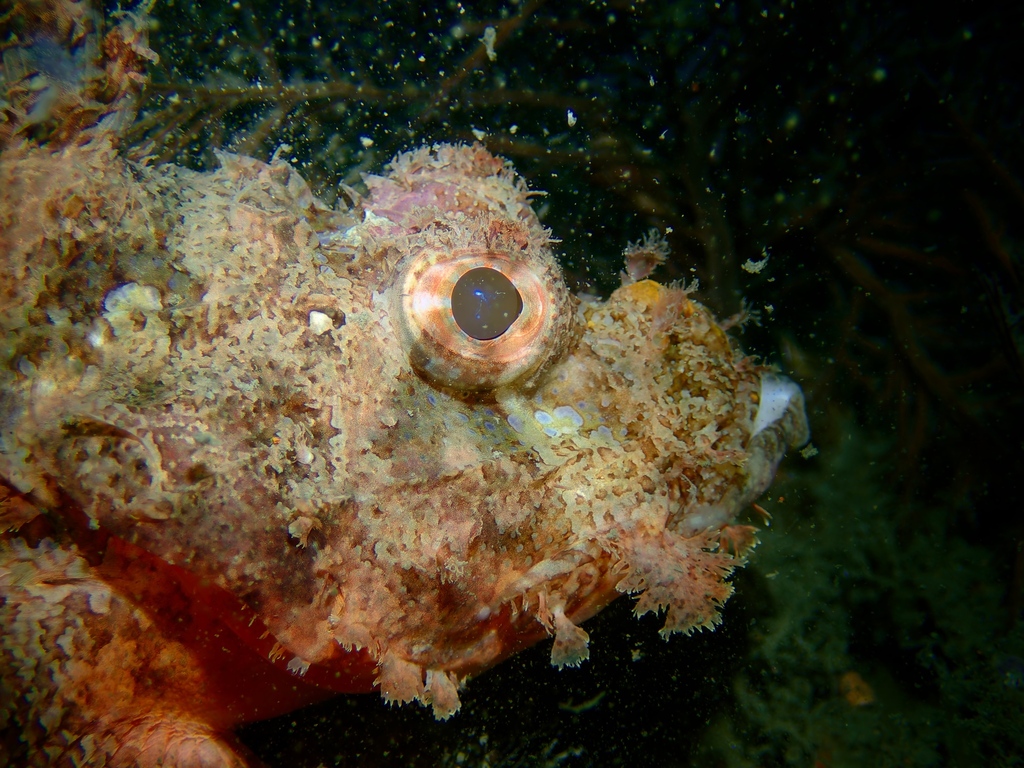
Oni scorpionfish
- Family
- Scorpaenidae
- Depth
- 3–91 m
Guides for this water
Technique, gear and safety guides that fit Devil firefish.