No minimum size limit
United States — California · US-CA
California has no minimum size limit for California scorpionfish.
The daily bag and possession limit is 5 fish with no minimum size limit.

The difficulty with a California scorpionfish is not catching it. It is the venom in the dorsal, anal and pelvic spines, and the two rulebooks that apply in state and federal water. Locals call it a sculpin, but it belongs to Scorpaenidae, not Cottidae; misidentify the fish or mismeasure it at the boat and the trip can turn into a violation.

The difficulty with a California scorpionfish is not catching it. It is the venom in the dorsal, anal and pelvic spines, and the two rulebooks that apply in state and federal water. Locals call it a sculpin, but it belongs to Scorpaenidae, not Cottidae; misidentify the fish or mismeasure it at the boat and the trip can turn into a violation.
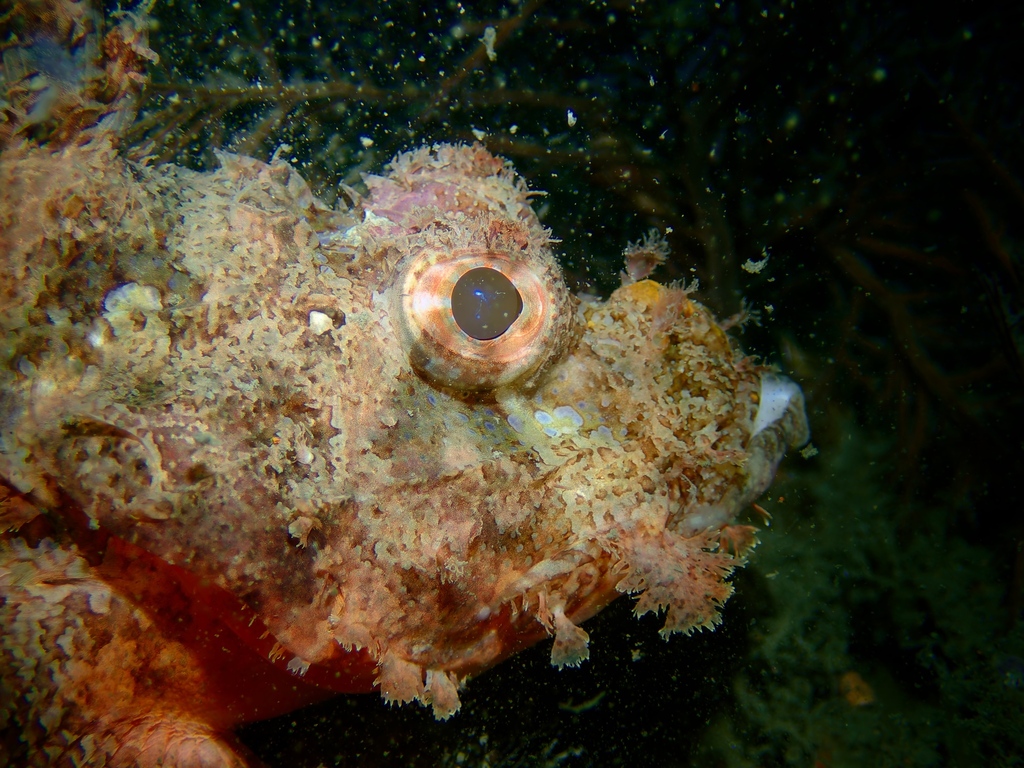
The head is the first clue: large, with high-set eyes, heavy head spines and skin flaps, and a wide mouth that opens upward. The body runs red-brown to orange-brown with dark spots and mottled patches, and the fins are patterned. The dorsal spines are stout, and the anal and pelvic spines carry venom as well; that is the difference that matters most against other bottom fish. Locals group these fish under the name sculpin, but Cottidae does not carry this venomous spine arrangement, and a shared common name is not a shared family. Hold the fish from back to belly or use pliers, never with a hand across the gill cover and dorsal fin.
FishBase runs the range from Santa Cruz in central California to Punta Abreojos in Baja California, including the northern Gulf of California and Guadalupe Island. The fish lives in rocky areas of bays and along shore, especially in caves and crevices, and spends the day inside structure. The depth data disagree: the field reads 26 to 183 m, while the biology text says the fish prefers depths under 26 m and notes that the minimum comes from an occurrence record. Read the two statements together; shallow catches do not contradict the field, they contradict a reading of the field as a hard lower bound.
FishBase gives no spawning season or spawning temperature for this species and records a maximum age of 21 years. Southern California catches improve as water warms in late spring, hold through summer and autumn around piers and shallow rock, and move deeper in winter when shore fishing gets hard. Night is better than day, because fish leave the crevices and feed along the edge of structure. Those months are arranged from local catches rather than from a survey, and the working window still depends on tide, water colour and swell on the day.
Bottom fishing is the main method: a whole sardine, a squid strip or a shrimp on a 3/0 hook, with enough weight to sit on the bottom and the bait parked at the edge of a crevice. The fish ambushes rather than chases, so a bait that stays still beats one that moves fast; set it down, wait, and lift and settle now and then. From a pier at night, a short rod and a vertical drop put the bait against piling and rock. Lures are a minor tool; a soft plastic crawled on the bottom works occasionally, but unhooking is risky, so the first fish is the moment to switch to pliers and heavy gloves.
A 7 foot medium-heavy boat or pier rod with a 4000 size spinning reel, 30 lb braid, a 25 lb fluorocarbon leader, a 3/0 circle or J hook and enough sinker for the current covers it. Crevices are everywhere, so the leader has to take abrasion and the braid should never touch rock. Unhook with long-nose pliers, with the fish on a wet towel or a flat deck, and never put a hand across the back. A puncture needs hot-water immersion and medical attention; that matters more than any item of tackle.
FishBase calls it an excellent food fish. The flesh is white and firm, good in soup, fried or as fillets; cut the dorsal, anal and pelvic spines off before opening the fish. In California state water, generally inside 3 nautical miles, the season is year-round with a five-fish limit, no minimum size and a two-hook, one-line gear limit, but Groundfish Exclusion Areas are closed to take (14 CCR § 28.54). In federal water, generally 3 to 200 nautical miles, it is open year-round with a five-fish limit and no minimum size; fishing is restricted to two hooks on one line, a provision written for south of 40°10′N; the species does not count toward the 10-fish rockfish, cabezon and greenling complex; and it may be taken inside recreational rockfish conservation areas (50 CFR 660.360(c)(3)(v)). Federal rules follow the current notice. Much of the Southern California rock lies inside marine protected areas, so check the CDFW notice and the MPA map. A licence is required from 16, plus the Ocean Enhancement Validation south of Point Arguello.
Length, age, distribution, habitat and the venomous spines come from FishBase, with the family from GBIF's Scorpaenidae; the IUCN listing is Data Deficient, assessed in 2008. The conflict between the 26 to 183 m field and the text preferring water under 26 m is left as the source states it, with no average invented to smooth it over. Spawning season, juvenile habitat and local population trend are missing and listed as pending. The regulation section is split into state and federal parts and uses only 14 CCR § 28.54 and 50 CFR 660.360(c)(3)(v), with annual adjustments and area boundaries left to the current notices. The local name sculpin appears only as an alias.
A whole sardine on a 3/0 hook and enough weight to sit, parked at the edge of a crevice; wait, then lift and settle.
A short rod, a squid strip or shrimp straight down beside the piling, moved slowly up and down along the rock.
Set the bait just outside the opening rather than inside it, and pull sideways the moment the fish is hooked.
These are the published regulations for this fish. Read the number first. The notice below it is the actual regulation.
California has no minimum size limit for California scorpionfish.
The daily bag and possession limit is 5 fish with no minimum size limit.
California allows five California scorpionfish per person per day, open year-round at all depths.
The recreational fishery for California scorpionfish (Scorpaena guttata) is open year-round, at all depths. The daily bag and possession limit is 5 fish with no minimum size limit.
Every record above names its source and the date it was retrieved. See the regulation register for the full list, or how to read these regulations.
Check these pages before you rely on a size, range or protection status.
These fish live in the same place.
Technique, gear and safety guides that fit California scorpionfish.