
Oni scorpionfish
Oni scorpionfish is a Northwest Pacific scorpaenid, from southern Japan and China south to Hong Kong and northern Taiwan. It lives on coral and rocky reefs at 3 to 91 m, often lying motionless on the bottom, feeding on small fish; its spines are venomous. FishBase gives a maximum of 23.1 cm SL. IUCN lists it as Least Concern, assessed in 2023, and bottom fishing and lures are the methods listed.
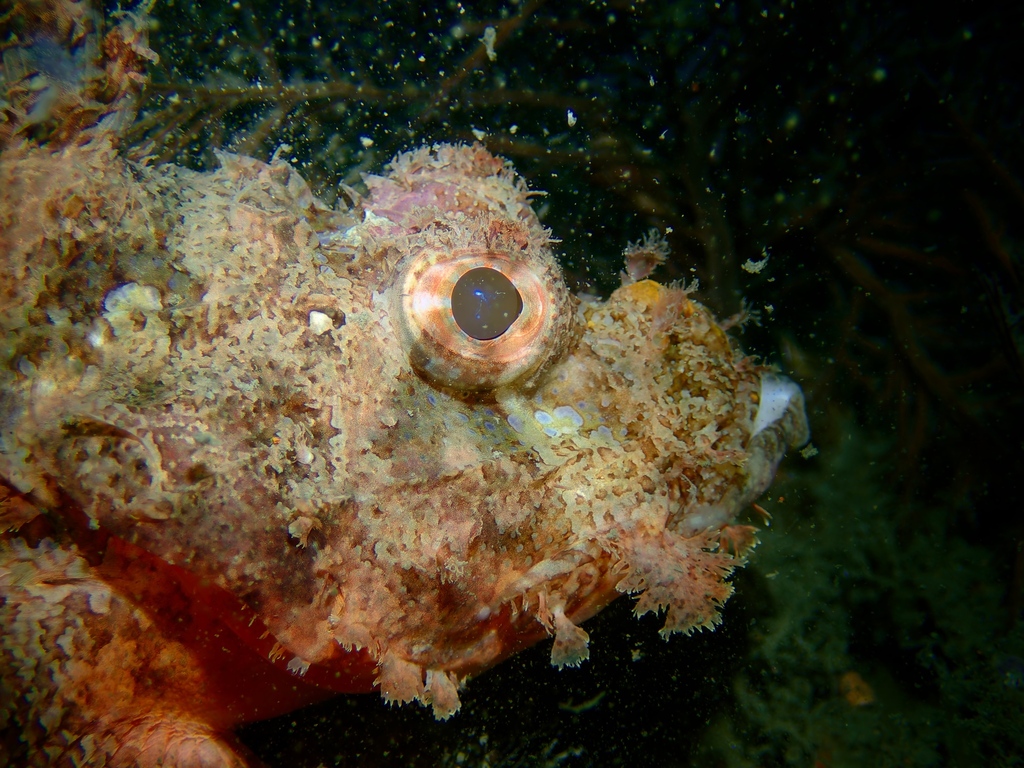
Oni scorpionfish is a Northwest Pacific scorpaenid, from southern Japan and China south to Hong Kong SAR and northern Taiwan region. It lives on coral and rocky reefs at 3–91 m, often lying motionless on the bottom, feeding on small fishes; its spines are venomous. FishBase gives a maximum of 23.1 cm standard length. IUCN lists it as Least Concern, assessed in 2023. The Chinese name follows FishBase's table, which gives ; is the master-plan name, is not listed by FishBase, and is kept as an alias, while and are colloquial names, not formal ones.
Reading the spines
About one-fourth of the eye projects above the dorsal profile of the head; viewed from the front, the interorbital space is hemispherical and not deep, its maximum depth more than 3 times in orbit diameter. The fourth or fifth dorsal spine is usually longest, 2.6–3.15 times in head length; the first dorsal spine is 1.7–2.1 times in the second; snout length is 2.8–3.05 times in head length. The body is fusiform. Colour is variable, often pale red, reddish brown or grey-brown with mottled patterns that mimic algae and rock; the head has flaps and spines; the mouth is large and upturned; the pectoral fins are broad. The projecting eye, hemispherical interorbital and long fourth or fifth dorsal spine are the reliable checks; scorpaenids are similar and colour alone misleads. Because so much of the eye sits above the head outline and the interorbital is domed, the fish can lie with the front of the head close to the bottom and still watch upward.
A sit-and-wait reef fish
FishBase's range is the Northwest Pacific: southern Japan and China south to Hong Kong SAR and northern Taiwan region. The country table includes mainland China, Hong Kong SAR, Japan, Korea, Taiwan region, Thailand and Vietnam. GBIF's 652 records are led by Japan (399), Korea (29), Taiwan region (28), the Philippines (27), Hong Kong SAR (26) and mainland China (19). It lives on coral and rocky reefs, often motionless on the bottom, ambushing small fish. Fish crevices, coral rubble and weed, especially calm spots with small fish; it often stays in one place by day and is more active at night.
The blanks are information
FishBase publishes no spawning months and no temperature window. The species is tropical to subtropical and catchable all year; in Taiwan region, Hong Kong SAR and southern China, late spring to autumn is the main window, with winter fish deeper or on lee reefs. No temperature number is published, so follow local reef temperature. Tide and slack water concentrate small fish and crustaceans; dawn, dusk and night also work. The fish sits still, so finding it matters more than attracting it.
Where to start looking
The GBIF pattern is Japanese-first, with Korea, Taiwan region, the Philippines and Hong Kong SAR secondary. Fish the crevice, the rubble and the weed line, not the open sand. The source gives no coordinates; local knowledge of reef structure is the real map.
Tackle and baits
Reef bottom fishing and light rock fishing are the standards: small hooks, short leaders, prawn, small fish, crab meat and sandworm. The mouth is large and the fish swallows deep, so a sharp, wide-gap hook helps; after the hookset it flares its spines defensively, so unhook with care. It waits on the bottom for small fish to come close and does not chase bait far, so the rig should land near its lie; a small live bait or a whole small fish fits its diet better than a large cut bait. Small soft plastics, jigheads and fish-shaped lures can be slow-dragged along crevices. Night fishing with scented bait is effective. Never grab the fish by hand; use pliers or thick gloves.
Eating, handling and the rules
The species is a commercial fishery target; the flesh is fine, good steamed, braised or in soup. Bleed, gut and ice it promptly. The venomous spines are in the dorsal, anal and pelvic fins; cut them off or wear thick gloves, because a sting causes severe pain and swelling and may need medical care. Ciguatera is mainly a reef-predator issue, so small scorpaenids are lower risk, but organs should not be eaten in quantity. Rules vary: Taiwan region manages inshore fishing and reef species through closed areas, seasons and protected zones, and recreational fishing must follow Fisheries Agency and local government notices; Hong Kong SAR's Fisheries Protection Ordinance regulates methods, with no angling or collecting in marine parks and reserves; Southeast Asian states differ widely. Check the current local notice.
What the record leaves open
The page is built from FishBase taxonomy, morphology, distribution, environment, biology, use, IUCN and venom entries, with the country table for range and GBIF/iNaturalist for occurrence. The formal Chinese name follows the master plan; FishBase's Chinese table is kept as aliases, and colloquial names are not formal. Spawning months, water temperature and local size limits are not standardised, so the text stays conservative.
How to catch it
Bottom fishing
Fished with the listed approach, matched to the recorded depth and size.
Lure fishing
Fished with the listed approach, matched to the recorded depth and size.
Where these facts come from
Check these pages before you rely on a size, range or protection status.
- FishBase — Scorpaenopsis cirrosa — FishBase · T2
- GBIF — Scorpaenopsis cirrosa occurrence records — GBIF · T2
- IUCN Red List — Scorpaenopsis cirrosa — IUCN · T1
- Photo record — iNaturalist — iNaturalist · T3
Fish in the same water
These fish live in the same place.


Guides for this water
Technique, gear and safety guides that fit Oni scorpionfish.