
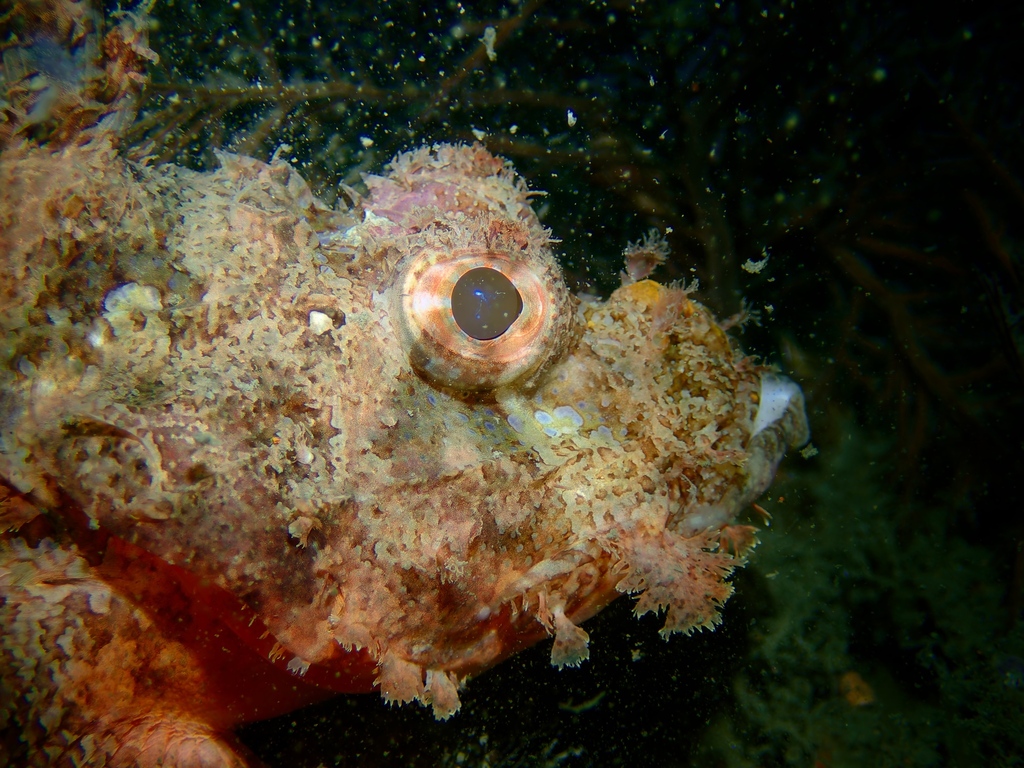
Black scorpionfish
Black scorpionfish is a small ambush predator of the eastern Atlantic and Mediterranean, from the British Isles and the Azores down through Morocco and into the Black Sea. It is recorded from shallow water out to 800 m and preys on crustaceans, fish and algae. Adults run to 40.5 cm TL and 0.87 kg. April to September is the season.

Black scorpionfish (Scorpaena porcus) is a fish of the family Scorpaenidae. FishBase gives its range as: Eastern Atlantic: British Isles to the Azores, and the Canary Islands, including Morocco, the Mediterranean Sea and the Black Sea. It is recorded shallower than 800 m, in temperate water. The recorded maxima are 40.5 cm TL, 0.87 kg. Diet includes crustaceans, fishes and algae. IUCN status: Least Concern (LC). Chinese name: .
A depth band with a ceiling and no floor
FishBase prints the depth as "? - 800 m". The question mark sits at the shallow end: the record gives a maximum of 800 m and no minimum at all. The species is demersal and non-migratory, so the gap is a missing measurement, not a season that a migration fills in. Temperate is the climate class; the box is 55°N to 25°N and 32°W to 42°E, from the British Isles through the Mediterranean to the eastern Atlantic. For a boat, an unrecorded shallow limit changes the first question. Instead of asking how deep, the angler asks which rock, because rock is the variable the page actually fills in.
One rock word, three prey words
The habitat field holds one keyword only: rocky. Not rocky and sandy, not a list: rocky. That one word carries more planning weight than the depth range, because it is complete where the depth is not. An ambush fish on rock is found by structure — boulder ground, a reef edge, the mouth of a cave — and the three diet keywords, crustaceans, fishes and algae, describe what turns up in front of that structure. The page gives them without proportion, without prey size and without the depth at which each is taken; none of the three comes with a proportion, a prey size or a capture depth. Algae is the odd item on the list: it is not a prey class that a fish hunting from a rock ambush would pursue, and no source here explains how it entered the diet field.
Fifteen centimetres against forty
Two lengths sit next to each other: a common length of 15.0 cm TL and a 40.5 cm TL maximum recorded from males and unsexed fish. The maximum is tied to a published weight of 870 g. Maturity is printed at 14.4 cm, with 10 cm as the lower bound and no upper bound. That puts the maturity figure below the common length, which means the average fish in the table has already spawned at least once. The 15 cm common length is therefore the more useful release reference, and 40.5 cm is a record, not a target. No maximum age appears on the page.
Spawning from April to September
April to September is the union the spawning table gives, assembled from eight dated records across five territories. The rows do not agree on a peak: Croatia and France (Gulf of Lions) give June and July; Spain (Catalan Sea) June to August; Tunisia (Gulf of Gabes) May to August; Türkiye (Marmara Sea) June to September; and the Sinop Peninsula on the Black Sea April to July. Six months is the union of those rows, not one population's season. An angler working the Aegean and an angler working the Black Sea coast are therefore reading different halves of the same table, and neither half matches the other's start or end.
A measured Black Sea sample settles what the table cannot. Monthly beam-trawl sampling off the Sinop Peninsula caught 1,086 fish between March 2002 and April 2003 from the shore down to 30 m; ripe and running gonads appeared in June, most often in July, spent gonads from September to October, and the gonadosomatic index peaked at the end of July before falling through September. That fixes the Black Sea spawn at June to September on the evidence of dissected gonads, not on a reported month. The same sample puts the 50 percent maturity point for females at 17.5 cm TL, three centimetres above the 14.4 cm that FishBase prints as global maturity. A release line built on the FishBase figure therefore passes most of the smaller females into the bag.
8,077 records concentrated in two countries
GBIF counts 8,077 occurrences under the key. The country facet opens with Spain 3,116 and France 2,813, then Croatia 421, Italy 373, Portugal 298 and Greece 281. That is a recorder map of the western and central Mediterranean, not a statement about where the fish is common. Eight distribution declarations sit behind the same key: IUCN contributes a global PRESENT row; WoRMS adds marine regions — the Black Sea, European Marine Waters, the Azores EEZ, the Greek EEZ and the Israeli eastern Mediterranean; the Doñana reserve row in Spain is NATIVE; and the Azores Archipelago is listed as NATIVE. The Black Sea line matters because FishBase's own territory table already lists Bulgaria, Romania, Georgia, Russia, Ukraine and Türkiye.
Eleven English names, two Chinese forms
The common-name table holds fifteen rows that reduce to eleven distinct English strings. Four of them differ only in hyphenation: Black scorpion fish, Black scorpion-fish and Black scorpionfish; Small-scaled scorpion fish, Small-scaled scorpionfish, Smallscaled scorpion-fish and Smallscaled scorpionfish. The Chinese side has one standard name, , and one variant character form, . The consequence is a search problem, not a naming curiosity: a regulation or a landing statistic keyed to "black scorpionfish" will not surface under "sea scorpion" or under the French "rascasse", and Mediterranean catch reports use the local name in preference to any of them. Check the national rule and the market name separately, and treat the scientific name as the only string that travels across all three.
Rock, bait and the spines
The fisheries entry is minor commercial, with a separate aquarium trade marked commercial. The human-danger field says Traumatogenic, which on a scorpionfish means the dorsal, anal and pelvic spines. Morphology gives 7 to 9 dorsal soft rays and 3 anal spines with 4 to 6 soft rays; the spines are the handling problem, not the weight. A 40.5 cm fish at 870 g does not need heavy tackle. It needs a trace that keeps the bait on the bottom next to rock, a landing mat, and a plan for unhooking a fish whose head is the part you must not grab.
The rule that is not on the page
Least Concern, dated 14 July 2014, is the global verdict and says nothing about what you may take. The 33 territories in FishBase's table are separate jurisdictions, and each one writes its own minimum size, bag cap and closed period; the rule that binds you is the one issued by the coast you launch from, and the same fish kept on the other side of a border can be legal in one place and not in the other. The release line that fits the biology is the 17.5 cm female maturity point from the Black Sea sample, not the 14.4 cm printed as a global figure. Where the two differ, the local rule decides what is legal and the measured maturity point decides what you should put back.
Where these facts come from
Check these pages before you rely on a size, range or protection status.
- FishBase — Scorpaena porcus — FishBase · T2
- GBIF — Scorpaena porcus occurrence records — GBIF · T2
- IUCN Red List — Scorpaena porcus — IUCN · T1
- Photo record — iNaturalist — iNaturalist · T3
Fish in the same water
These fish live in the same place.


Guides for this water
Technique, gear and safety guides that fit Black scorpionfish.