
Red lionfish
Red lionfish is an Indo-Pacific scorpionfish introduced to the western Atlantic, now common on Gulf and Caribbean reefs from 2 to 55 m at 22 to 28 C. It reaches 45.7 cm and 1.4 kg, hunts small fish and crustaceans at night, and carries venom in its dorsal, anal and pelvic spines.
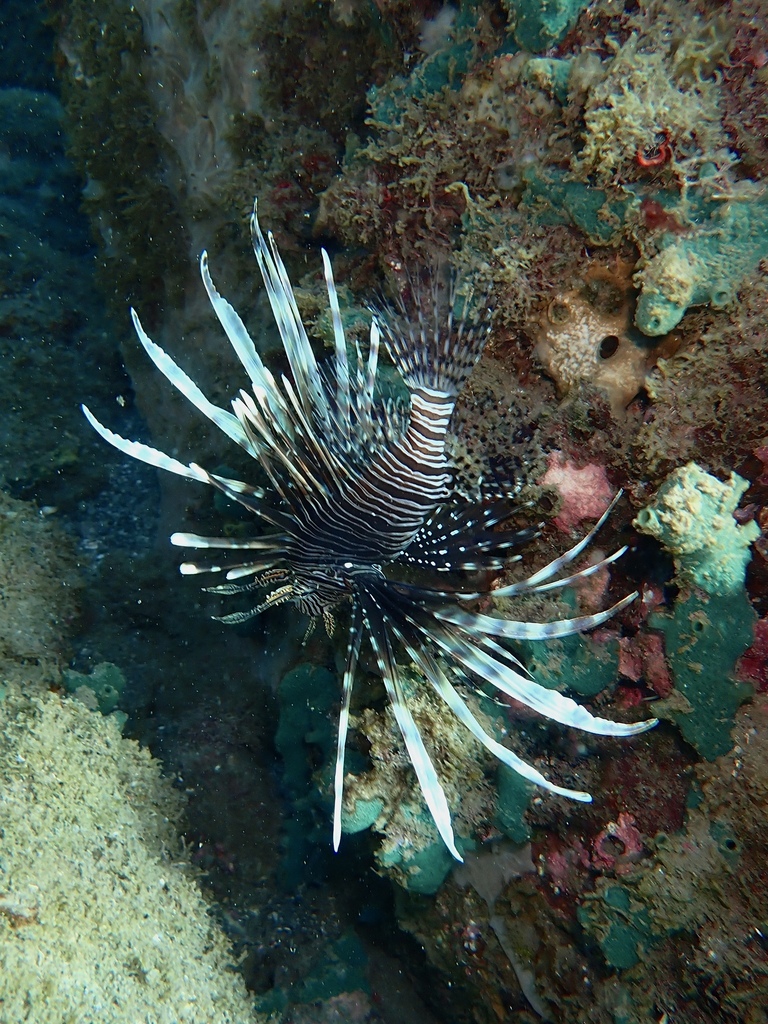
Red lionfish is a Indo-Pacific scorpionfish introduced to the western Atlantic, now common on Gulf and Caribbean reefs from 2 to 55 m at 22 to 28 C. It reaches 45.7 cm and 1.4 kg, hunts small fish and crustaceans at night, and carries venom in its dorsal, anal and pelvic spines.
Identification
Red lionfish is unmistakable in the western Atlantic. The body carries bold red-brown and white vertical bars, the pectoral fins open into a wide fan, and the dorsal, anal and pelvic spines are slender and venomous. Bony ridges cover the head, with small flaps above the eyes.
FishBase records a maximum of 45.7 cm total length, 1.4 kg and a maximum age of 10 years, with no common length given. The similar Pterois miles replaces it from the Red Sea to Sumatra; in the Gulf and Caribbean the invasive population is managed as red lionfish, and the two are often treated together.
Distribution and Habitat
The native range is the Indo-Pacific, from Cocos-Keeling and Western Australia east to the Marquesas and north to southern Japan and Korea. It has been introduced to the western Atlantic and is now recorded from the US Atlantic coast, Bermuda, the Bahamas, the Gulf of Mexico, the Caribbean and Brazil.
FishBase gives a depth range of 2 to 55 m and a preferred temperature of 22 to 28 C. Fish occupy lagoon and seaward reefs, from turbid inshore water to about 50 m, and they readily use ledges, wrecks, pilings, mangrove roots and artificial structure.
Habits and Diet
By day lionfish hide in unexposed places, often head down and motionless. At night they hunt small fishes, shrimps and crabs, spreading the pectoral fins to corner prey before a quick strike and swallow.
In the invaded range the species reaches high densities, has no significant local predator, and feeds heavily on native reef-fish juveniles and small crustaceans. That mix of predation and competition for forage is the core ecological concern in the Gulf and Caribbean, where removal is encouraged.
Fishing Methods
Spearfishing is the standard method: a short pole spear or three-prong in a reef crevice, wreck or under a ledge, approached slowly. Lionfish rarely flee a diver, so the first careful approach is usually enough.
On hook and line, use a small hook with live shrimp or a small live fish, a light sinker and a bait placed right at the mouth of a crevice. Let the fish swallow before setting the hook. A small jerkbait twitched along structure also draws strikes.
Gear and Approach
Carry puncture-resistant gloves, long tongs or forceps, heavy shears and a hard-sided cooler. Soft mesh bags and stringers are a bad idea; the spines pass straight through them.
Cut all dorsal, anal and pelvic spines at the base before the fish goes anywhere near a hand or a bag. Then bleed, gut and ice it. The venom is in the spines, not the flesh, so a properly trimmed fish is safe to handle and cook.
Seasonal Window
There is no closed season and no bag limit, so the window is set by water temperature and access. Fish are most active and easiest to find when the water sits in the 22 to 28 C range.
In winter, cold snaps push fish deeper or offshore and shallow structure empties. Dawn, dusk and the first hours of dark are the most productive times, and calm clear water after a settled night is better than a stirred-up day.
Edibility and Handling
The flesh is white, firm and mild, and FishBase calls it a popular table fish. It holds up to frying, grilling, steaming and ceviche, and the yield is better than most people expect.
Handle the spines as the hazard they are. A sting causes severe pain; first aid is immersion in hot water plus medical assessment, and FishBase notes heat and corticoids. Trim the spines first, then bleed and ice the fish, and keep trimmed fish separate from bare hands and soft bags.
Regulations and Conservation
Federal waters set no bag limit, no size limit and no seasonal closure for lionfish, and the species is not on the federal reef-fish table. Florida, Louisiana and the other Gulf states encourage removal and prohibit releasing a live fish.
The global IUCN assessment is Least Concern, dated 3 March 2015, which reflects the healthy Indo-Pacific population rather than the Atlantic invasion. In the invaded range the management goal is reduction, so the rules are written to make keeping fish easy and release illegal. There is no sign of overfishing in the native range; in the Atlantic the pressure runs the other way, with removal encouraged.
How to catch it
Spearfishing
Hand net
Hook and line
Where these facts come from
Check these pages before you rely on a size, range or protection status.
- FishBase — Pterois volitans — FishBase · T2
- GBIF — Pterois volitans occurrence records — GBIF · T2
- IUCN Red List — Pterois volitans — IUCN · T1
- Photo record — iNaturalist — iNaturalist · T3
Fish in the same water
These fish live in the same place.


Guides for this water
Technique, gear and safety guides that fit Red lionfish.