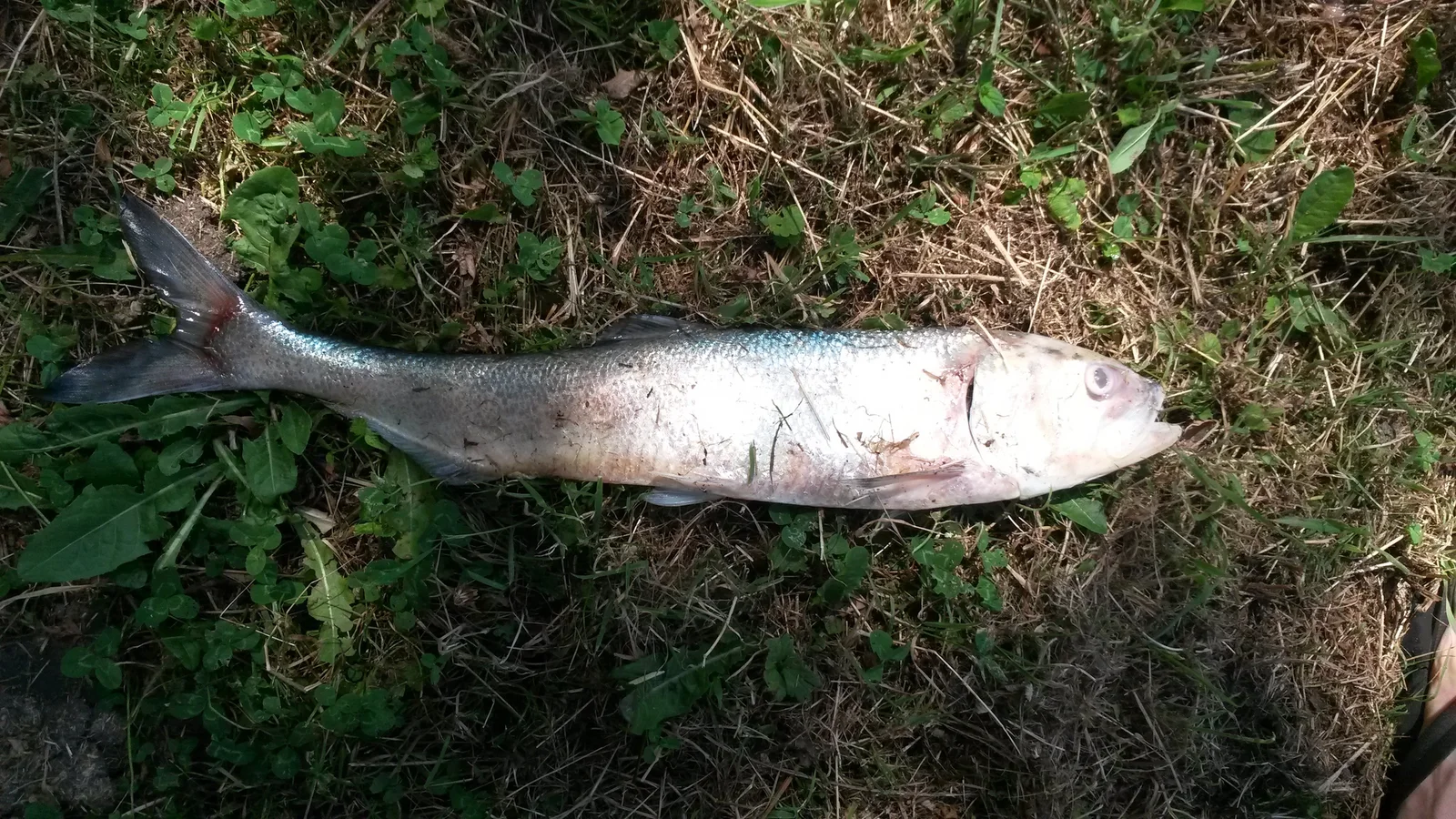
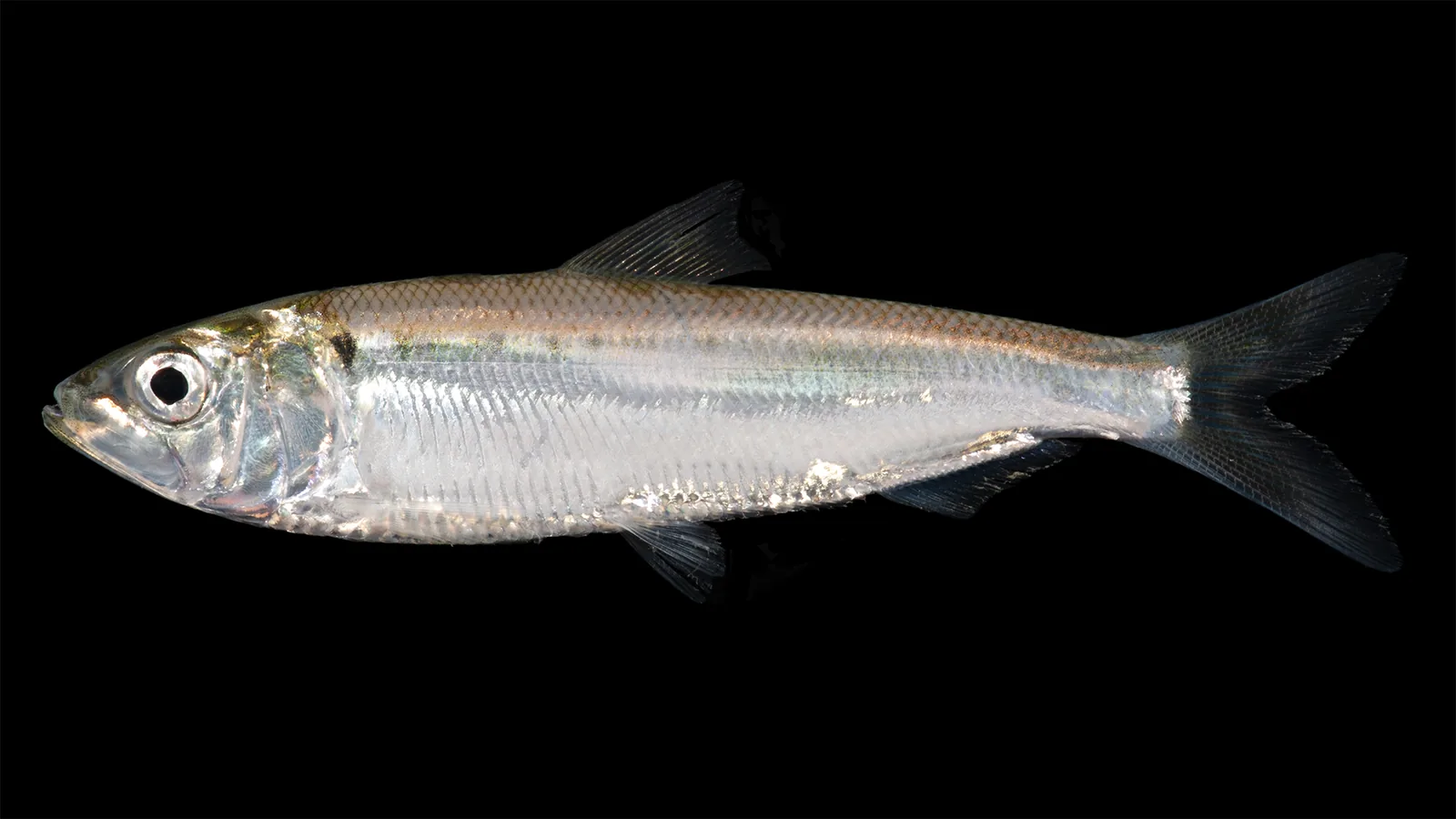
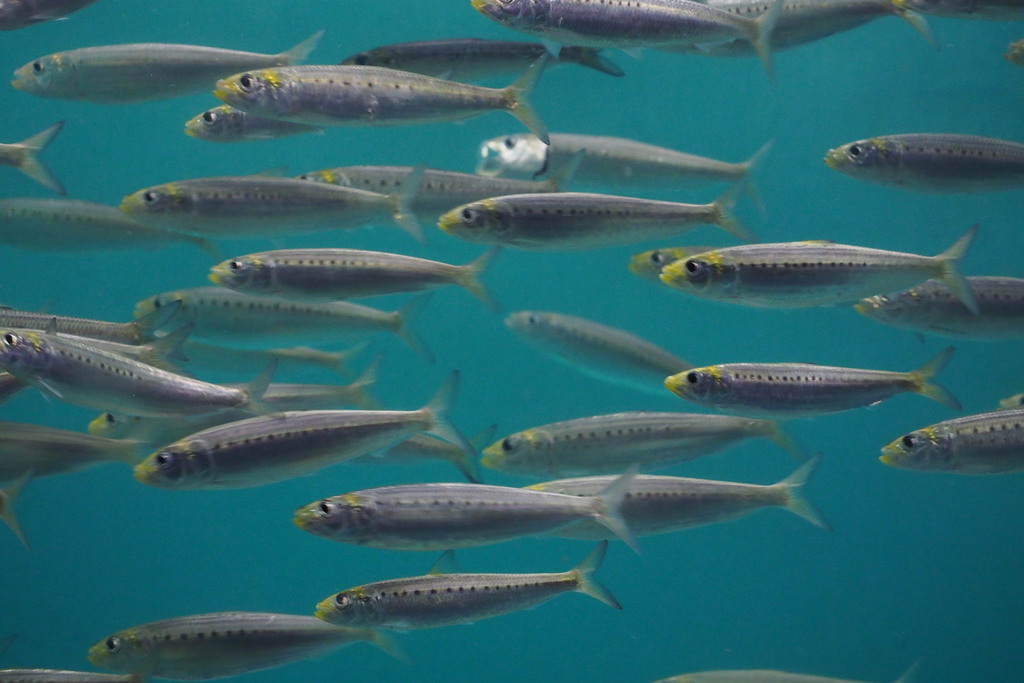
European pilchard (Sardina pilchardus) is a fish of the family Alosidae. FishBase gives its range as: Northeast Atlantic: Iceland (rare) and North Sea, southward to Bay de Gorée, Senegal. Mediterranean (common in the western part and in Adriatic Sea, rare in the eastern part), Sea of Marmara and Black Sea. It is recorded from 10 to 100 m, in subtropical water. The recorded maxima are 27.5 cm SL, 15 years. Diet includes crustaceans and zooplankton. IUCN status: Least Concern (LC). Chinese name: .
The label says sardine; the catalogue says Sardina pilchardus
A can, a market stall and a restaurant menu all use one word, and the word is not a species. FishBase lists this animal as European pilchard, Pilchard, Sardine and True sardine; iNaturalist files it under European Sardine; the Portuguese stock page is headed Sardinha. Four names, one fish, and none of the four is precise enough to separate it from the other small clupeids sold under the same word.
The binomial is the only unambiguous string, and here it is unusually clean. Sardina is a monotypic genus: this species is the genus. So the two-word name does not have to be narrowed by geography or by subspecies. A rulebook, a landing statistic or a canning standard written around "sardine" may cover three or four genera; written around Sardina pilchardus it covers one animal.
One genus, two spellings, two families
The Chinese name shows the same problem in miniature. FishBase records both and , which differ only in the character form, so a search typed in one form can miss a page indexed in the other.
The higher classification is less stable than the species name. FishBase places the species in Alosidae, the family that now holds many of the sardines and shads once grouped with the herrings. A user searching an older key under Clupeidae is looking for the same fish under a family that has since been divided. That is not a dispute about the animal; it is a reminder that the family line in a reference is a filing decision with a date on it, while the species epithet is not.
Twenty-seven centimetres is the record, twenty the plate
FishBase gives a maximum of 27.5 cm standard length, 20 cm as the common length, first maturity at 14.8 cm, and a top recorded age of 15 years. The three numbers answer three different questions. A 20 cm fish is what the word "sardine" usually means on a plate; 27.5 cm is what the species can reach; 14.8 cm is the line below which a fish has not spawned.
That last figure is the one with a use at the quay. A landings box of very small sardines is a box of juveniles, and no amount of cooking changes that. It is also the figure that varies least between sources, because maturity in a short-lived clupeid is reached quickly and measured often.
Ten to a hundred metres, salt or brackish
FishBase records the species from 10 to 100 m, usually 25 to 100 m, as a pelagic-neritic fish that tolerates brackish water and migrates within the sea. The brackish tolerance is not a detail: it is why the species appears in estuaries, lagoons and the Black Sea, and why a mark inside a river mouth can hold fish that a strictly marine species would never reach.
The range runs from Iceland, where FishBase calls it rare, and the North Sea south to the Bay de Gorée in Senegal; at the eastern end it reaches the Black Sea, entering that basin by way of the Sea of Marmara, with the Mediterranean lying between it and the Atlantic coast. Within the Mediterranean the page distinguishes a common western and Adriatic population from a rare eastern one. That is a range statement with an internal gradient, not a uniform block of coastline, and a plan built on the western fishery does not transfer intact to the Levant.
Spawning is not a season here
FishBase's spawning table for this species is a set of local windows rather than one season. Portugal appears four times: Aveiro in January and October–December, Lisboa in January, November and December, Matosinhos from January to April and again in October–December. Spain is recorded in March–April off Galicia and the east Cantabrian coast. The English Channel has a single April record. The Black Sea and the North Sea both sit in June–August. Morocco, off northwest Africa, runs from January to June and again in October–December.
Put the records together and the species spawns somewhere in the Atlantic and Mediterranean in every month of the year. The practical reading is that a closed season declared for one coast is a statement about that coast. A Portugal winter closure does not describe the Black Sea summer window, and a summer closure in the north does not protect the Moroccan winter spawn.
A stock with published trigger points
The Portuguese sea and atmosphere institute publishes the Iberian stock position and the plan that governs it. Biomass has been above the MSY trigger since 2020; recruitment in 2024 was above the geometric mean of the historical series; fishing mortality in 2023 was above FMSY; and the latest assessment shows biomass falling 16% from 2023 to 2024.
The management plan for 2021–2026 replaced older reference points with ones built on the low-productivity period of 2006–2019 and a hockey-stick stock-recruitment relationship. Its harvest rule sets F at zero when spawning biomass is at or below 112,943 t, rises linearly to 0.064 up to 252,523 t, rises again to 0.12 up to 446,331 t, and stays at 0.12 above that. For 2025, ICES advises that total Portuguese and Spanish catch should not exceed 40,073 t, while the institute notes that the agreed rule was judged precautionary for catches up to 50,000 t. Both numbers are in the same document, and the advice is the lower one.
One assumption sits under all of it: every capture is treated as landed. A fishery with discards or unrecorded bait landings sits outside that accounting, and the trigger points are only as good as the landings file.
Twenty-five rows, and an empty African column
The GBIF distributions endpoint returns 25 rows for this species. Fifteen name a country — Belgium three times, France twice, Sweden twice, and Denmark, Spain, Britain, Greece, Ireland, Israel, Norway and Portugal once each. Ten name only a sea, an ocean or a global region. One Swedish row is marked irregular rather than present.
The rows that are missing matter as much as the rows that are there. FishBase lists Morocco, Mauritania, Senegal, Western Sahara and Cabo Verde; the GBIF distribution rows contain no African country at all. That is a statement about a table, not about the fish, and it is exactly the kind of gap that gets read as a range limit if nobody checks the second file.
iNaturalist holds 367 observations. The count is concentrated where people carry cameras and post catches, which in this range means the northern European coast, not the Moroccan canning ports.
Least Concern in 2013, F above FMSY in 2023
FishBase carries a global IUCN category of Least Concern, assessed on 20 May 2013. The institute's current position is that fishing mortality in 2023 was above FMSY and that spawning biomass fell 16% in a single year. A global category from 2013 and a stock-level mortality figure from 2023 are not competing verdicts; they describe different objects at different dates, and the second one is the one tied to the catch limit in front of you.
For anyone fishing this species, the useful order is: read the current advice, then the local seasonal rule, then the global category. The global label says the species is in no danger of disappearing; it does not say that the stock you are fishing is being harvested at the right rate. The published trigger points do.
Regulations before you keep it
These are the published regulations for this fish. Read the number first. The notice below it is the actual regulation.
Minimum size4
The minimum size for European pilchard in Spain is ≥11 cm.
| Sardina (Sardina pilchardus) | 11 |
The minimum size for European pilchard in France is ≥11 cm.
| SARDINE | Sardina pilchardus | 11 cm |
The minimum size for European pilchard in Portugal is ≥11 cm.
Sardinha (Sardina pilchardus) | 11 cm
≥11 cm
United Kingdom · UK
The minimum size for European pilchard in UK waters is ≥11 cm.
| Sardine | Sardina pilchardus | 11 cm |
Every record above names its source and the date it was retrieved. See the regulation register for the full list, or how to read these regulations.
Where these facts come from
Check these pages before you rely on a size, range or protection status.
-
FishBase — Sardina pilchardus
— FishBase · T2
-
GBIF — Sardina pilchardus occurrence records
— GBIF · T2
-
IUCN Red List — Sardina pilchardus
— IUCN · T1
-
Photo record — iNaturalist
— iNaturalist · T3