
Pacific sardine
Pacific sardine is a small surface herring of the Indo-Pacific, from southern Africa across to the eastern Pacific. It lives in the top 200 m of water between 9 and 21 degrees C and feeds on crustaceans, small fish and zooplankton. Adults reach 39.5 cm SL and 0.486 kg, and the species can live 25 years. It is present year-round, and because the school itself is the target there is no bottom or structure to read.
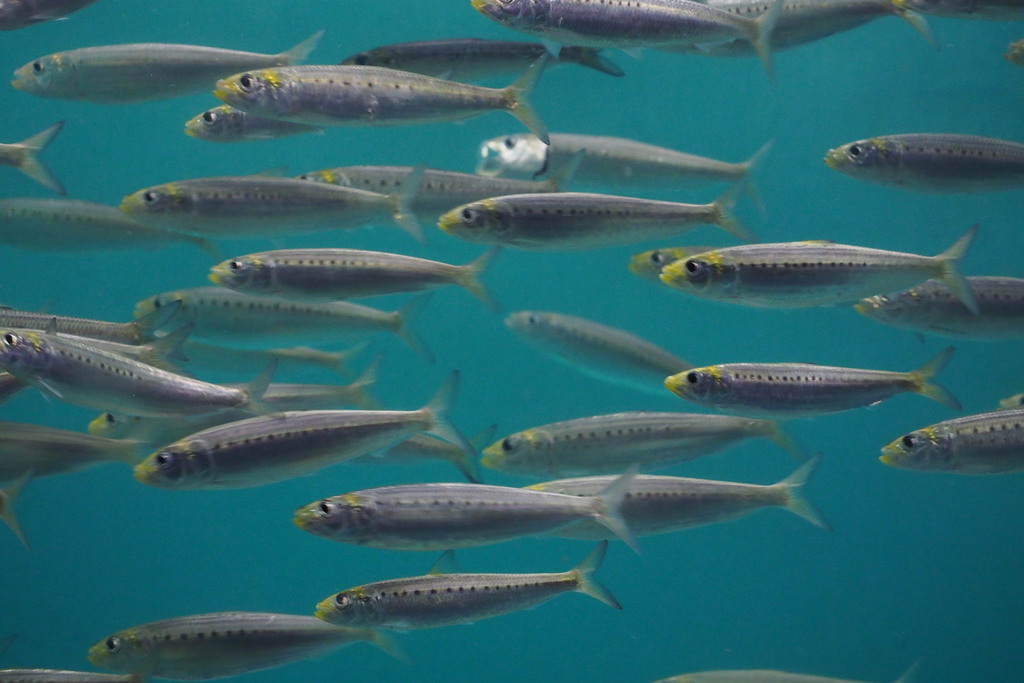
Pacific sardine (Sardinops sagax) is a fish of the family Alosidae. FishBase gives its range as: Indo-Pacific: southern Africa to eastern Pacific. Three lineages were confirmed through cluster and parsimony analyses of haplotypic divergences: southern Africa ( ocellatus ) and Australia ( neopilchardus ); Chile ( sagax ); California ( caeruleus ); and, Japan ( melanostictus ). It is recorded from 0 to 200 m, in subtropical water at 9–21 °C. The recorded maxima are 39.5 cm SL, 0.486 kg, 25 years. Diet includes crustaceans, fishes and zooplankton. IUCN status: Least Concern (LC). Chinese name: .
Two documents, two counts
Open FishBase and this is one species with five regional lineages. Open NOAA's account of its 2024 genetic survey and the same water holds two species that only genetics can separate. Neither document is careless; they answer at different resolutions, and the gap between them is where to start.
The naming follows the same fault line. FishBase files the whole species under the English name Japanese sardine, while NOAA's West Coast page calls its stock Pacific sardine and writes the name as Sardinops sagax caerulea. FishBase's Chinese aliases are equally regional, running from to to . A landings figure filed under one of those labels may describe the same animal as a figure filed under another, and a rule written for one label may never mention the rest.
The five lineages are written into the distribution
FishBase states the case in its own distribution text: cluster and parsimony analyses of haplotype divergence confirmed five lineages — ocellatus in southern Africa, neopilchardus in Australia, sagax in Chile, caeruleus in California and melanostictus in Japan. The account also keeps Sardinops melanostictus among its previous scientific names, which is what a catalogue does when one lineage has been ranked as a separate species by some authors.
So the disagreement is older than the 2024 survey. It is a question of rank: one species with five regional forms, or several species that look alike. FishBase's answer is the first. The 2024 genetics is an argument for the second, at least between the Japanese and Pacific forms.
The 2024 survey found two species in one haul
NOAA reported in October 2024 that genomic sequencing of 345 sardines from its 2021 and 2022 coastal pelagic surveys found every 2021 fish to be a Pacific sardine, while the 2022 sample was a mix of Pacific and Japanese sardines. Another 825 fish collected the following year gave the same result. The Japanese fish were 1 to 3 years old, appeared from Washington to southern California, and sometimes schooled with Pacific sardines. Archived samples from 2013–2021 contained none.
Three consequences matter for anyone reading a species file. The two forms are similar enough that only genetic analysis separated them in the survey, so a dockside identification by eye is a guess. The appearance is recent and the authors suggest marine heatwaves opened a corridor across the North Pacific. And it is not yet known whether the two interbreed, which decides whether "one species" or "two" is the better description in the long run.
Nine centimetres to maturity, thirty-nine to the record
FishBase gives first maturity at 9.0 cm, a maximum of 39.5 cm SL, a common size of 20 cm, a maximum weight of 486 g and an oldest recorded fish of 25 years. NOAA's page gives more than 12 inches, a lifespan of up to 13 years that usually does not pass 5, and reproduction at age 1 or 2.
The 25-year figure and "usually not past 5" do not conflict. One is the oldest fish in a compilation, the other is what a fished population normally contains. The number that changes a decision is 9 cm: a shorter fish has not yet bred, and because this species matures in its first or second year, that line is crossed early and a box of small fish is a box of fish that have already bred at least once.
Zero to two hundred metres, nine to twenty-one degrees
FishBase records the species from the surface to 200 m, in 9–21 °C water, across 61°N to 47°S and 145°W to 180°E. That span runs from the Gulf of Alaska to southern Chile and across to Japan, which is another way of saying the entry covers several stocks and cannot describe one.
NOAA's West Coast description is more concrete: dense schools near the surface, nearshore and offshore, sometimes in estuaries, moving seasonally along the coast, with older adults shifting between spawning grounds off southern California and northern Baja and feeding grounds off the Pacific Northwest and Canada. For a boat there is no bottom and no structure to read; the school itself is the target, found by sonar or by birds.
Every lineage spawns on its own calendar
FishBase's spawning records read like several different fish. Central Honshu runs March–May. California runs January–June from Point Conception to San Diego, with a separate April–June record at San Pedro. Peru runs January–March and September–December. Chile runs February–March and July–September. South Australia runs January–May and December. Southern Africa runs January–February and September–December.
Put those side by side and there is no spawning season for the species, only seasons for lineages. A closure timed to the Japanese window is meaningless off Peru, and a Peruvian closure says nothing about the Australian stock. NOAA adds the mechanics for the northern population: repeated spawning within a season, external fertilisation, and eggs hatching in about three days. A three-day egg stage in surface water is short enough that a survey arriving a week late can miss the event altogether.
Nineteen rows, twelve without a country
The GBIF distributions endpoint returns 19 rows. Seven carry a country code: Canada twice, and Chile, Mauritius, Mexico, Mozambique and New Zealand once each. Twelve carry none, although two of those name South Africa and Madagascar in the locality text. FishBase's country table, by contrast, includes Japan, both Koreas, China, Peru and Ecuador.
Not one of those five appears as a country row in the GBIF file. That is a statement about two databases, not about the fish: one table is a literature range with 24 entries, the other is a sparse set of submissions. iNaturalist holds 663 observations, concentrated where photographers live, which in this range is the west coast of North America and Australia rather than the Japanese or Peruvian fishing grounds.
Closed since 2015 under one label
NOAA's page states the position plainly: Pacific sardine is overfished under the 2025 assessment, the directed commercial fishery has been closed since 2015, and the precautionary threshold that triggers a closure is 150,000 metric tons, a level the latest estimate is below. In 2014, the last full fishing year, landings exceeded 23,000 metric tons and were worth $8.85 million, taken with round haul nets; the rebuilding plan has a target date of 2035.
FishBase's global category for the species is Least Concern, assessed in 2018. The two statements are compatible: a species spread from southern Africa to Chile is not globally threatened, while one stock on one coast is depleted and closed. The 2024 genetics adds the third layer. Some of the fish in the water covered by that closure may belong to a differently named form, and the label on the file is the least reliable part of the story.
Where these facts come from
Check these pages before you rely on a size, range or protection status.
- FishBase — Sardinops sagax — FishBase · T2
- GBIF — Sardinops sagax occurrence records — GBIF · T2
- IUCN Red List — Sardinops sagax — IUCN · T1
- Photo record — iNaturalist — iNaturalist · T3
Fish in the same water
These fish live in the same place.
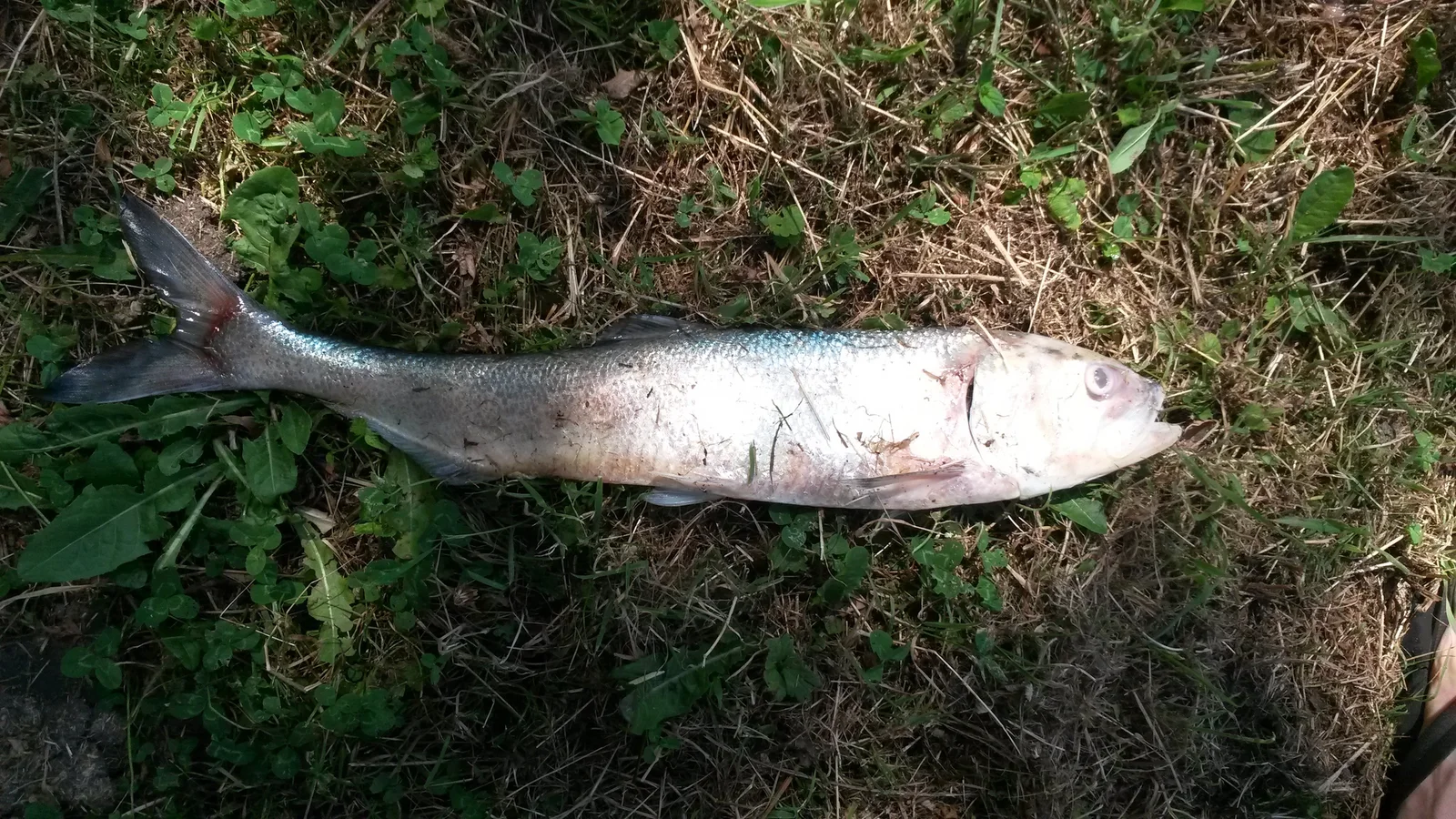
Allis shad
- Family
- Alosidae
- Depth
- 10–400 m
- Season
- Apr, May, Jun, Jul
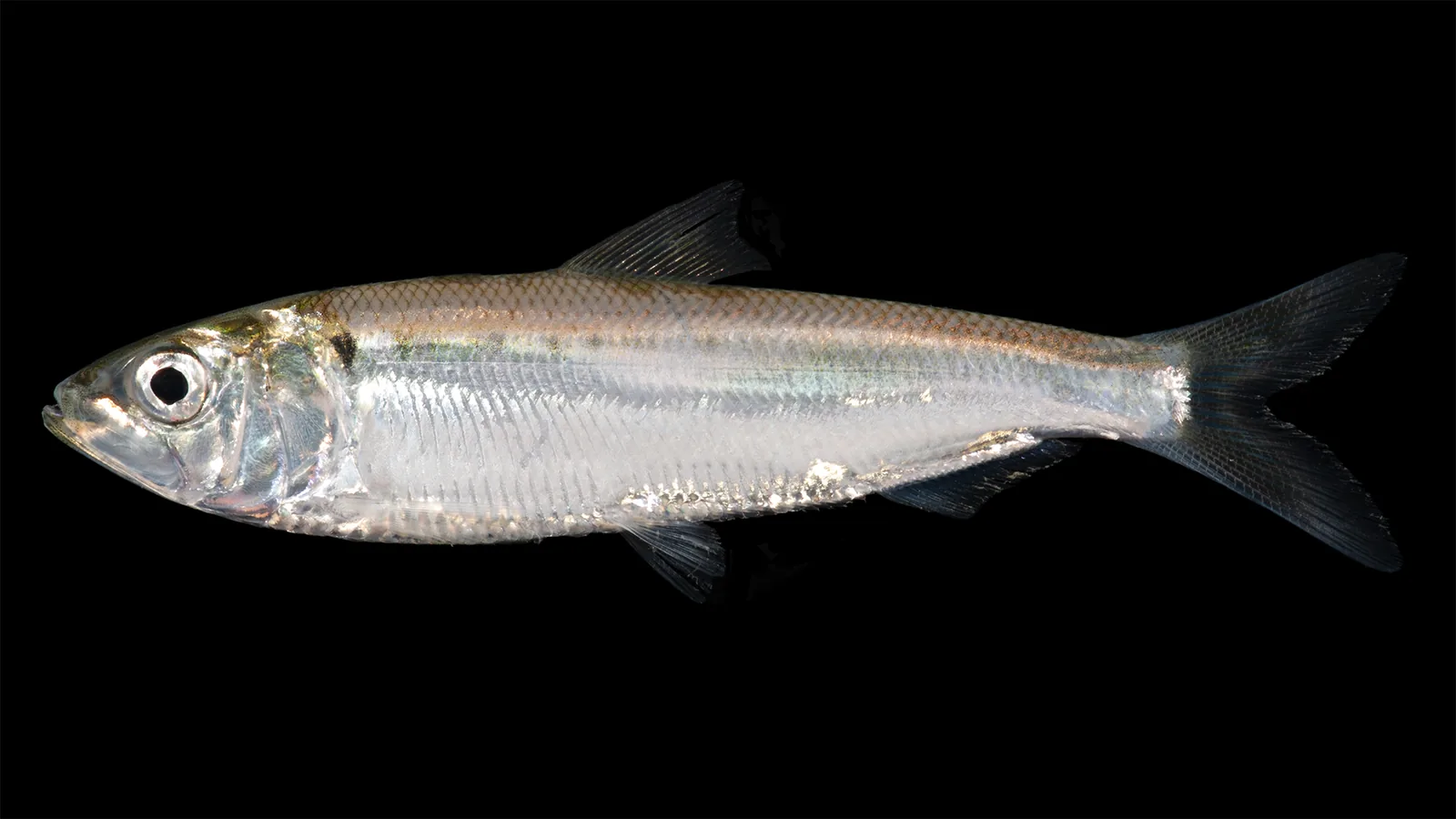
American shad
- Family
- Alosidae
- Depth
- 0–250 m
- Season
- Nov–Jun (spawning run)

European pilchard
- Family
- Alosidae
- Depth
- 10–100 m
- Season
- Jan, Feb, Mar, Apr, May, Jun, Jul, Aug, Sep, Oct, Nov, Dec
Guides for this water
Technique, gear and safety guides that fit Pacific sardine.