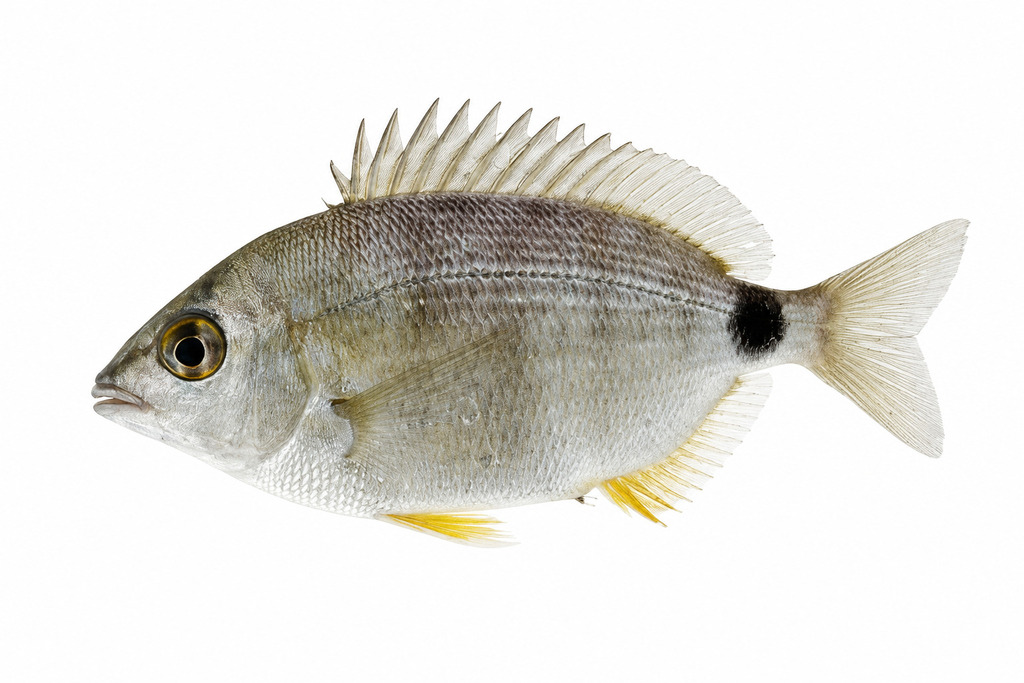
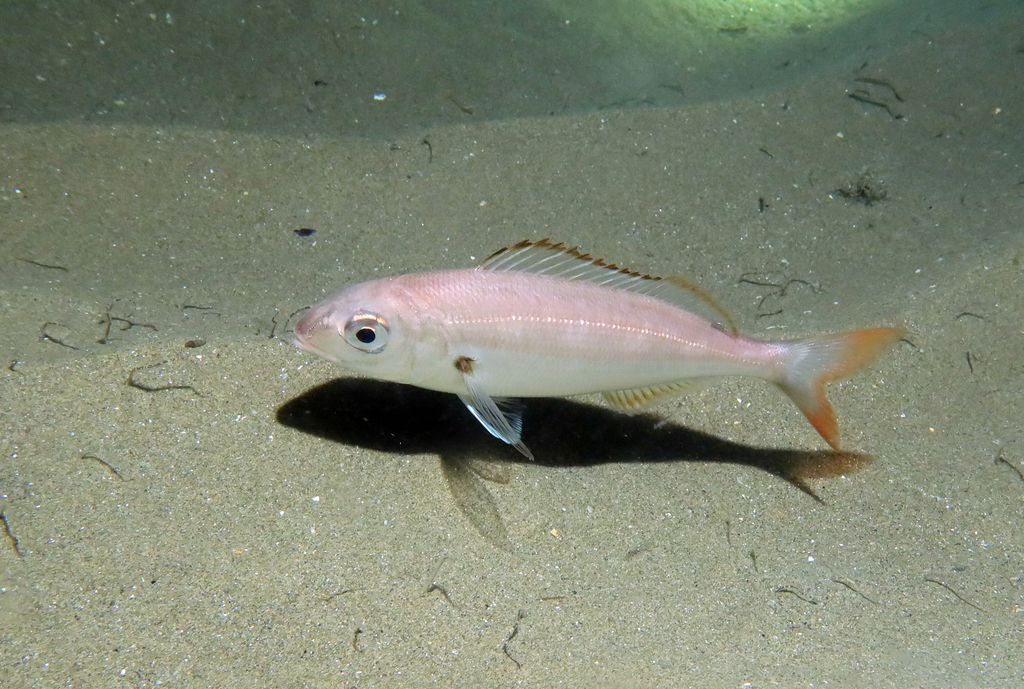
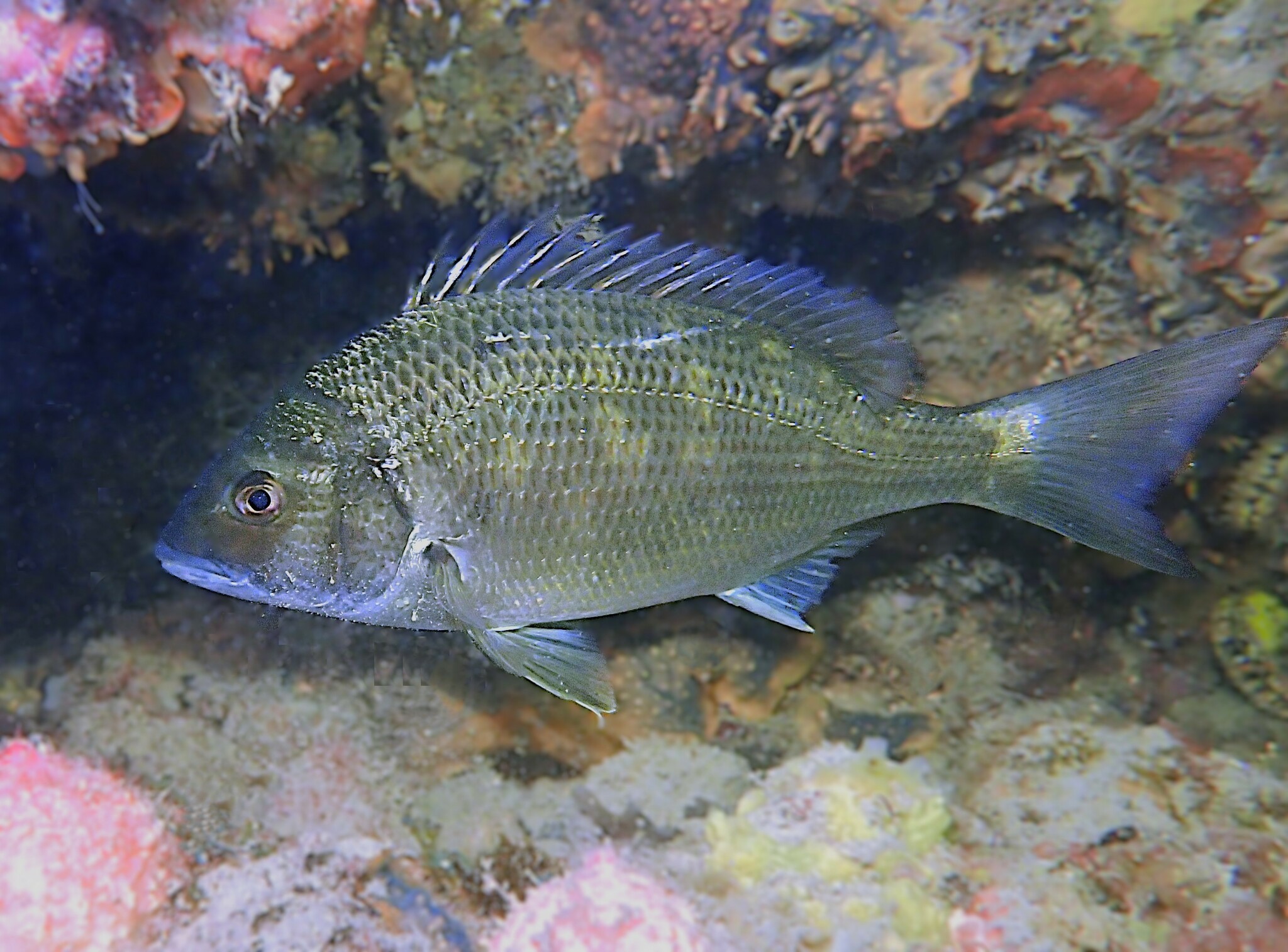
Salema (Sarpa salpa) is a fish of the family Sparidae. FishBase gives its range as: Eastern Atlantic: Bay of Biscay and Strait of Gibraltar to Sierra Leone, including Madeira, the Canary Islands, and Cape Verde; Congo to South Africa. Also present in the Mediterranean. It is recorded from 5 to 70 m, in subtropical water. The recorded maximum is 51 cm SL. Diet includes crustaceans and algae. IUCN status: Least Concern (LC). Chinese name: .
The measurement behind the number
A standard-length measurement begins at the snout tip and ends where the last caudal-fin rays base. Total length adds the tail. A salema's tail is deeply forked and, on a live fish, folds and spreads; laid flat next to a ruler it can add several centimetres. FishBase's maximum of 51 cm and common size of 30 cm are both recorded as SL, so they should never be compared with a TL figure from a different page or a club record. The 5–70 m depth band and the subtropical range from 45°N to 40°S are given separately and carry no length information.
Fifty-one centimetres, standard length
A 51 cm SL salema is a large adult; the figure is a maximum for the species, not a working target. The catalogue's common length of 30 cm SL describes the fish a coastal angler actually meets in a school. Put the two side by side and the gap is 21 cm of standard length, which is more than half the common fish again. Nothing in the source explains the gap with age or growth data; the species record carries neither a maximum weight nor a maximum age. The honest reading is that the maximum is an outlier and the common figure is the population most gear will encounter.
What the thirty-centimetre fish looks like
The body is relatively slender and carries ten golden longitudinal stripes; a black spot sits at the base of the pectoral fin. Dorsal spines number 11–12 and soft rays 14–17, anal spines three and soft rays 13–15. The common-name table carries 118 entries and includes Gold line, Goldline, Salpa, Saupe and Strepie, several of which name the stripe rather than the fish. At 30 cm SL the stripes are usually clear and the black shoulder mark is obvious. On a fish near the maximum the stripes can fade into a general gold wash, which is one reason large individuals are sometimes logged under a different name by people working from memory rather than from a key.
A tape measure in the wrong place: sex change at 25 cm
The reproductive record contains a number in a different currency. Sex change is reported at 25.0 cm TL and 3.75 years of age. That is total length, while the size fields are standard length. A fish at the 25 cm TL threshold is therefore shorter than 25 cm SL, and the same animal sits well below the 30 cm common SL figure. The same source also records conflicting accounts of the reproductive style, including possible gonochorism, alongside the protandric description. The conflict is left as it stands: the threshold is a TL figure inside an SL datasheet, and the reproductive label itself is not settled.
Reading the fish before you measure it
Two marks do most of the identification work before any tape appears: the black pectoral-fin base and the longitudinal gold lines. The stripes run the length of the flank rather than forming vertical bars, which separates the fish from the barred sparids sharing the same weed. The pectoral spot is present at both ends of the size range, so a small fish with faint stripes still keys out cleanly. This matters because the size question is hard to settle on a moving fish, while the spot and the stripe direction are visible in a landing net.
Where the school sits on the rock
The species is described from rocky substrates and sandy areas with algal growth, and it is gregarious, sometimes forming sizeable schools. Its territory list counts 41 territories, while GBIF's 22,165 occurrence records are weighted towards France (6,730) and Spain (5,339), with Greece third at 2,166; that concentration describes where observers dive and fish, not the whole 41-territory range. Young fish take crustaceans; adults are almost exclusively herbivorous and feed on seaweeds. That diet shift is the practical link between habitat and bait: the adult fish is grazing, not hunting, so it is found where algae actually grow rather than on clean sand. The 5–70 m range is wide, but the feeding description points to the upper, lit part of it where weed can hold.
Read as declarations rather than counts, the GBIF distribution endpoint is harder to summarise: it carries the Black Sea as PRESENT from WoRMS, and at the same time records INTRODUCED status for Bulgaria, Georgia, the Russian Federation and Ukraine through the GRIIS register, with the overlapping Ukraine/Russia part of the Black Sea also marked INTRODUCED by WRiMS. WoRMS files the accepted name as AphiaID 127064, credited to Linnaeus, 1758, and its marine-plus-brackish flags match a fish that grazes seagrass in coastal water.
Gear sized to the SL–TL gap
Because the common fish is 30 cm SL, tackle can be light without being fragile. A long, soft rod and a small reel loaded with thin braid are enough for the usual school fish; the same outfit is under-gunned for a genuine 50 cm SL adult, which is a different animal on the line. The herbivorous adult diet suggests weed-fly patterns, small soft plastics and bait presented close to the rock, while the crustacean-eating young fish take small crustacean imitations. Hooks should be small enough for a mouth built for scraping, not for swallowing a whole fish.
The number that decides keep or release
The species is assessed Least Concern, with the assessment dated 17 August 2009, and it appears under both commercial catch and gamefish. Commercial landings and angling pressure can therefore coexist with a non-threatened rating without contradiction. For the angler, the useful threshold is not the 51 cm maximum but the 30 cm common SL: a fish at or above the common figure is an adult, while a fish near the 16.5 cm maturity length is not. iNaturalist holds 11,532 observations of the species, which is a measure of how often it is seen rather than how large it grows. The tape, held to the snout-to-tail-base convention, is what makes that judgement repeatable.
Regulations before you keep it
These are the published regulations for this fish. Read the number first. The notice below it is the actual regulation.
Minimum size3
The minimum size for Salema in Spain is ≥15 cm.
| Salema (Sarpa salpa) | 15 |
≥24 cm
Spain — Canary Islands · ES-CN
The minimum size for Salema in the Canary Islands is ≥24 cm.
| Salema (Sarpa salpa) | Salema, salpa | 24 |
The minimum size for Salema in Portugal is ≥18 cm.
Salema (Sarpa salpa) | 18 cm
Every record above names its source and the date it was retrieved. See the regulation register for the full list, or how to read these regulations.
Where these facts come from
Check these pages before you rely on a size, range or protection status.
-
FishBase — Sarpa salpa
— FishBase · T2
-
GBIF — Sarpa salpa occurrence records
— GBIF · T2
-
IUCN Red List — Sarpa salpa
— IUCN · T1
-
Photo record — iNaturalist
— iNaturalist · T3