
Spotted scat
Spotted scat is an Indo-Pacific euryhaline fish, from Kuwait to Fiji, north to southern Japan and south to New Caledonia. It lives at 0 to 5 m in 20 to 28 degrees C in harbours, embayments, estuaries, mangroves and the lower reaches of freshwater streams, and it is amphidromous. It reaches 45 cm TL with a common length of 20 cm and maturity at about 14 cm. Bottom fishing and lures are the methods listed.
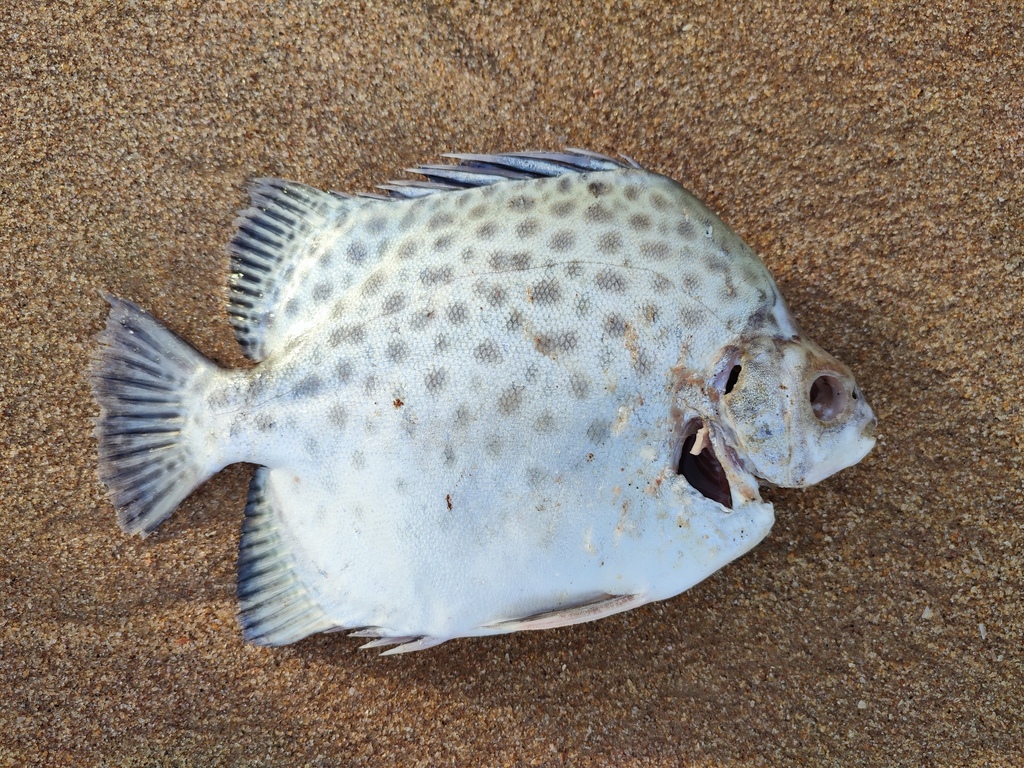
Spotted scat is an Indo-Pacific euryhaline fish, from Kuwait to Fiji, north to southern Japan and south to New Caledonia, with records from Samoa, Tonga and the Society Islands. It lives at 0–5 m in 20–28°C harbours, embayments, estuaries, mangroves and the lower reaches of freshwater streams; it enters freshwater and is amphidromous. FishBase gives a maximum of 45 cm total length, a common length of 20 cm and maturity at about 14 cm. IUCN lists it as Least Concern, assessed in 2009.
Reading the spines
The dorsal fin has 10–11 spines and 16–18 soft rays; the anal fin has 4 spines and 13–15 soft rays. The body is quadrangular and strongly compressed; the dorsal head profile is steep; the eye is moderately large, its diameter somewhat smaller than the snout; the snout is rounded; the mouth is small, horizontal and not protractile; the jaws have several rows of villiform teeth. The ground colour is greenish. Juveniles have a few round blotches about the size of the eye, or 5–6 broad dark vertical bars; in large adults the spots may be faint and restricted to the upper flank. The square body, small mouth and juvenile blotches are the field marks; adults lose the spots, so do not rely on them. The dorsal, anal and pelvic spines are believed by Philippine fishers to be venomous and capable of inflicting wounds.
A mangrove and harbour fish
FishBase's range is the Indo-Pacific: Kuwait to Fiji, north to southern Japan and south to New Caledonia, with Samoa, Tonga and the Society Islands. The country table includes the Andaman and Nicobar Islands, Australia, Bahrain, Bangladesh, Cambodia, China, Fiji, French Polynesia, Hong Kong SAR, India, Indonesia, Iran, Iraq, Japan, Korea, Kuwait, Malaysia, Malta (introduced), Micronesia, Myanmar, New Caledonia, Oman, Pakistan, Palau, Papua New Guinea, the Philippines, Qatar, the Ryukyu Islands, Samoa, Saudi Arabia, Singapore, the Society Islands, Sri Lanka, Taiwan region, Thailand, Timor-Leste, Tonga, the UAE and Vietnam. GBIF's 3,729 records are led by Thailand (442), Australia (394), Japan (332), Indonesia (313), India (294), Taiwan region (272), mainland China (262), the Philippines (201), Bangladesh (192), Malaysia (145), Singapore (133) and Hong Kong SAR (109). Adults inhabit harbours, natural embayments, brackish estuaries and the lower reaches of freshwater streams, often among mangroves; they feed on worms, crustaceans, insects and plant matter.
The blanks are information
FishBase gives a spawning window of April–August in the coastal waters of southern China. It lives at 20–28°C and is catchable all year; in Taiwan region, Hong Kong SAR and southern China, late spring to autumn is the main window, with winter fish deeper or inside estuaries. No finer local season table is published, so follow local estuary temperature. Tide and slack water concentrate food along mangrove edges and the inner estuary; dawn and dusk also work. It often schools, so finding mangrove structure and harbour walls beats fishing an empty flat.
Where to start looking
The GBIF pattern is Thailand, Australia, Japan, Indonesia, India, Taiwan region and mainland China first. Fish the mangrove edge, the harbour wall and the shallow estuary, not the open beach. The source gives no coordinates; local knowledge of creeks and structure is the real map.
Tackle and baits
Shore casting and light rock fishing are the standards: small hooks, fine leaders, and prawn, sandworm, bread or plant matter. The mouth is small, so large hooks cost bites; because the fish eats plants and detritus, bread and algae-based bait often beat pure prawn around mangroves. Small soft plastics, micro-minnows and jigheads can be slow-rolled. Fish light lead and a slow sink along shallow structure. The dorsal and anal spines are venomous: unhook with long-nose pliers, never grab the fish.
Eating, handling and the rules
Spotted scat supports minor commercial fisheries, commercial aquaculture and the aquarium trade; it is sold in Hong Kong live-fish markets and fresh, and the flesh is fine, good steamed, braised or in soup. Bleed, gut and ice it promptly; cut the dorsal, anal and pelvic spines or wear thick gloves. Ciguatera is mainly a reef-predator issue, so this species is lower risk, but organs should not be eaten in quantity. Rules vary: Taiwan region manages inshore fishing through closed areas, seasons and gear restrictions, and recreational fishing must follow Fisheries Agency and local government notices; Hong Kong SAR's Fisheries Protection Ordinance regulates methods, with no angling or collecting in marine parks and reserves; Southeast Asian states differ widely, with Malaysia, Indonesia, the Philippines and Thailand issuing size and closed-season rules and usually prohibiting take in mangrove protected areas. Check the current local notice.
What the record leaves open
The page is built from FishBase taxonomy, morphology, distribution, environment, biology, reproduction, use, IUCN and venom entries, with the country table for range and GBIF/iNaturalist for occurrence. Water temperature, local size limits and spine treatment are not standardised, so the text stays conservative. and are local aliases; the formal name remains .
How to catch it
Bottom fishing
Fished with the listed approach, matched to the recorded depth and size.
Lure fishing
Fished with the listed approach, matched to the recorded depth and size.
Where these facts come from
Check these pages before you rely on a size, range or protection status.
- FishBase — Scatophagus argus — FishBase · T2
- GBIF — Scatophagus argus occurrence records — GBIF · T2
- IUCN Red List — Scatophagus argus — IUCN · T1
- Photo record — iNaturalist — iNaturalist · T3
Fish in the same water
These fish live in the same place.

Acoupa weakfish
- Family
- Sciaenidae
- Depth
- 1–20 m
- Season
- Jan, Feb, Mar, Apr, May, Jun, Jul, Aug, Sep, Oct, Nov, Dec

American angler
- Family
- Lophiidae
- Depth
- 0–800 m
- Season
- Mar, Apr, May, Jun

American eel
- Family
- Anguillidae
- Depth
- 0–464 m
- Season
- Jan, Feb, Mar, May, Jun, Jul
Guides for this water
Technique, gear and safety guides that fit Spotted scat.