
Small red scorpionfish
The small red scorpionfish is not hard to catch; it is hard to handle. It sits in shallow rock crevices in numbers, takes bait readily, and stays small enough that anglers relax around it, which is exactly when a dorsal spine finds a thumb. Read the pectoral fin and the snout before you touch the fish, and it becomes a predictable shallow-water target instead of an accident.
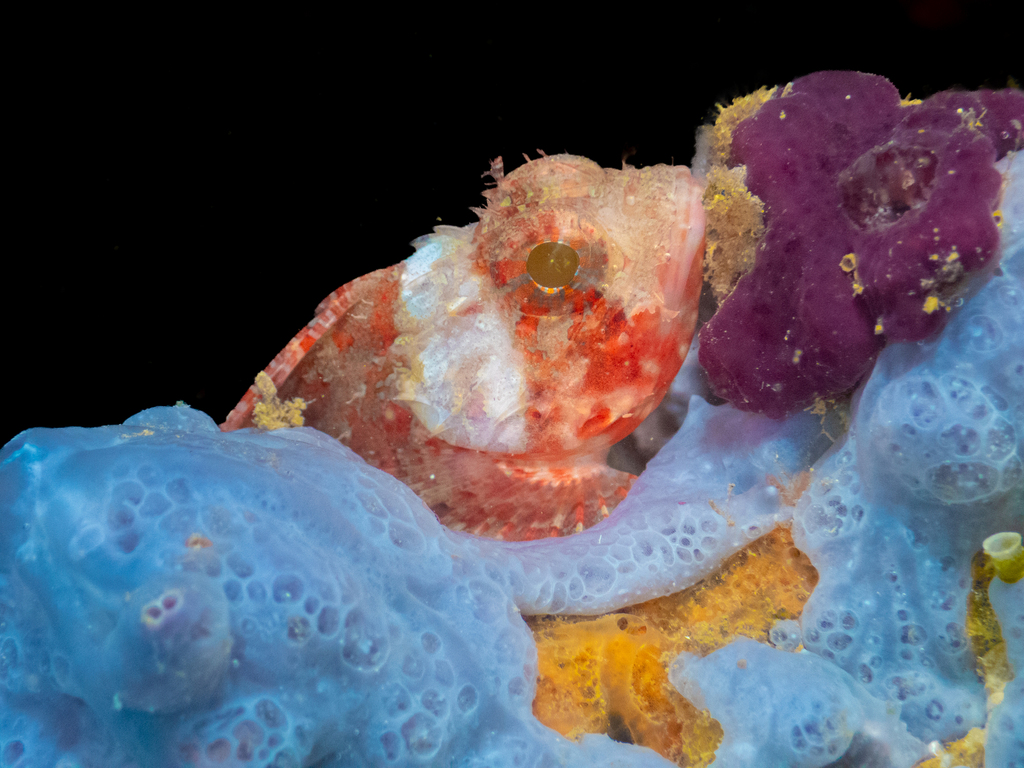
The small red scorpionfish is not hard to catch; it is hard to handle. It sits in shallow rock crevices in numbers, takes bait readily, and stays small enough that anglers relax around it, which is exactly when a dorsal spine finds a thumb. Read the pectoral fin and the snout before you touch the fish, and it becomes a predictable shallow-water target instead of an accident.
Small, spiny and easy to misjudge at the rail
Start with size and head proportions. Adults commonly run around 12 cm, with a recorded maximum of 26 cm; the head is large, the snout short, the mouth angled upward, and the head ridges well developed. The pectoral fins are broad and fan-like. Colour runs red-brown to orange-brown with irregular darker mottling, and the spiny dorsal section often carries a dark blotch, which is what the specific name notata refers to. Against S. porcus this fish is smaller and shorter-snouted, without the large dark patch on the inner pectoral. Against S. scrofa the gap is obvious: that species is far larger, and the 30 cm line in the Croatian table is written for S. scrofa, not for this fish. Pectoral markings only show in good light, so photograph the flank and check a reference rather than judging by feel.
A shallow crevice fish with a very deep range on paper
FishBase runs the range from the Bay of Biscay to Senegal, including Madeira, the Azores and the Canaries, plus the Mediterranean and Black Sea; it is uncommon in the northern Adriatic. The recorded depth band is 10 to 700 m, which does not mean the fish is spread evenly through it. Catches cluster on shallow rock, rubble and the edge of seagrass, while the deeper records come mostly from survey gear. This is a bottom ambush predator: by day it presses into crevices, cave mouths and the shadow of algae, waiting for crustaceans and small fish to come close. Shore anglers meet the shallow end of the population; boat anglers working the lower reef slope meet the same fish at a slightly larger size.
Warm months push fish up onto the shallow rock
FishBase gives a temperature record of 15 to 26°C but no month-by-month spawning table. The Mediterranean pattern is a spring and summer climb: as water warms, fish move up from deeper structure onto shallow rock, and shore catches peak from late spring into early autumn. When water cools in late autumn they drop back down the slope, the bite slows without stopping, and the fish are simply harder to reach. The recorded maximum age is eight years and growth is not fast, so shallow rock that is worked hard does not refill quickly. Spawning months and spawning temperature are not published here, so plan on the season's water colour and temperature rather than a fixed calendar date.
Slow baits fished against the rock, not through the water
Diet decides presentation. FishBase lists crustaceans and small fish, so the bait belongs on the bottom edge of structure, not suspended mid-water. From shore, a short rod places shrimp or squid strip at a crevice mouth, with a sinker light enough for the swell to nudge the bait into the gap. From a boat, crawl the bait slowly down the lower reef slope and stop at hard structure, letting the fish come out. The third option is after dark, when activity increases and light draws the small shrimp and fish that bring scorpionfish up. All three share one rule: slow. The strike range is short, and a bait that passes the fish at speed never gets looked at.
Rig for the rock, and rig for your own hands
A 2.1 to 2.4 m medium-heavy boat rod or a 2.7 m shore rod, a 3000-size spinning reel, 20 lb braid and a 20 to 25 lb fluorocarbon leader cover it. The leader is not about pulling power; it is about lifting a fish out of a crevice. Use a 1/0 to 2/0 wide-gap single hook with a stiff wire, because the jaw is bony and a soft hook straightens. Unhooking is the part that matters most: long-nose pliers or forceps, and hands kept away from the head. Keep a wet cloth and side cutters on board, and if the hook is deep, cut the leader and release the fish with the hook in place. No long release ritual is needed; let it go where it was caught.
Good flesh, venomous spines, no species size limit
FishBase states plainly that the flesh is tasty and used in bouillabaisse, which sits oddly with a fish this small. Cut the dorsal spines off before handling, then head, gut and ice it; small size and fine bones make it a soup fish rather than a pan fish. Rules differ by jurisdiction. EU: Scorpaena notata is not listed in Annex IX Part A of Regulation (EU) 2019/1241, so there is no EU minimum conservation reference size. Article 2(2) of that regulation applies only Articles 7, 10, 11 and 12 to recreational fishing, so Annex IX sizes do not automatically bind anglers unless a member state extends them. Article 17 of Regulation (EC) 1967/2006 bans the sale of recreational catch. Spain (ES): shore and boat fishing both need an autonomous-community licence under RD 347/2011; the Mediterranean table in RD 560/1995 Annex II does not list the species, and communities may be stricter. France (FR): no permit for sea fishing, but anglers aged 16 and over must register under RecFishing; the Mediterranean section of the 26 October 2012 arrêté lists only S. scrofa at 30 cm. Italy (IT): no paid licence, but an annual MASAF declaration is required, with electronic catch registration from 2026. Greece (GR): the recreational licence was abolished by Law 4256/2014, the daily limit is 5 kg per person, and spearfishing is banned nationwide in May. Croatia (HR): a licence is needed from shore and boat, the daily limit is 5 kg plus one fish over 5 kg, and the national 30 cm entry is S. scrofa, not this species. Turkey (TR): foreign visitors may fish from shore without a document, boat fishing needs a tourism permit or avlanma fişi, and the 2024/21 size table could not be retrieved, so no Turkish size is stated here. No species-specific size does not mean no rules: gear limits, protected areas and the sale ban still apply. Check the current year's official notices before you go.
What is measured, what is inferred, what is missing
Length, depth, distribution, diet, age, temperature tolerance and IUCN status (LC, assessed 2014) come from FishBase. Regulation text comes from the EU regulation and national official sources retrieved in November 2026. Monthly spawning, juvenile habitat and local catch pressure have no published statistics, so the seasonal ranking here follows regional angling reports and should be read as a working pattern, not a measured curve. The Chinese name follows FishBase and Chinese Wikipedia; the older project name is kept as an alias.
How to catch it
Shore casting
Fished with the listed approach, matched to the recorded depth and size.
Boat bottom fishing
Fished with the listed approach, matched to the recorded depth and size.
Where these facts come from
Check these pages before you rely on a size, range or protection status.
- FishBase — Scorpaena notata — FishBase · T2
- GBIF — Scorpaena notata occurrence records — GBIF · T2
- IUCN Red List — Scorpaena notata — IUCN · T1
- Photo record — iNaturalist — iNaturalist · T3
Fish in the same water
These fish live in the same place.


Guides for this water
Technique, gear and safety guides that fit Small red scorpionfish.