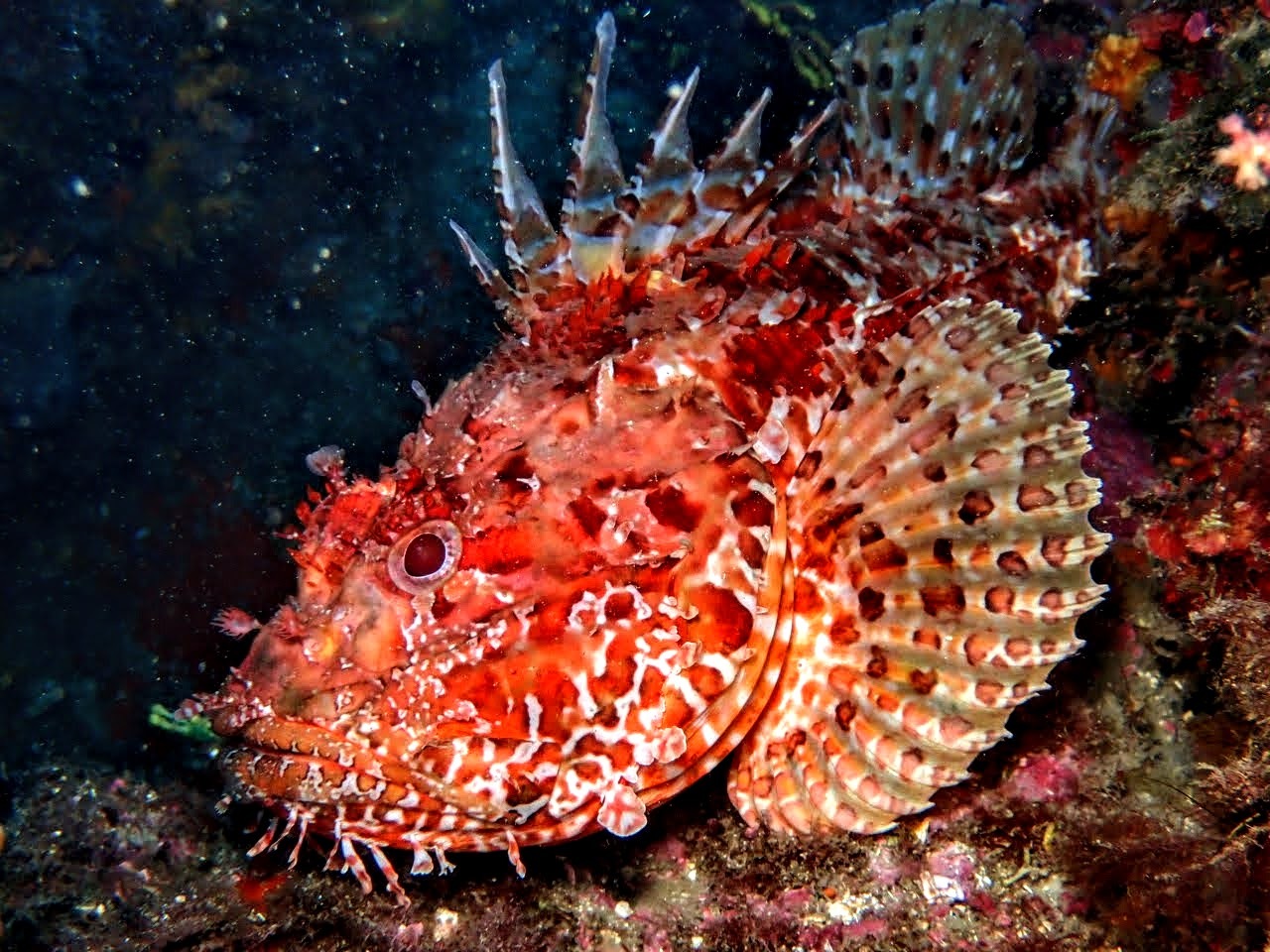
Red scorpionfish (Scorpaena scrofa) is a fish of the family Scorpaenidae. FishBase gives its range as: Eastern Atlantic: British Isles (rare) to Senegal including Madeira, the Canary Islands, and Cape Verde. Also throughout the Mediterranean except Black Sea. South African species thought to be the same as population in the northeast Atlantic. It is recorded from 20 to 500 m, in subtropical water. The recorded maxima are 50 cm TL, 3 kg. Diet includes crustaceans and fishes. IUCN status: Least Concern (LC). Chinese name: .
Four names on one card
FishBase titles the species Largescaled scorpionfish. iNaturalist prefers Red Scorpionfish for its 2,103 observations. The Chinese field gives ; the name table adds , a name built on a country rather than a colour. The English table is no tidier: eleven rows reduce to nine distinct strings. None of the three — title, iNaturalist label, Chinese field — is ranked against the others, so the page opens with a choice the record itself does not make.
Eleven rows into nine strings
The nine strings are Bigscale scorpionfish, Large-scaled scorpion fish, Largescaled scorpion-fish, Largescaled scorpionfish, Orange scorpionfish, Red scorpion fish, Red scorpion-fish, Red scorpionfish and Whiskery scorpionfish. Bigscale and Largescaled describe the same feature under two spellings; Red and Orange are two colour words for one animal; Whiskery points at the skin flaps around the mouth. iNaturalist's title picks one of the nine, FishBase's title picks another, and neither list ranks them. The Chinese side repeats the pattern: names the colour, names a coastline, and both are offered without a preference. In a genus that already holds several red scorpionfishes, that is enough ambiguity to route a reader to the wrong species card.
The South African sentence
FishBase ends its range paragraph with a caveat: the South African species are thought to be the same as the population in the northeast Atlantic (Ref. 4313). That is an open taxonomic question sitting inside a distribution sentence. The prose runs from the British Isles, marked rare, to Senegal and includes Madeira, the Canary Islands and Cape Verde, plus the Mediterranean except the Black Sea. The territory table then adds three entries the prose never mentions: Kenya, South Africa and Yemen. Kenya and Yemen sit outside the eastern Atlantic frame the prose draws, and South Africa is the one place the caveat is about. GBIF's declaration list adds a Mozambican EEZ entry that is not in FishBase's table at all; Mozambique has no row in that table, so the row enters the map from GBIF alone. Read side by side, the sources describe a species whose southern and Indian Ocean limits are asserted in one place and doubted in another.
Twelve declarations, 8,584 records
GBIF counts 8,584 occurrences: France 3,785, Spain 2,684, Croatia 331, Italy 212, Portugal 151 and Greece 118. The facet stops at six countries, so nothing below 118 appears; the map shows European recorder effort, not abundance. The distribution endpoint returns 12 declarations: FADA Afrotropical and Palaearctic rows with no status; the IUCN entry is a global PRESENT; WoRMS adds marine regions — the Azores EEZ twice, European Marine Waters, South Africa, the Greek EEZ, the Israeli eastern Mediterranean, the Kenyan EEZ and the Mozambican EEZ; and the Azores Archipelago carries a NATIVE row. The same Azores EEZ appears twice in that WoRMS block.
Twenty to five hundred, usually to one hundred and fifty
The depth block prints 20 to 500 m and a usual range of "? - 150 m". As on the black scorpionfish page, the question mark is the shallow end of the working band. What the record supports is a floor at 20 m for the full range and a working band that runs from an unrecorded shallow limit to 150 m. The three habitat keywords — rocky, sandy, muddy — cover every bottom a bait can be presented over, so inside the band the substrate narrows nothing at all. The diet field is shorter still: crustaceans and fishes, two words, with no prey size and no depth attached to either. The climate line is subtropical, 60°N to 35°S and 26°W to 36°E, a box wider than the Atlantic coast alone. The usual band stops at 150 m, 350 m short of the 500 m extreme, and the record says nothing about what the fish is doing between those two lines.
Maturity left blank
The record tops out at 50.0 cm TL, common length 30.0 cm TL, published weight 3.0 kg, and the maturity field is "?" with a range of "? - ?". The 50.0 cm figure carries reference 4510, the 30.0 cm figure reference 2683 and the 3.0 kg weight reference 40637, so the three values come from three different papers. The spawning table is absent, and the missing-field list names the Japanese name, spawning months and the gamefish flag. No maximum age is published either, so the 50 cm ceiling has no age behind it. Thirty centimetres is the working size, fifty is the record, and where maturity falls between them is not stated anywhere in the record. With no spawning season either, the commercial landings section and the biology section cannot be joined to each other.
Venom, landings, aquariums
The species is commercial in the fisheries field and listed for public aquariums in the aquarium field. The human-danger field says Venomous; the morphology block lists three anal spines and five anal soft rays with the dorsal counts empty, so the counts do not describe the venom apparatus at all. Neither appendix list has assessed it. The country table then holds 34 entries, covering the Mediterranean and a strip of eastern Atlantic coast from the British Isles to Western Sahara, with Cabo Verde and the Azores listed separately. All 34 of those rows are marked NATIVE; the introduced, endemic and uncertain columns of that table are empty. That separation matters when a landing is reported by region rather than by state.
What the name does to a search
The WoRMS entry is AphiaID 127248 (Linnaeus, 1758), with marine and brackish both set. FishBase also prints "Marine; brackish", a combination that no estuary in the 12 declarations supports. Least Concern, dated 15 July 2014, is the Red List verdict, and iNaturalist holds 2,103 observations. The last check is the label rather than the fish: a search for "red scorpionfish" has to pass , , Red Scorpionfish, Orange scorpionfish and Largescaled scorpionfish before it reaches AphiaID 127248, and the backbone key used here is 2334574.
Regulations before you keep it
These are the published regulations for this fish. Read the number first. The notice below it is the actual regulation.
Minimum size1
The minimum size for Red scorpionfish in France is ≥30 cm.
| CHAPON | Scorpaena scrofa | 30 cm |
Every record above names its source and the date it was retrieved. See the regulation register for the full list, or how to read these regulations.
Where these facts come from
Check these pages before you rely on a size, range or protection status.
-
FishBase — Scorpaena scrofa
— FishBase · T2
-
GBIF — Scorpaena scrofa occurrence records
— GBIF · T2
-
IUCN Red List — Scorpaena scrofa
— IUCN · T1
-
Photo record — iNaturalist
— iNaturalist · T3