The Mediterranean holds one parrotfish, and its two colour phases look like two different species: red-brown females with grey blotches, grey-blue males marked in red and yellow. The same fused beak that scrapes algae will cut a leader. And the 22 cm rule that exists for the Canary Islands does not travel to the Mediterranean.
The only parrotfish, and two colour phases
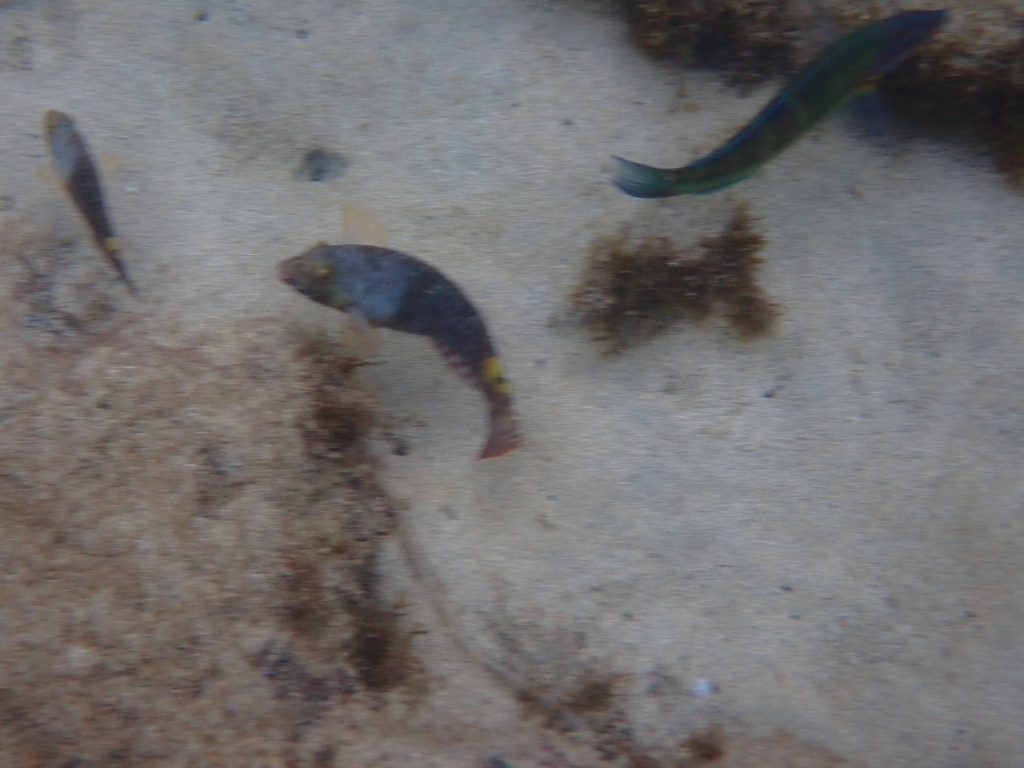
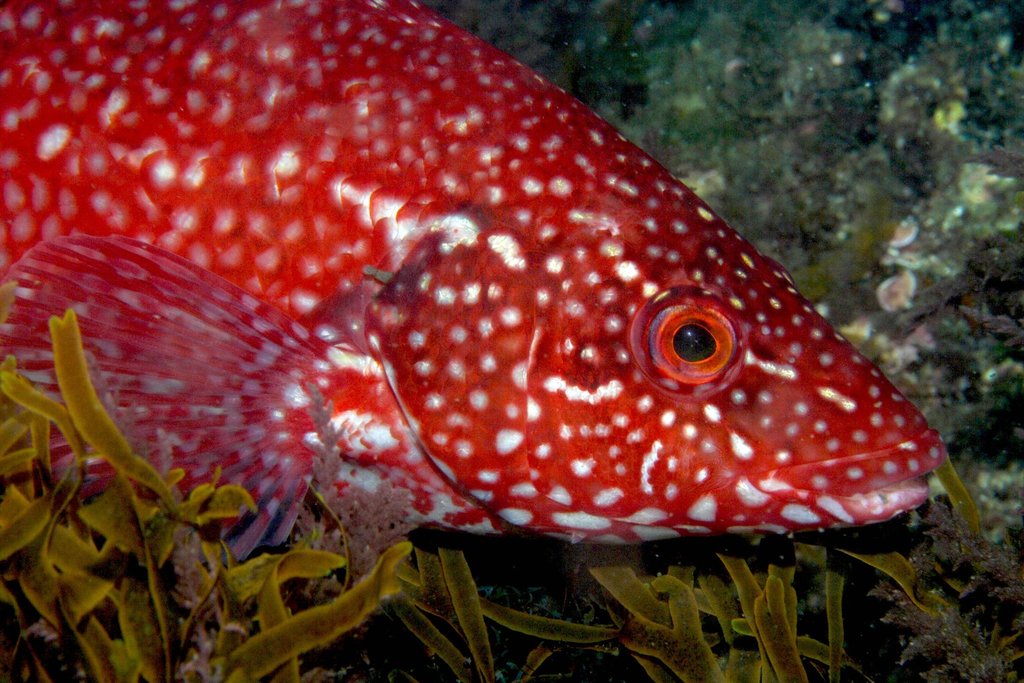
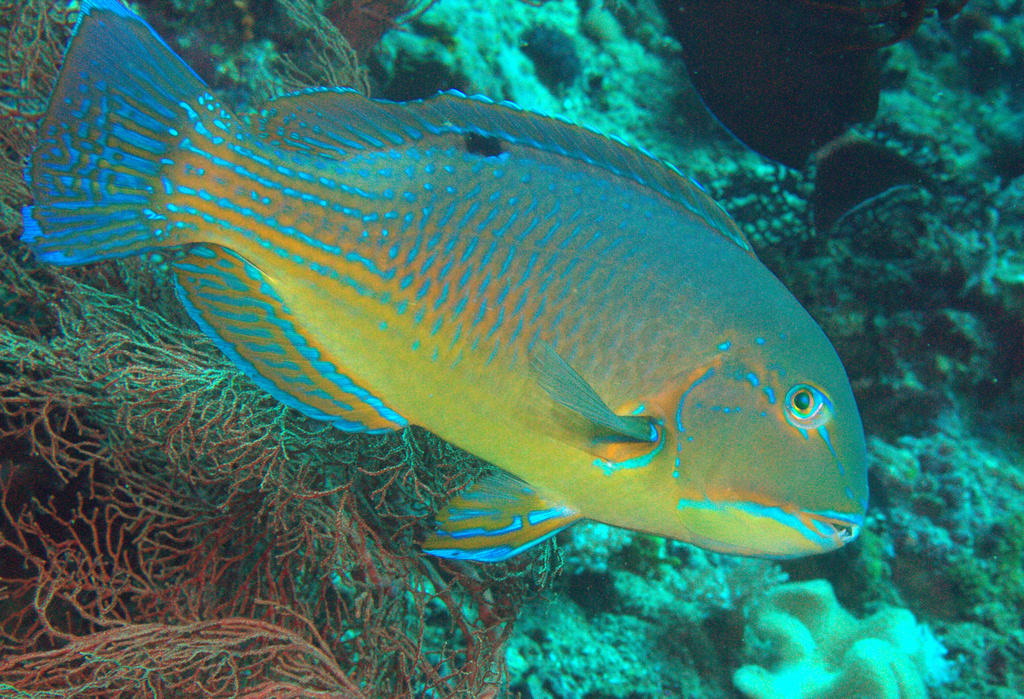
Start with the mouth. The teeth are fused into a beak-like plate, visible when the fish opens up, with a second cutting edge inside the lip. The body is oval and compressed, the tail nearly truncate or slightly concave. Females run red-brown with grey-white blotches along the flank and back; males are grey-blue with red and yellow marks on the flank and head, and often red edging on the dorsal and anal fins. Against the wrasses on the same reef, the beak is complete, the body is thicker, and the fish rows with its pectorals rather than sweeping its tail. Growth to 50 cm and a common 30 cm put large individuals beyond wrasse size, which is obvious at the boat.
Eastern and southern rock, 20 to 50 metres
FishBase gives an eastern Atlantic range from Portugal, the Azores and Madeira south to the Canary Islands and Senegal, and notes that the species is more common on the eastern and southern Mediterranean coasts. The depth field says 20 to 50 m while the biology text describes shallow rocky shore, and the two do not quite agree; the shallow records may refer to juveniles or to local populations. The habitat is rock and algal-covered rock, with adults working the upper edge of the slope and bolting into crevices when pressed. Catches in the western Mediterranean are far thinner than around Greece, southern Turkey and Cyprus, which is why many western anglers know the fish only from a field guide.
A Portuguese spawning record, not a Mediterranean one
FishBase gives breeding from July to September, with juveniles recruiting in late summer, and attributes that record to Portugal. Whether Mediterranean populations follow the same timetable is not stated in the sources used here. What can be used: fish are most active on shallow rock at the warmest part of summer, which is also when spearfishing and shore fishing meet the largest individuals; through autumn they move down the slope; in winter they are scarce in the shallows. They do not form large schools, so success depends on finding one feeding fish rather than waiting for a school to pass.
Fishing a beak that eats algae and cuts line
The fish grazes algae and takes small invertebrates, so the bait belongs on the algal surface. From shore, a float carries shrimp or crab flesh to the edge of a rock platform, swinging with the swell so it reads as something attached to the weed. From a boat, a light lead and single hook crawl over the slope, pausing at each ledge, and the take usually follows the pause. Lures work with a small soft plastic or a short pencil crawled across the film, at a lower rate than natural bait. The teeth cut line, so a leader is mandatory; the first run goes for a crevice, so hold the rod and stop the head from turning back into the hole. Keep the boat still, because the fish watches for shadows.
Medium gear for a reef fish with teeth
A 2.4 to 3.0 m medium-heavy boat rod or a 3 m shore rod, a 4000 reel, 1.0 to 1.5 braid, a 20 to 30 lb fluorocarbon leader and a 1/0 to 2/0 heavy-wire single cover it. The leader should run at least an arm and a half, because both ledge and weed abrade it. The mouth is hard and the teeth are sharp, so the hookset must be firm and the drag must keep some reserve; a locked drag tears the hook out of the beak or breaks the line. Unhook with long-nosed pliers at the corner of the mouth, never with fingers inside the beak. If the fish is going back, release it in the water: the mucus layer is thick and recovery slows with every minute in the air.
The Canary Islands 22 cm rule does not apply here
The flesh is white and firm, good fried, grilled or in soup; large fish are better bled, skinned and trimmed of belly fat. It is treated as a premium fish in some markets, which puts the largest individuals under pressure. EU: Regulation (EU) 2019/1241 Annex IX Part A sets no size for Scaridae or this species, Article 2(2) does not extend Annex IX sizes to recreational fishing, and Article 17 of Regulation (EC) 1967/2006 bans selling recreational catch. Spain: RD 347/2011 requires an autonomous-community licence from shore and from a boat, and RD 560/1995 Annex II for the Mediterranean has no entry. The 22 cm entry for this species sits in the Canary Islands annex and applies there only, not to the Spanish Mediterranean or the Balearics. France: no licence, RecFishing registration from 16, no Mediterranean entry in the 2012 order. Italy: the annual MASAF declaration, with electronic catch registration from 2026. Greece: no licence, 5 kg per day, and a May spearfishing ban that matters because this is a spearfishing target. Croatia: licence required, 5 kg bag. No size rule does not mean no rules: the sale ban, gear restrictions and protected areas still apply. Check the current year's notices.
Where the numbers come from
The 50 cm maximum, the 30 cm common length, the 20 to 50 m depth band, the eastern Atlantic and Mediterranean range, the mixed algal and invertebrate diet, the July to September breeding note and the IUCN Least Concern assessment of 2009 all come from FishBase, and the breeding record is explicitly Portuguese. The limited reach of the Canary Islands 22 cm rule comes from the annex structure of Spanish RD 560/1995. Family placement is contested: FishBase puts the species in Labridae, GBIF in Scaridae, and this entry follows FishBase while leaving the order blank.
How to catch it
Shore casting
Fished with the listed approach, matched to the recorded depth and size.
Lure fishing
Fished with the listed approach, matched to the recorded depth and size.
Regulations before you keep it
These are the published regulations for this fish. Read the number first. The notice below it is the actual regulation.
Minimum size1
≥22 cm
Spain — Canary Islands · ES-CN
The minimum size for Parrotfish in the Canary Islands is ≥22 cm.
| Vieja colorada (Sparisoma cretense) | Vieja | 22 |
Every record above names its source and the date it was retrieved. See the regulation register for the full list, or how to read these regulations.
Where these facts come from
Check these pages before you rely on a size, range or protection status.
-
FishBase — Sparisoma cretense
— FishBase · T2
-
GBIF — Sparisoma cretense occurrence records
— GBIF · T2
-
IUCN Red List — Sparisoma cretense
— IUCN · T1
-
Photo record — iNaturalist
— iNaturalist · T3