
Bonnethead
The bonnethead is the smallest hammerhead and the only one centred on the western Atlantic: FishBase records it from North Carolina to Belize, including the Gulf of Mexico and the Caribbean. Maximum length is 150 cm TL, common 80 cm, maximum weight 10.8 kg and maximum age 12 years; maturity is about 85 cm. It is an inshore shark of estuaries, bays, sand and mud bottoms, seagrass and reefs.
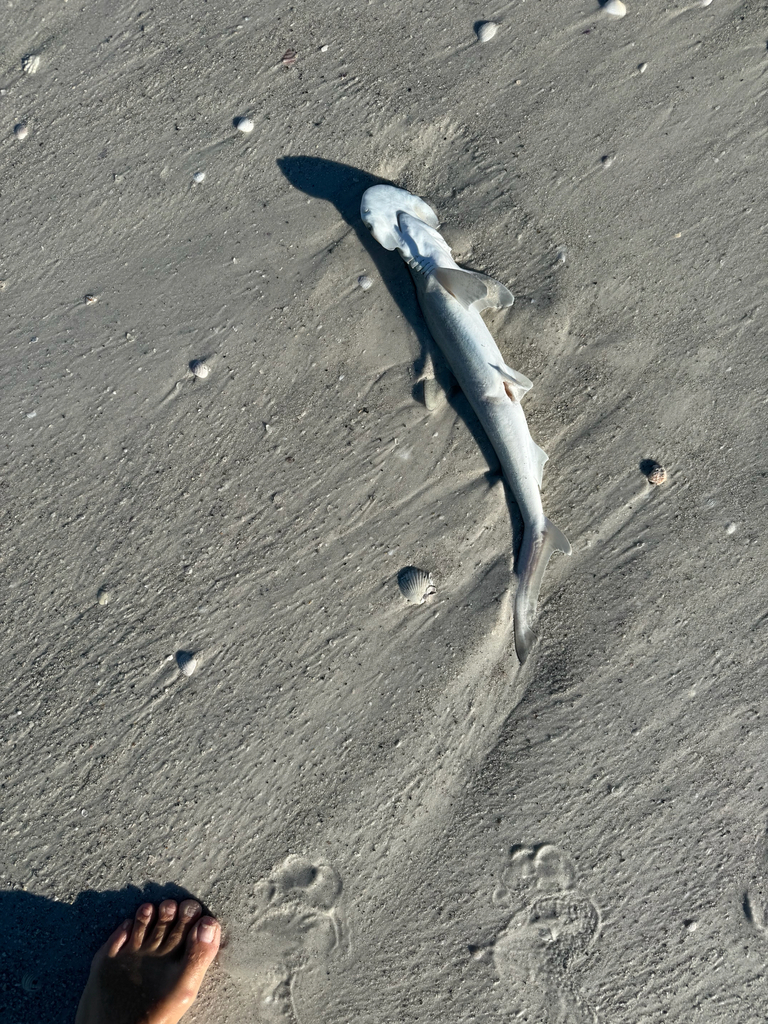
The bonnethead is the smallest hammerhead and the only one centred on the western Atlantic: FishBase records it from North Carolina to Belize, including the Gulf of Mexico and the Caribbean. Maximum length is 150 cm TL, common 80 cm, maximum weight 10.8 kg and maximum age 12 years; maturity is about 85 cm. It is an inshore shark of estuaries, bays, sand and mud bottoms, seagrass and reefs. IUCN: EN (Endangered), assessed 2 July 2019.
Identification
The head is the identification: FishBase describes the front of the head as semicircular and notes that no other hammerhead shares that outline. The body is elongated rather than deep, and the fish is far smaller than the great, scalloped and smooth hammerheads, which have a wider head. It is also the only shark known to show sexual dimorphism in head shape. FishBase gives body shape but no fin formula, so check the outline against photographs.
Habitat and distribution
Bonnetheads work continental and insular shelves from 10 to 80 m over mud, sand and coral, and enter estuaries and bays. FishBase records a diel pattern: nights on shallow grass flats hunting invertebrates, days in deeper water, in small groups with considerable sexual segregation. The diet is mainly crustaceans, plus bivalves, octopus and small fish; it is also the first shark shown to digest seagrass.
The range runs from North Carolina to Belize, and FishBase notes that the name once covered a species complex: S. vespertina in the eastern Pacific and S. alleni from Belize to Brazil are now separated, so records outside the western Atlantic core may be those species. GBIF holds 2,224 records, led by the United States (1,535), Brazil (113) and Mexico (109).
Season and fishing approach
The spawning table gives March to September: March–August in Florida Bay (1983–84) and April–September in Tampa Bay. Those are spawning records, not a promise of fish on any tide. In practice the fish follow warm shallow water — flats, bay margins and inlet edges in the warm months — and leave the flats as the water cools.
The approved methods are shore casting, boat bottom fishing and lure fishing. On foot, fish the moving tide where a flat drains into a channel; from a boat, work the edges of flats and nearby deeper water. Small crabs, shrimp and cut bait on a circle hook are the obvious baits; small jigs and soft plastics work on clear flats. Keep tackle heavy enough to land it quickly; a long fight on light line is bad for an Endangered species.
Treat it as release-first: leave the shark in the water, support the body, cut the leader or use a long-handled dehooker, and do not lift it out for a photo. Federal rules allow one fish per person per trip, but releasing is the better choice. Do not confuse it with the great, scalloped and smooth hammerheads, which are managed separately and are not open to retention.
Edibility and regulations
FishBase lists the species as a commercial catch, a gamefish and a source of food and fishmeal. It is edible, but that is a weak argument for keeping an Endangered shark.
In U.S. Atlantic federal waters the 2025 HMS table gives no minimum size and a bag limit of one per person per trip; no species-specific federal closed season was verified. State rules can differ; check the state where you land the fish. IUCN: EN, assessed 2 July 2019; CITES Appendix II; CMS Not Evaluated; harmless to humans.
How to catch it
Shore casting
Fished with the listed approach, matched to the recorded depth and size.
Boat bottom fishing
Fished with the listed approach, matched to the recorded depth and size.
Lure fishing
Fished with the listed approach, matched to the recorded depth and size.
Where these facts come from
Check these pages before you rely on a size, range or protection status.
- FishBase — Sphyrna tiburo — FishBase · T2
- GBIF — Sphyrna tiburo occurrence records — GBIF · T2
- IUCN Red List — Sphyrna tiburo — IUCN · T1
- Photo record — iNaturalist — iNaturalist · T3
Fish in the same water
These fish live in the same place.


Guides for this water
Technique, gear and safety guides that fit Bonnethead.