
Threadsail filefish
A FishBase page can hold two numbers that never met. On this filefish's card the size box prints a maximum length of 30.0 cm TL and a maximum published weight of 77.70 g. Thirty centimetres is about twelve inches, and the Wikipedia entry repeats that figure. The same box holds no common length and no maturity length.
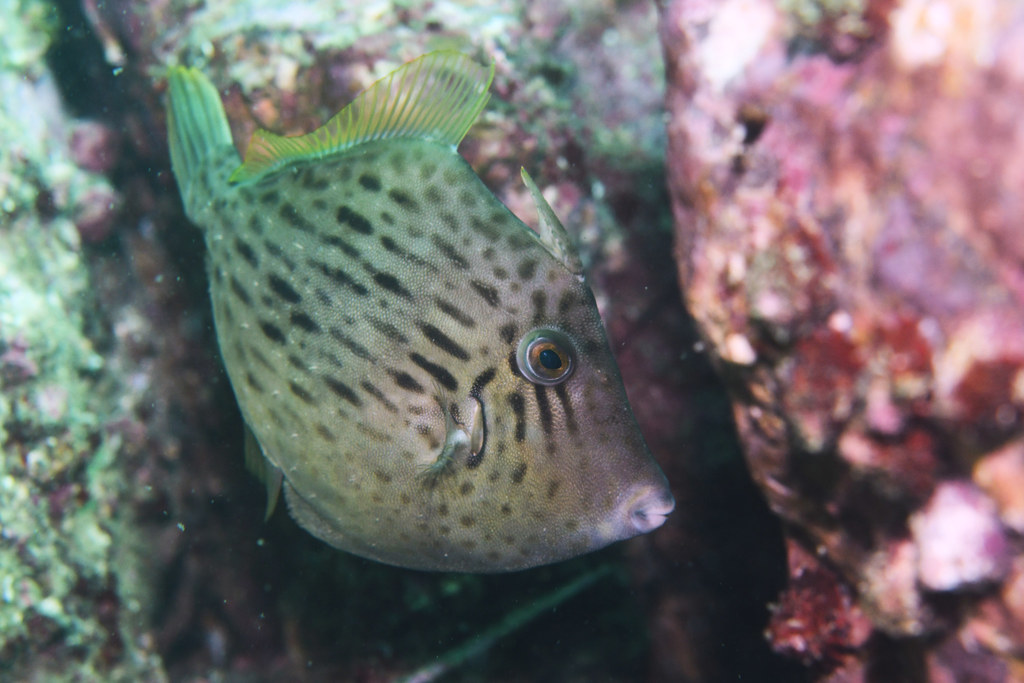
A FishBase page can hold two numbers that never met. On this filefish's card the size box prints a maximum length of 30.0 cm TL and a maximum published weight of 77.70 g. Thirty centimetres is about twelve inches, and the Wikipedia entry repeats that figure. Nothing repeats the weight. The same box holds no common length and no maturity length. So the only size the card will defend is a ceiling, and the routine fish — the one a rod would actually meet — has no published length at all.
Thirty centimetres, 77.7 grams
Read the two figures as one animal and you get a 30 cm fish weighing about as much as a small lemon. The page does not ask for that reading. The length carries reference 56557 and the weight reference 124713; two citations are FishBase's ordinary way of saying the two maxima came from two papers, on two fish, at two times. Neither paper is credited with a common length. The 30.0 cm is a total length, taken to the caudal fin tip. The 77.70 g carries no length at all in the box. That is what to settle before a trip: a length record and a weight record are separate entries, and neither one describes a typical fish.
A length record is not a weight record
A crude cube rule — one hundred-thousandth of total length cubed, in kilograms — puts a 30 cm fish near 270 g. The published 77.70 g is 0.288 of that, the ratio this card stores for the pair. The card's sanity window runs from 0.1 to 10, so 0.288 passes: it is a mismatch signal, not a verdict of bad data. A fish at the 30 cm ceiling should not weigh 78 g, so the weight belongs to a smaller specimen, and the page never says how much smaller. What survives is a length ceiling and a weight ceiling from two different records, with nothing in between. Averaging them into "30 cm, 78 g" manufactures the one fish the sources do not contain.
No common length: where the gear starts
With no common length, the ceiling is the only length the page will defend, and a ceiling is a limit rather than a size to rig for. Start under it: a light rod, jig heads around 5–7 g or a couple of split shot, and hooks small enough for a bait the size of a fingernail. The card files this fish as a bottom-dweller and as a seasonal wanderer, so the bait belongs near the bottom, and the mark may be empty next week. The 77.70 g record is not a tackle target either: nothing heavier than 78 g has been published, so tackle built to lift a much larger fish has no basis here.
Small food, small hooks
The recorded diet starts at algae, and the Wikipedia summary widens the menu to plant material and small marine organisms such as skeleton shrimp. That is grazing, and it fixes bait size: slivers of shrimp, thin strips of fish flesh, a small piece of weed-bound worm, nothing a 78 g fish could not swallow. The same summary names Peniculus minuticaudae, a parasite for which this filefish is a host — useful when something is found attached to a fish on deck, and silent about how the fish feeds. FishBase marks the species as highly commercial and as a gamefish on one line, which is how the same species ends up in a market tray and on a hook.
Hokkaido to the East China Sea
The range text reads western Pacific, Hokkaido to the East China Sea, and the country table adds China, Hong Kong, Japan, South Korea, the Ogasawara or Bonin Islands and Taiwan. The environment line reads temperate, 32°N–23°N, marine, demersal, oceanodromous, with its own reference number. No depth figure appears anywhere, and depth is one of the fields this card lists as missing. A boat has a latitude band and a bottom habit, and nothing about how deep the bottom lies. Hokkaido also sits north of the printed band, so the range sentence and the latitude line describe different water. In Japan the fish is Kawahagi, the name a local landing uses instead of an English list.
Where the third-party range comes from
Third-party range data here comes from two registers only: an ocean-level entry from ITIS reading Indo-West Pacific and a Red List entry reading Global. Neither is a coastline list, so the shore has to come from the FishBase country table. Photographs are a separate strand: iNaturalist holds 402 observations and eleven images for taxon 418232. WoRMS accepts the name as Stephanolepis cirrhifer (Temminck & Schlegel, 1850) and flags it marine only. The assessment behind that Red List entry is dated 18 July 2017 and reads LC; the binding rule for a catch is national rather than international.
May to August, at the northern edge
The spawning table gives Primorye, in Russia, from May through August — a season for a place rather than for the species, and the place sits north of the latitude line quoted above. Read it as a dated observation, not as a calendar to book against. No maturity length is printed, so the 30 cm ceiling cannot be tied to a breeding fish, and whether a fish goes back is decided by the national rule rather than by a figure on this card. A trip plan can use one statement: spawning has been logged in late spring and summer at the range's northern edge, whereas the southern half has no row.
Leave the record in the record column
The figure to carry on a trip is 30 cm, and it is a ceiling. The figure to leave on the page is 77.70 g, because it belongs to another fish and another paper. A release card should record total length, say whether the weight was taken on deck or estimated, and name the reference only when the fish is compared with a published record. What the sources will not do is promise a common size. With the common-length field empty, no one can state what a typical Kawahagi weighs. The record stays in the record column; the fish on the hook is somewhere below it.
Where these facts come from
Check these pages before you rely on a size, range or protection status.
- FishBase — Stephanolepis cirrhifer — FishBase · T2
- GBIF — Stephanolepis cirrhifer occurrence records — GBIF · T2
- IUCN Red List — Stephanolepis cirrhifer — IUCN · T1
- Photo record — iNaturalist — iNaturalist · T3
Fish in the same water
These fish live in the same place.

Black scraper
- Family
- Monacanthidae
- Depth
- 50–110 m
- Season
- May, Jun, Aug, Sep

Acoupa weakfish
- Family
- Sciaenidae
- Depth
- 1–20 m
- Season
- Jan, Feb, Mar, Apr, May, Jun, Jul, Aug, Sep, Oct, Nov, Dec

American angler
- Family
- Lophiidae
- Depth
- 0–800 m
- Season
- Mar, Apr, May, Jun
Guides for this water
Technique, gear and safety guides that fit Threadsail filefish.