
Black scraper
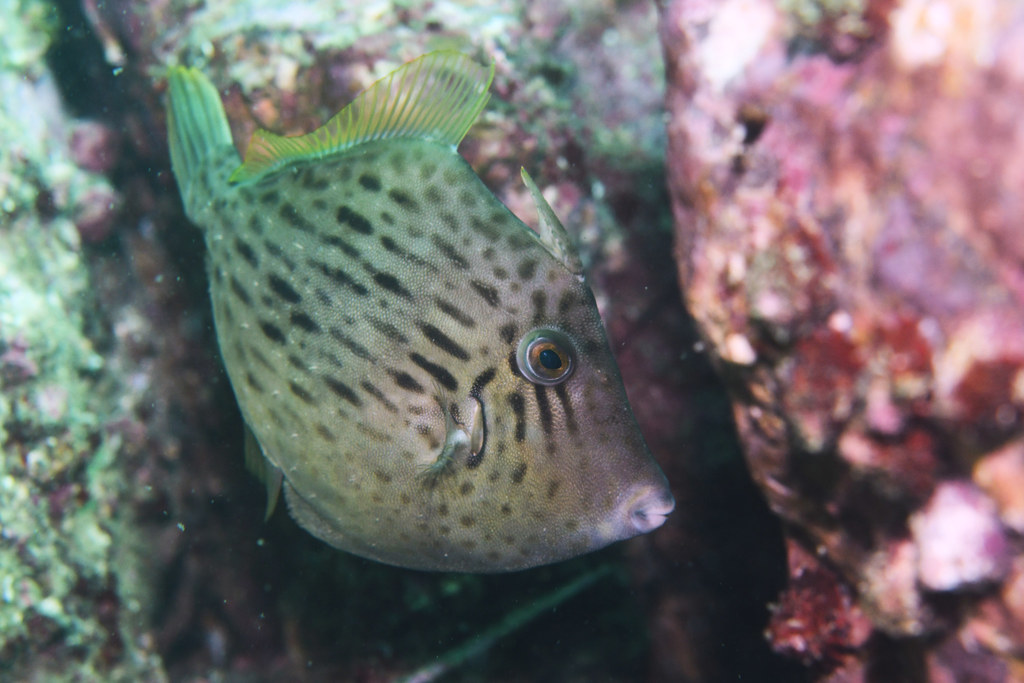
Black scraper is a small filefish of the northwest Pacific and South China Sea, sold on market trays with the skin already off, which is why the local names mean peel-skin fish and horse-face. It works 50 to 110 m in tropical water of 10 to 28 degrees C. Adults reach 37.4 cm TL. The season covers May, June, August and September, so July is the gap.

translates as peel-skin fish, as horse-face. Both names belong to a body sold on a tray with the skin already off, and both were written at a stall rather than on a chart. The FishBase environment line for the same animal begins its depth at 50 m. This page takes the depth line as the fishing claim and the stall name as a label to set aside.
A name from the stall, a line from the shelf
At the San Hui Market display the fish lie skinned in rows, which is the only view most buyers get: a palm-sized grey body with no skin, no scales and no hint of where it swam. FishBase gives the species 50–110 m. Set that against reach. An angler working water up to chest height covers less than 2 m of column, so the shallowest documented fish sits roughly thirty times deeper than the deepest place a wading cast can put a bait. That gap is the distance between tray and terrain, and it answers the first question: this is not a rock-pool fish with a homely name.
Fifty metres is the floor, not the middle
The depth string reads 50–110 m and stops; there is no "usually" clause behind it. FishBase normally prints a narrower core band after the full range, and its absence here means no core band has been documented. That changes what the figure can be used for. The 60 m span is the whole claim rather than an outer envelope around a tighter one, and it rests on a single reference, 126482, so it is one citation and not a settled range. Nobody may write "fish the 80 m line": 70, 80 or 90 m as a target would be invented, because the page never narrows the band. A plan on the middle of the range rests on arithmetic the source never did.
What sits above 110 m, and what the page leaves below
Above the band the record gives a bottom type and a habit rather than a number: the fish is tied to reef relief and moves with the season, and that claim rests on reference 51243, a different paper from the depth figure. So the two statements come from separate literature and neither confirms the other. The same environment box also prints "Tropical", while giving 10–28°C and while the Wikipedia summary calls the water temperate. Those labels cannot all be tight at once: a tropical tag, a 10°C floor and a Hokkaido-to-Ryukyu range describe a fish that crosses climatic zones, not one that lives in a warm sea. Below 110 m the page simply ends. Nothing in the record places it deeper, so a drop past the band is an unchecked guess rather than a documented extension.
Tide moves this band by metres, not by tens of metres
The band is 60 m thick. A tide is a metre-scale rise and fall; the page carries no tidal figure, and none is needed, because a change measured in metres cannot re-seat a 60 m window in any decisive way. On the 50 m line a tide adds or removes a few metres over the same ground without moving the fish. What moves the band is the calendar. The spawning table records Jeju Island in May–June and Primorye in August–September; the northern locality is the later one, which reads as a seasonal shift up the coast instead of one fixed mark. With a 10–28°C window on the page, month and temperature are the variables a trip should carry, and tide height is not among them.
A 17.5 cm common fish beside a 37.4 cm record
Both size figures are total length, so this comparison is honest in a way mixed-measure pairs are not: 37.4 cm maximum against 17.5 cm common is a factor of about 2.1, and they come from different references, 123681 and 56557. The number that matters is not the ratio but the placement. The common length sits 8.4 cm short of the 25.9 cm length at first maturity on the same page. A figure labelled "common" that falls below the maturity point is not a description of the adult population; it is a description of what gets measured, and for a species whose recorded human use is bycatch, what gets measured is the landed fish.
The 25.9 cm release line
The maturity point is 25.9 cm, and the range behind it is written 21–? cm. The question mark should not be smoothed away: the lower end is documented at 21 cm, the mean is 25.9, and the upper end was never filled in. On deck the only number that changes behaviour is the lower one — a fish under 25.9 cm has not spawned, so it goes back; above it the decision is the national rule. What survives as an adult window runs from 25.9 to 37.4 cm, and that strip is the only part of the size range the page supports as mature. It also explains the bycatch line. Gear that takes 17.5 cm fish is working below the maturity point by design, and the record maximum is 2.1 times the common size, so a slot limit drawn around the maximum would protect almost nothing. The usable cut is the maturity figure, not the record.
A boat drop that starts at 50 m
No rig can be lifted from this page, so it has to be built from the depth and the relief. The move is one: sound until the ground is deeper than 50 m, because above that line the documented fish is absent. The 110 m contour is the far edge, not a target. Between the two, the reef claim puts the drop on relief rather than on flat ground, and the seasonal claim makes a mark a visit rather than a residence. The order of decisions is depth, then structure, then season; a shoreline cast is not a shallow version of this fishery, it sits outside the record.
Where the range statements come from
What GBIF holds for the species is a pair of register entries — Indo-West Pacific from ITIS, Global from the Red List — not a range map. "Global" is broader than any fish centred on Hokkaido to the Ryukyus. FishBase's own text is tighter: Hokkaido south to the Ryukyu Islands, plus the East and South China Seas, with China, Japan, South Korea, North Korea and Taiwan region in the country table. The iNaturalist taxon carries 97 observations, and the Commons set adds an Enoshima specimen and the market tray — both from the corner of the Pacific that FishBase describes. The photographs and the narrow text agree; the register entries add detail to neither.
Where these facts come from
Check these pages before you rely on a size, range or protection status.
- FishBase — Thamnaconus modestus — FishBase · T2
- GBIF — Thamnaconus modestus occurrence records — GBIF · T2
- IUCN Red List — Thamnaconus modestus — IUCN · T1
- Photo record — iNaturalist — iNaturalist · T3
Fish in the same water
These fish live in the same place.

Guides for this water
Technique, gear and safety guides that fit Black scraper.