
Peacock wrasse
The peacock wrasse is a fish whose colour misleads: males, females and fish in different moods can look like three different species on the same reef. In the breeding season it becomes easier to identify, because males guard a nest built from seaweed and chase everything that comes near. Reading that behaviour beats memorising a colour plate.
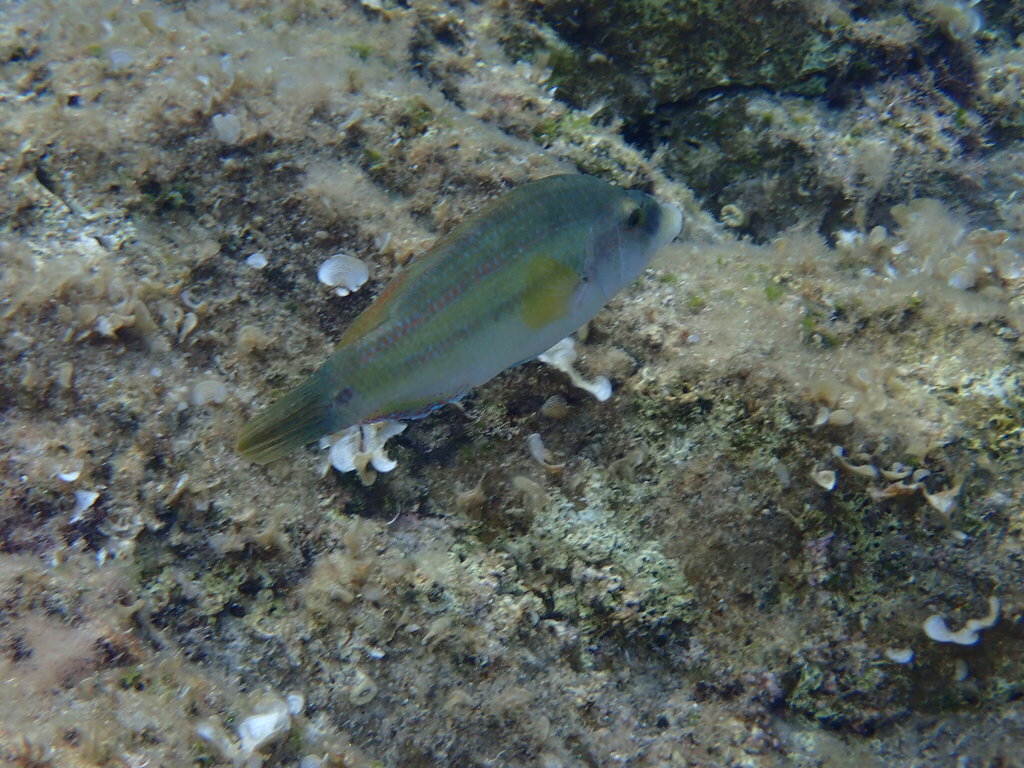
The peacock wrasse is a fish whose colour misleads: males, females and fish in different moods can look like three different species on the same reef. In the breeding season it becomes easier to identify, because males guard a nest built from seaweed and chase everything that comes near. Reading that behaviour beats memorising a colour plate.
An oval wrasse with folded lips and a guarded nest
The body is oval and laterally compressed; the mouth is small and protrusile, the lips thick with six to nine folds, the jaws carry strong canine teeth, and the snout has a few cephalic pores. Colour runs green-brown to yellow-brown with dark blotches on the flank, and males show blue-green in the caudal fin, strongest in the breeding season. This is the largest Symphodus, with a recorded maximum of 44 cm and a common length of 25 cm. Against S. melanocercus it is larger with a different tail shape, while melanocercus is smaller with colour concentrated at the tail. Within the genus the resemblance is close, so judge size, lip folds and tail shape first and flank pattern second; colour alone will mislead you on females. Photograph the flank and the tail if unsure.
Rock, eelgrass and brackish lagoons
FishBase records the range from Spain to Morocco in the eastern Atlantic, including the Mediterranean and Black Sea. It is a classic rock-and-meadow fish, living near rock with eelgrass as the main cover, and it also enters salty lagoons, so it tolerates a range of salinity. The recorded depth is 1 to 50 m, which covers everything a shore angler can reach. Productive areas are the rock-meadow seam, lagoon mouths and shallow rubble; the fish is gregarious, and one group often holds several colour forms. Boat anglers meet them on the deeper slope too, but density is highest in shallow water.
Nest guarding is the season marker
FishBase records that the species is oviparous, that a male builds and keeps a nest of seaweed with one or more females spawning in it, and that the species undergoes sex reversal. No monthly spawning table or spawning temperature is given, but nest guarding is itself a seasonal signal: males take up sites and build as water warms in spring, and behaviour is most visible during the breeding period. Mediterranean catches improve in spring, hold in summer, continue into autumn and fall back to deeper structure in winter. A recorded lifespan of fifteen years with slow growth means large fish are not a fast-renewing resource. A guarding male is worth a photograph and a release.
Concrete foods call for compact baits on the bottom
The diet is specific: sea urchins, ophiuroids, bivalves, shrimps and crabs, so the bait should sit low and feel solid. From shore, a float rig with shrimp sinks to the meadow edge, and the bite is light enough that small float movements are the signal. From a boat, bottom-fish crab meat or shrimp at the base of the rock with light lead that lets the swell move it. The third option is a soft plastic crawled along the weed edge for patrolling fish. Because they travel in groups, stay on the spot after the first fish; the same group often gives another chance. Small fish dominate, so do not shrink the bait too far, and keep the hook gap selective. Retrieve slowly: the chase range is short.
Fine hooks and a soft mouth need a gentle strike
A 2.4 to 2.7 m medium spinning rod with a 2500 to 3000 reel, 15 to 20 lb braid, a 20 lb fluorocarbon leader and a size 2 to 1/0 wide-gap hook is the working set. The mouth is small and the lips thick, so use a fine, tough wire and strike firmly but without force, or the lip tears. Eelgrass snags often, so keep lead light and park the bait at the edge rather than pressing it into the weed. A hooked fish dives into cover, so leave drag margin and an arm's length of leader for abrasion. Unhook in the water where possible; if you photograph it, support the belly and let it swim off on its own.
No species size limit, but lagoons have their own rules
Flesh: sources describe it as a local food fish but give no dedicated eating-quality assessment. Wrasse flesh is soft and needs prompt icing; small fish have too many bones to be worth the work. Rules by jurisdiction. EU: Symphodus tinca is not listed in Annex IX Part A of Regulation (EU) 2019/1241, so there is no EU minimum conservation reference size. Article 2(2) applies only Articles 7, 10, 11 and 12 to recreational fishing, so Annex IX sizes do not automatically bind anglers unless a member state extends them. Article 17 of Regulation (EC) 1967/2006 bans sale of recreational catch. Spain (ES): shore and boat fishing both need an autonomous-community licence under RD 347/2011; the Mediterranean table in RD 560/1995 Annex II does not list the species, and communities may be stricter. France (FR): no sea-fishing permit, but RecFishing registration is required from age 16, and the Mediterranean section of the 26 October 2012 arrêté does not list it. Italy (IT): no paid licence, annual MASAF declaration required, electronic catch registration from 2026. Greece (GR): licence abolished by Law 4256/2014, 5 kg per person per day, spearfishing banned in May. Croatia (HR): licence from shore and boat, 5 kg per person per day, and the national table does not list it. Turkey (TR): foreign visitors may shore-fish without a document; boat fishing needs a tourism permit or avlanma fişi, and the 2024/21 size table was not retrieved, so no Turkish size is stated. No species-specific size does not mean no restrictions: lagoons and seagrass often sit under additional protected-area rules, and gear limits and the sale ban still apply. Check the current year's official notices before you go.
Evidence, naming and the genus problem
Length, depth, distribution, habitat, diet, the fifteen-year lifespan, nest building, sex reversal and IUCN status (LC, assessed 2008) come from FishBase, as do the lip-fold and cephalic-pore details. Regulation text comes from the EU regulation and national official sources retrieved in November 2026. Separation within Symphodus rests on size, lips and tail shape, which are field characters rather than measured ones. Monthly spawning and juvenile habitat are not published here and are listed as pending.
How to catch it
Float fishing
Fished with the listed approach, matched to the recorded depth and size.
Shore casting
Fished with the listed approach, matched to the recorded depth and size.
Trolling
Fished with the listed approach, matched to the recorded depth and size.
Where these facts come from
Check these pages before you rely on a size, range or protection status.
- FishBase — Symphodus tinca — FishBase · T2
- GBIF — Symphodus tinca occurrence records — GBIF · T2
- IUCN Red List — Symphodus tinca — IUCN · T1
- Photo record — iNaturalist — iNaturalist · T3
Fish in the same water
These fish live in the same place.
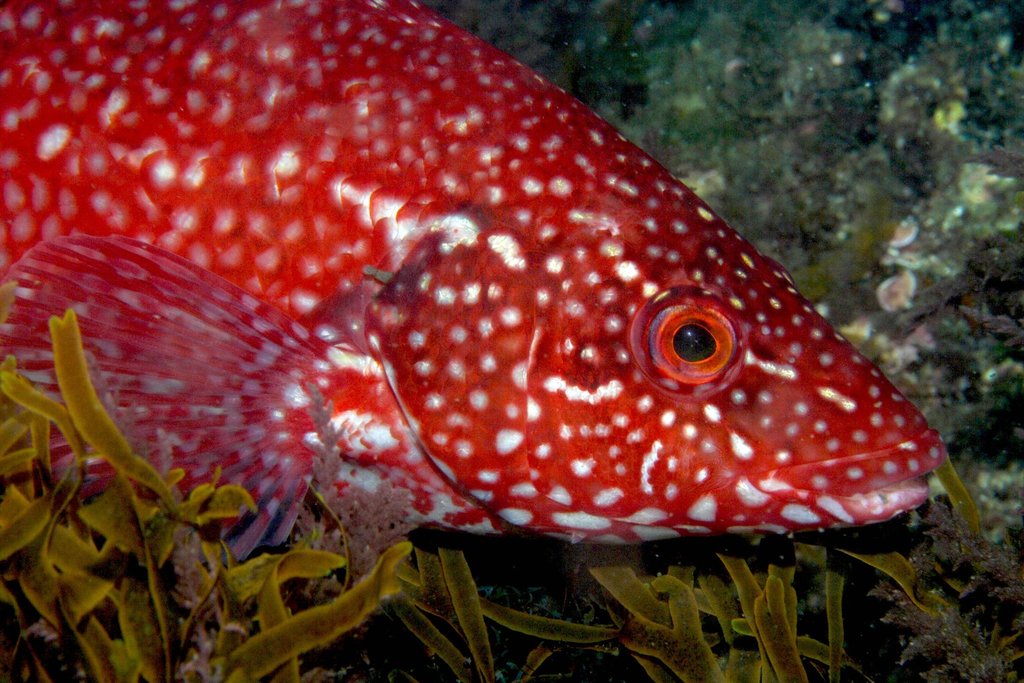
Ballan wrasse
- Family
- Labridae
- Depth
- 1–50 m
- Season
- Apr, May, Jun, Jul, Aug
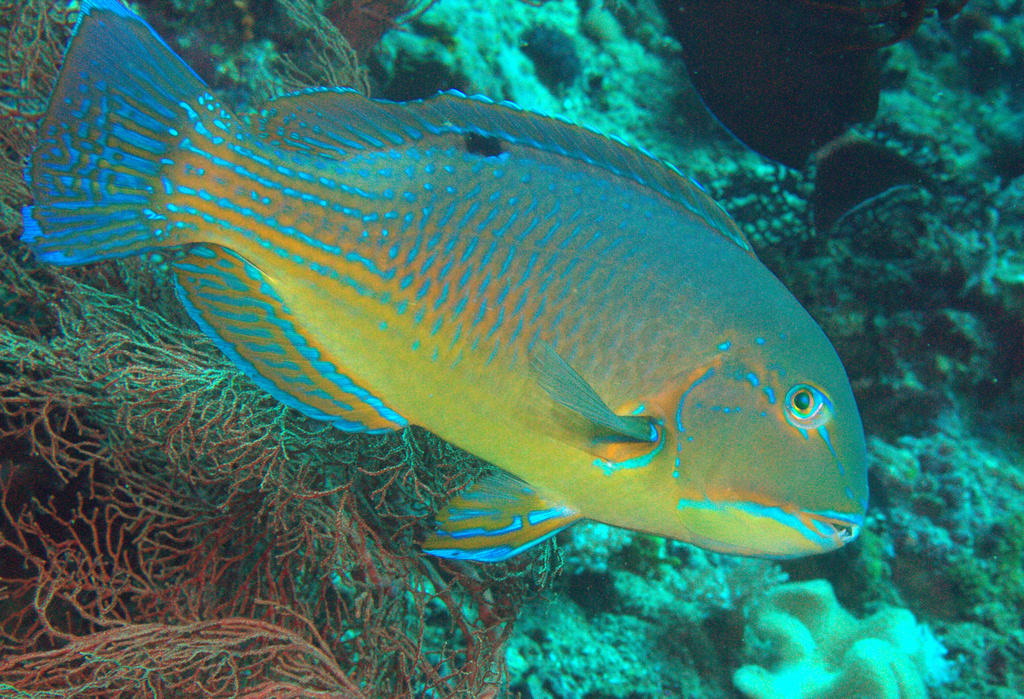
Blackspot tuskfish
- Family
- Labridae
- Depth
- 10–60 m
- Season
- Jan, Feb, Mar, Apr, May, Jun, Jul, Aug, Sep, Oct, Nov, Dec

Blue tuskfish
- Family
- Labridae
Guides for this water
Technique, gear and safety guides that fit Peacock wrasse.