
Greater pipefish
A long, slender fish of the pipefish and seahorse family, the greater pipefish is the type species of its genus. It ranges through the eastern Atlantic from Norway and the British Isles down to Western Sahara, entering the Mediterranean and Black Sea. Most records come from sand or mud in 3–15 m, although the species has been taken down to 110 m.
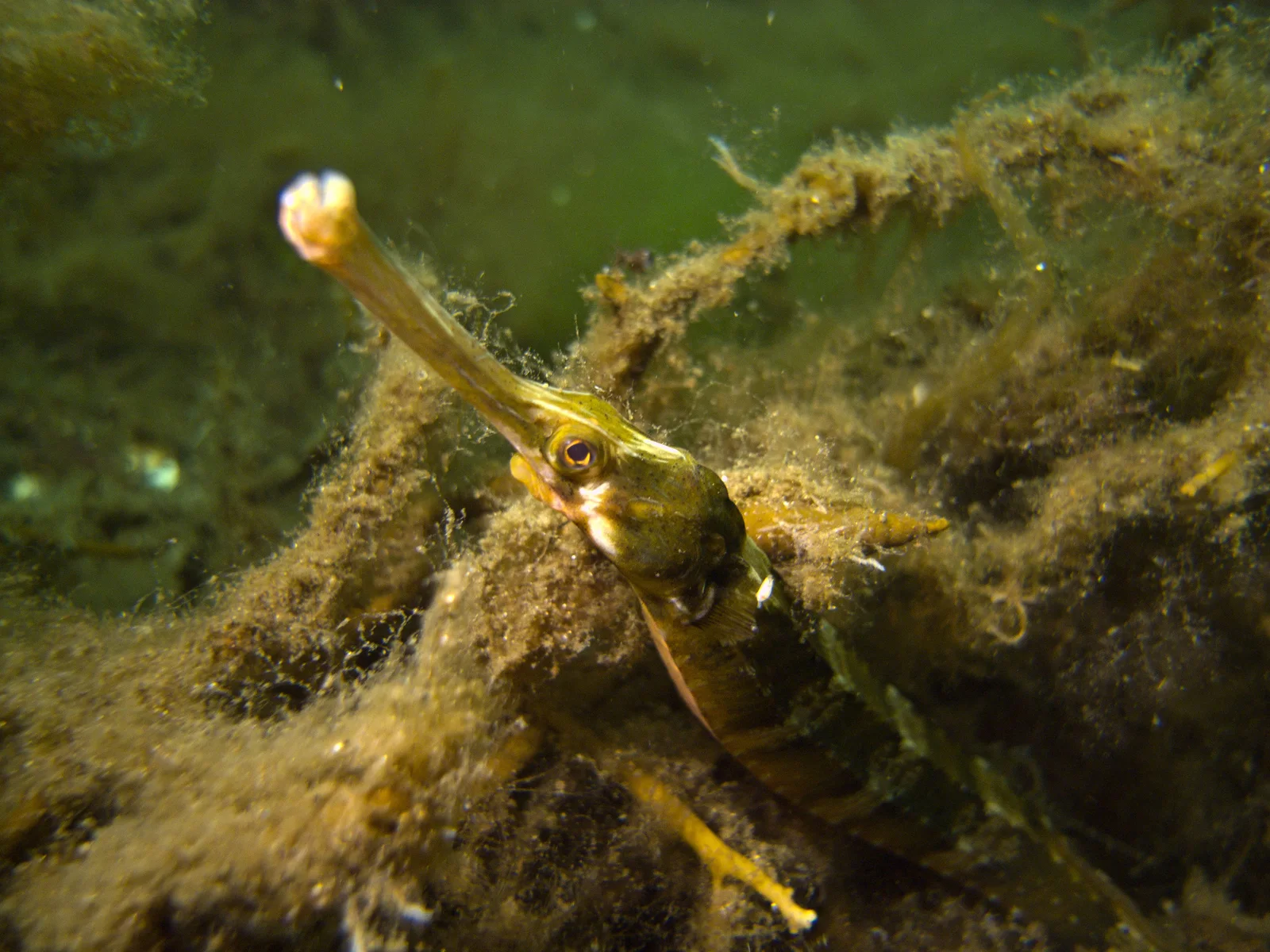
A long, slender fish of the pipefish and seahorse family, the greater pipefish is the type species of its genus. It ranges through the eastern Atlantic from Norway and the British Isles down to Western Sahara, entering the Mediterranean and Black Sea. Most records come from sand or mud in 3–15 m, although the species has been taken down to 110 m. There is no recreational fishery: FishBase marks it "of no interest" and records the aquarium trade as its only commercial use. With a maximum total length of 50 cm and a Least Concern assessment from 2024, it is best identified, photographed and released.
Identification
The greater pipefish is a long, thin fish, but the capture gives only part of the counts: 33–42 dorsal soft rays, no anal spines and three anal soft rays. Vertebrae, dorsal spines and body shape are blank. Maximum length is 50.0 cm total length, first maturity is 16.3 cm, and the recorded range extends from 7 to 25.6 cm; there is neither a common length nor a weight, nor an age. The maturity range spans more than threefold, which is unusually wide and warns against treating 16.3 cm as a fixed threshold.
It is the type species of Syngnathus, and the genus name is built from Greek syn (together) and gnathos (jaw). Chinese is ; English and iNaturalist both use Greater pipefish. Family Syngnathidae, order Syngnathiformes.
Habitat and distribution
The text range follows the eastern Atlantic from Norway, the Faroes and the British Isles to Western Sahara and Senegambia, then from Namibia to the Cape and north to Zululand in the western Indian Ocean, plus the Mediterranean, Aegean and Black seas. The page is careful about the Indo-Pacific: records outside South African waters lack conclusive evidence. Fifty-five country entries are all native.
The fish is marine and brackish, demersal, non-migratory, 0–110 m with a usual 3–15 m, in subtropical water between 71°N and 35°S and 19°W and 42°E. Habitat keywords are sandy, muddy and coastal; the diet is crustaceans and algae. The usual band is shallow — 3–15 m — and the two bottom types are open ground rather than reef.
GBIF holds 51 distribution rows, twenty without a country code; the Netherlands 7, Belgium 6 and Mozambique 3 lead the rest. iNaturalist has 964 observations. Relative to most species here the GBIF list is long while the observation count is moderate, which suggests a well-surveyed European coast.
Season and fishing approach
Two spawning rows are carried. The North Sea row runs March–August; the Calmati Lagoon at Izmir, sampled December 2001 to November 2002, lists all twelve months. The second row is a year-round listing from one lagoon, not a general rule, and the first row is the only regional window.
Human use is thin: fisheries "of no interest", commercial aquarium, and no gamefish field — it is listed as missing. No method is recorded. The angler's usable information is positional: 3–15 m usual, sand and mud, coastal, in brackish or marine water. A pipefish is not a rod target; it is encountered by net, seine or aquarium collector. The capture supports that placement and nothing more.
Edibility and regulations
There is no weight and no common length, and the only fisheries entry is "of no interest"; the aquarium trade is the recorded commercial use. IUCN is Least Concern, assessed 1 May 2024 — a recent assessment. No size, season or bag rule appears. Wikipedia describes the species as the type of its genus and a seawater fish, with no regulation note.
The honest limit: distribution and habitat are well documented, and both the food and the angling side are essentially empty. is a fish to identify and release, not one to plan a trip around.
Where these facts come from
Check these pages before you rely on a size, range or protection status.
- FishBase — Syngnathus acus — FishBase · T2
- GBIF — Syngnathus acus occurrence records — GBIF · T2
- IUCN Red List — Syngnathus acus — IUCN · T1
- Photo record — iNaturalist — iNaturalist · T3
Fish in the same water
These fish live in the same place.

Acoupa weakfish
- Family
- Sciaenidae
- Depth
- 1–20 m
- Season
- Jan, Feb, Mar, Apr, May, Jun, Jul, Aug, Sep, Oct, Nov, Dec

American angler
- Family
- Lophiidae
- Depth
- 0–800 m
- Season
- Mar, Apr, May, Jun

American eel
- Family
- Anguillidae
- Depth
- 0–464 m
- Season
- Jan, Feb, Mar, May, Jun, Jul
Guides for this water
Technique, gear and safety guides that fit Greater pipefish.