
Vermiculated puffer
A medium puffer common along the Japanese coast, called shosai-fugu in Kanto. It lives on sand inside 100 m, spawns in early summer on sand, mud or gravel shallower than 20 m, and lays adhesive eggs. The liver and ovary are highly toxic, the skin and intestine strongly toxic, and the milt is not; processing is licensed in Japan.
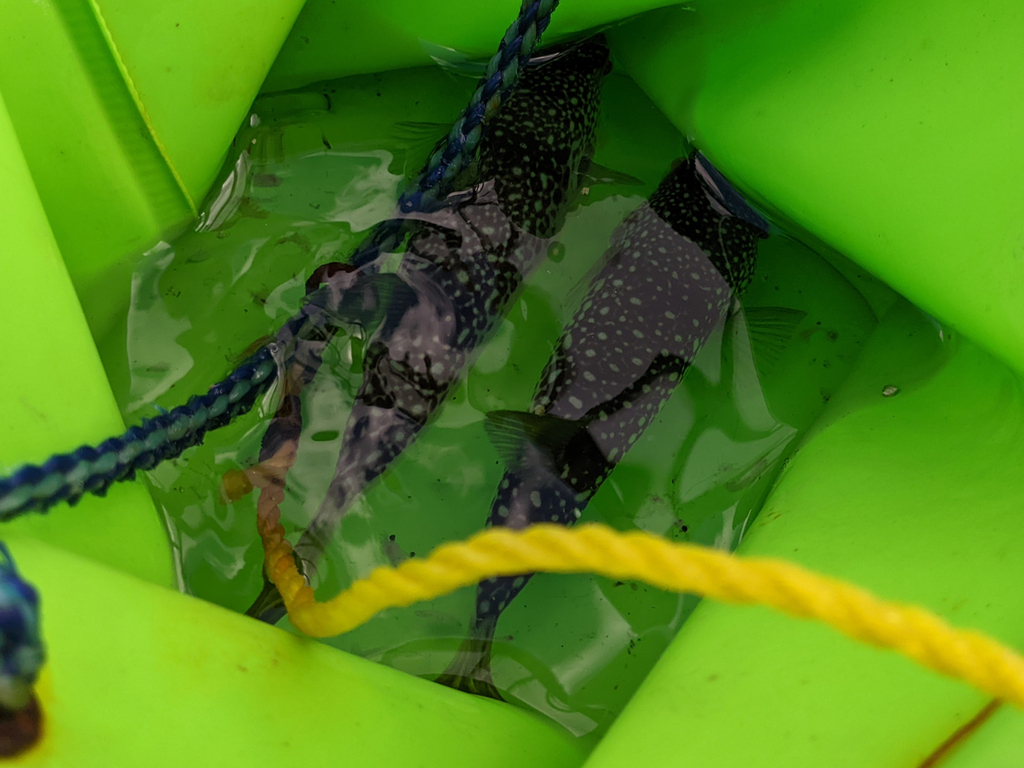
A medium puffer common along the Japanese coast, called shosai-fugu in Kanto. It lives on sand inside 100 m, spawns in early summer on sand, mud or gravel shallower than 20 m, and lays adhesive eggs. The liver and ovary are highly toxic, the skin and intestine strongly toxic, and the milt is not; processing is licensed in Japan.
A smooth puffer with a net pattern
The body is rounded, the snout ends in a small puckered mouth, and the skin is smooth without small spines. The back is brown with an irregular dark brown reticulation, the belly white, the pectoral and dorsal fins pale yellow-brown, the anal fin near white, and the caudal fin pale yellow-brown with a darker rear edge. When alarmed the fish fills its stomach with water or air and becomes spherical.
Against the tiger puffer it is smaller and has no skin spines. Against a juvenile mafugu, the key is the anal fin: yellow in mafugu, near white here.
FishBase gives a maximum of 30 cm standard length; the Japanese guide gives adults of 30 to 40 cm total length.
Coastal sand to a hundred metres
FishBase records the western Pacific: Japan, the Yellow Sea and the South China Sea. The Japanese record is the Sea of Japan and East China Sea coast from the Tsugaru Strait to Hyogo Hamasaka and Nagasaki, and the Pacific coast from the Tsugaru Strait to southern Kyushu, plus the south and east coasts of the Korean peninsula and the East China Sea.
The fish lives on sand along the coast and offshore, inside 100 m. Juveniles feed mainly on zooplankton, and adults crush crustaceans and polychaetes with fused tooth plates.
Spawning grounds are on sand, mud or gravel shallower than 20 m, and the eggs are adhesive, attached to the substrate.
Two peaks in Tokyo Bay
Spawning runs from the rainy season into early summer, and the Japanese angling encyclopedia narrows it to early summer, with adhesive eggs laid shallower than 20 m.
In Tokyo Bay the fish can be caught almost year-round, but two peaks are clear: October to December for numbers, and early summer for large fish carrying milt.
The same source notes that many areas set closed periods to protect the stock. That fits a country with no nationwide closed season: the months depend on the local cooperative rules or the prefectural rules, and a national closure is not the right mental model.
Cut-away hooks, not baited hooks
The busiest Kanto ground runs from Owane to Kisarazu offshore in Tokyo Bay, with additional grounds off Oarai and Kashima in Ibaraki, Iioka in Chiba, Ohara and Kamogawa on the Outer Boso coast, Omaezaki in Suruga Bay, and Irago in Mikawa Bay.
The main method is kattou fishing, which uses an anchor-shaped hook to snag the body rather than waiting for the fish to take a bait. The teeth cut leader easily, so ordinary rigs lose a great deal of gear; the kattou rig exists for this problem.
The rig fishes on the bottom, and the sinker has to transmit the feel of sand and mud through the rod.
Wire, pliers, and a licensed handler
A 2 to 2.7 m tip-action rod, a 2000 to 3000 reel, PE main line of 0.8 to 1.2, leader 3 to 5 or a dedicated wire trace, kattou hooks in 2 to 4, and sinkers of 20 to 40.
Line bites are routine rather than occasional, so the leader should be checked by the hour. A long leader is not an advantage with this rig: the hook is set into the body, and the wire only has to survive the teeth. Control a landed fish with pliers and keep hands out of the mouth. Before boarding, confirm whether the boat provides licensed processing; if it does not, leave the fish behind.
Toxin by organ
The milt is not toxic, and fish carrying milt from spring into early summer are the anglers' target. The muscle is reported by some accounts to be slightly toxic; the liver and ovary are highly toxic, the skin and intestine strongly toxic, and self-preparation is out of the question.
In Japan, fugu processing is licensed under the Ministry of Health, Labour and Welfare notice On securing the hygiene of fugu, dated 2 December 1983 and numbered Einyu 59, which sets licence requirements and species and organ limits. Prefectures run their own fugu handler systems. Killing and selling a landed puffer belongs to a licence holder, not to the angler.
The Russian Far East does not have this species, so there is no corresponding rule to compare.
What the sources say about closures
Classification, distribution and the 30 cm standard length come from FishBase. The Japanese range, spawning period, toxic organs, market position and eating assessment come from the market guide. Morphology, grounds, the kattou method and the regional closure note come from the angling encyclopedia. The fugu hygiene system comes from the ministry notice.
The toxicity statement is kept at the strength of the original: liver and ovary highly toxic, skin and intestine strongly toxic, milt non-toxic. The regional closed periods are recorded as a regional practice, not converted into a national season.
How to catch it
Shore casting
Fished with the listed approach, matched to the recorded depth and size.
Boat bottom fishing
Fished with the listed approach, matched to the recorded depth and size.
Where these facts come from
Check these pages before you rely on a size, range or protection status.
- FishBase — Takifugu snyderi — FishBase · T2
- GBIF — Takifugu snyderi occurrence records — GBIF · T2
- IUCN Red List — Takifugu snyderi — IUCN · T1
- Photo record — iNaturalist — iNaturalist · T3
Fish in the same water
These fish live in the same place.

Acoupa weakfish
- Family
- Sciaenidae
- Depth
- 1–20 m
- Season
- Jan, Feb, Mar, Apr, May, Jun, Jul, Aug, Sep, Oct, Nov, Dec

American angler
- Family
- Lophiidae
- Depth
- 0–800 m
- Season
- Mar, Apr, May, Jun

American eel
- Family
- Anguillidae
- Depth
- 0–464 m
- Season
- Jan, Feb, Mar, May, Jun, Jul
Guides for this water
Technique, gear and safety guides that fit Vermiculated puffer.