
Mahi-mahi in Mexico: 2 fish per angler per day · the two count as 5 fish against the 10-fish daily limit — Mexican federal waters.
En el caso de sábalo, dorado o pez gallo, el límite máximo será de dos ejemplares de cualquiera de tales especies, los que también serán equivalentes a cinco organismos de otras especies.
Quoted from NORMA Oficial Mexicana NOM-017-PESC-1994 (FONMAR reproduction)
Clause 4.7.1 of the standard, published in the Diario Oficial de la Federación on 9 May 1995.
Regulation guide
Official sourcesHow Atlantic mahi mahi is managed
Atlantic mahi mahi are managed by NOAA Fisheries, the South Atlantic Fishery Management Council and the Caribbean Fishery Management Council, with the Mid-Atlantic and New England councils cooperating. In the U.S. South Atlantic the species sits under the Fishery Management Plan for the Dolphin and Wahoo Fishery of the Atlantic. The plan covers dolphin and wahoo together, with separate catch limits for each species.
NOAA lists four stocks and stock complexes: South Atlantic, St. Croix, St. Thomas/St. John, and the Puerto Rico Dolphinfish Complex. The South Atlantic stock has not been formally assessed, so its overfished and overfishing status is unknown, but management measures are in place.
Mahi mahi are fast-growing, short-lived pelagic fish that live near the surface in tropical and subtropical waters. Dolphin are attracted to floating Sargassum, which provides cover and food and helps concentrate the fishery.
Source: NOAA Fisheries: Atlantic Mahi Mahi · South Atlantic Fishery Management Council: Dolphin
Federal bag and vessel limits
Federal rules for dolphin in the Atlantic EEZ from Maine to the Florida Keys set a recreational bag limit of 10 fish per person per day. The recreational vessel limit is 54 dolphin per vessel, excluding headboats; the 10-fish-per-person limit applies on private, charter and headboat trips.
Dolphin must be landed with head and fins intact. There is no federal minimum size in the northern part of the range, but a 20-inch fork-length minimum applies in federal waters off Florida, Georgia and South Carolina. Amendment 10 set the 54-fish vessel limit, effective May 2, 2022, and kept the 10-fish bag limit unchanged.
The recreational sector receives 93 percent of the dolphin annual catch limit and the commercial sector 7 percent, reflecting the fishery's overwhelmingly recreational character. Amendment 10 also addressed commercial trip limits and an operator permit requirement; those commercial measures are separate from the recreational bag and vessel limits above.
Source: NOAA Fisheries: Changes to the Dolphin and Wahoo Fishery of the Atlantic (FB22-018) · South Atlantic Fishery Management Council: Dolphin
North Carolina
North Carolina's recreational table lists dolphin with no minimum length and a bag limit of 10 per person per day. The state's footnote explains that the limit is 10 per person per day or 54 per trip, whichever is less, and that headboats use 10 per person per day.
Federal dolphin management applies, and the state points anglers to the South Atlantic council's regulations. A Coastal Recreational Fishing License is required for recreational fishing in North Carolina coastal waters. The state table uses the same 10-fish and 54-fish figures as the federal rule, so an angler fishing inside three miles and outside three miles is working from the same bag.
Source: NC DEQ Division of Marine Fisheries: Recreational Size and Bag Limits
Florida, Georgia and South Carolina
Off Florida, Georgia and South Carolina, federal waters add a 20-inch fork-length minimum for dolphin. The bag limit remains 10 per person per day and the vessel limit 54, excluding headboats, and the head and fins must stay intact.
The minimum-size rule is regional: it does not apply to dolphin caught farther north. The 20-inch minimum is a fork-length measure, so the tail fork is the reference point, not the tip of the tail. Anglers fishing off those three states therefore need to measure fork length, not total length.
Source: South Atlantic Fishery Management Council: Dolphin · NOAA Fisheries: Atlantic Mahi Mahi
New South Wales
New South Wales, Australia, manages mahi mahi as dolphinfish under its saltwater bag and size limits. The state sets a 60 cm minimum, allows only one fish over 110 cm, and permits 10 fish per person per day.
For species outside the special table the daily bag is 20, but mahi mahi has its own row. The possession limit for mahi mahi equals the daily bag limit, and anglers must pay the NSW recreational fishing fee and carry the receipt. The species arrives off the NSW coast with warm currents, usually in summer, and is most often found offshore around floating objects.
Source: NSW Department of Primary Industries and Regional Development: Saltwater bag and size limits · NSW Department of Primary Industries and Regional Development: Mahi Mahi (Dolphinfish)
Mexico
Mexican waters are a separate jurisdiction. Recreational fishing there requires a Mexican sport-fishing permit issued through CONAPESCA, and catch limits are set under Mexican rules rather than NOAA's.
A trip that crosses from U.S. waters into Mexico should therefore check the current permit and bag limits before fishing. The U.S. federal limits described above do not travel with the boat.
Before you keep a mahi mahi
Mahi mahi can be confused with the pompano dolphin, a smaller relative; the South Atlantic council notes that true dolphin have 55 to 66 dorsal fin rays and a wide, square tooth patch on the tongue. Confirm the identification before counting a fish against the bag.
Measure the fish the way the local rule requires, keep the head and fins intact where required, and check whether you are in state or federal water. The South Atlantic council notes that mahi colours fade almost immediately after death, which makes identification at the dock harder. Selling mahi mahi requires a permit, so recreational catch should stay out of the market.
Source: South Atlantic Fishery Management Council: Dolphin · NOAA Fisheries: Atlantic Mahi Mahi
Official pages: NOAA Fisheries: Atlantic Mahi Mahi · NOAA Fisheries: Dolphin and Wahoo Fishery of the Atlantic Amendment 10 (FB22-018) · South Atlantic Fishery Management Council: Dolphin · NC DEQ Division of Marine Fisheries: Recreational Size and Bag Limits · NSW Department of Primary Industries and Regional Development: Saltwater bag and size limits · CONAPESCA
Mahi-mahi regulations at a glance
6 jurisdictions| Jurisdiction | Area | Size | Bag | Season / closure | Closed area | Other |
|---|---|---|---|---|---|---|
| Australia — New South Wales | — | ≥60 cm (only 1 fish over 110 cm) · 10 fish per day | — | — | — | |
| Australia — Queensland | Queensland tidal waters | ≥50 cm | 5 fish possession limit | — | — | — |
| Australia — Western Australia | Western Australia — statewide | ≥500 mm | — | — | — | — |
| Mexico | Mexican federal waters | — | 2 fish per angler per day · the two count as 5 fish against the 10-fish daily limit | — | — | — |
| United States — North Carolina | North Carolina coastal and joint waters | — | No minimum size · 10 fish per person per day (54 per trip, whichever is less) | — | — | — |
| United States — federal (Atlantic) | Atlantic EEZ, North Carolina to Maine | — | 10 fish per person · 54 fish per vessel · no minimum size | — | — | — |
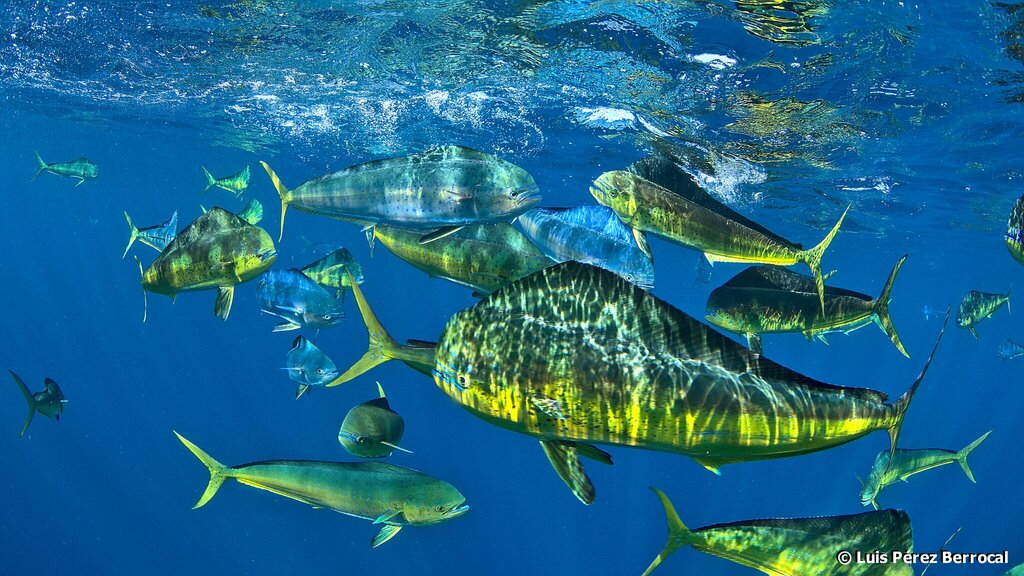
Mahi-mahi
Coryphaena hippurus · Coryphaenidae
Mahi-mahi is a large surface fish of warm seas, known in markets as dorado and sometimes confused with the dolphin mammal. It lives from the surface to 85 m, reaches 210 cm and 40 kg, and can live four years. Trolling or jigging is the usual approach, with fish present year-round in water of 21 to 30 °C.
- Family
- Coryphaenidae
- Max length
- 210 cm TL
- Max weight
- 40 kg
- Max age
- 4 years
- Depth
- 0–85 m
- IUCN
- LC
- Climate
- Subtropical · 21–30 °C
- Diet
- crustaceans, fishes, zooplankton
This fish has two English names that behave very differently. Mahi-mahi and dorado are market and angling words, and both point at one animal. Dolphin is the one that causes trouble, because in ordinary English it belongs to a mammal. The page keeps all of them in a single alias list and lets the reader sort it out. Sorting out which name owns which record is the job of this article.
Techniques
- Trolling —
- Jigging —
Seasonality
Other MX regulations
Same jurisdictionBefore you keep a fish
- Read the recorded value. It is copied from the notice; if the number and the notice disagree, the notice wins.
- Check the area. Federal, state and local waters can set different limits for the same fish.
- Check the date. Seasons, quotas and closures change; confirm the current notice before you go.
Common questions
- What is the bag limit for Mahi-mahi in Mexico?
- 2 fish per angler per day · the two count as 5 fish against the 10-fish daily limit
- Where does this regulation apply?
- Mexican federal waters
- When was it checked?
- 2026-11-18, against NORMA Oficial Mexicana NOM-017-PESC-1994 (FONMAR reproduction).
- Do other jurisdictions set different limits?
- Yes. This register lists 6 jurisdictions for Mahi-mahi; compare them in the table above.