
Roosterfish in Mexico: 2 fish per angler per day across sábalo, dorado, roosterfish and baya · counts as 5 against the 10-fish limit — Mexican federal waters.
En el caso de sábalo, dorado o pez gallo, el límite máximo será de dos ejemplares de cualquiera de tales especies, los que también serán equivalentes a cinco organismos de otras especies.
Quoted from NORMA Oficial Mexicana NOM-017-PESC-1994 (FONMAR reproduction)
No minimum size is set in the standard; sizes and closures are set by DOF notices. Shoreline, boat and underwater permits differ (clause 4.3).
Regulation guide
Official sourcesHow Mexico manages roosterfish
Roosterfish (Nematistius pectoralis) is taken in Mexican federal waters under NOM-017-PESC-1994, the official standard for sport-recreational fishing, and under the 2013 amendment that rewrote its catch limits. The standard is issued by the federal fisheries authority, published in the Diario Oficial de la Federacion, and applied by CONAPESCA. Both the original text and the amendment are held in FAOLEX.
The standard reserves roosterfish for recreational fishing. Together with marlin, sailfish, swordfish, sabalo and dorado, it is set aside exclusively for sport-recreational fishing inside a 50-nautical-mile strip measured from the baseline of the territorial sea. Fish retained under a sport permit belong to the permit holder and may not be sold.
This is not only a size table. The standard sets the permitted gear, the permits, the logbook duties and the catch limits for the whole sport fishery in federal waters, which is where roosterfish are taken along the Pacific coast.
Source: FAOLEX: NOM-017-PESC-1994, para regular las actividades de pesca deportivo recreativa en las aguas de jurisdiccion federal de los Estados Unidos Mexicanos · FAOLEX: Modificacion a la NOM-017-PESC-1994 (2013)
Two fish, counted as five against the day
Section 4.9.1 sets the marine bag at ten fish per angler per day, with no more than five of a single species. For sabalo, dorado, pez gallo (roosterfish) and baya, the maximum is two fish per angler per day, and those two count as five fish of other species.
The arithmetic is unusual. Two roosterfish do not sit outside the ten-fish day; they consume half of it. The two-fish ceiling is also shared across the four listed species, so one roosterfish plus one dorado uses the same allowance as two roosterfish.
What is left in the ten-fish day
After two roosterfish, five units remain. Those units can be filled with other marine species, subject to the five-fish-per-species cap and to any stricter limit for the species concerned. Billfish, shark and giant sea bass, for example, are one fish per angler per day and also count as five units each.
Long trips do not multiply the allowance freely. Section 4.9.3 lets vessels on trips of more than three days accumulate the equivalent of three days of fishing under the 4.9.1 quotas. Squid is treated separately, at five per angler per day.
A day that starts with two roosterfish and continues with five snapper reaches ten units and also reaches the five-fish cap for snapper. Adding a sixth snapper would break both the unit ceiling and the per-species cap.
No minimum size in the standard
NOM-017 sets no minimum size for roosterfish. Section 4.4 leaves minimum sizes, closed seasons and closed areas to the Secretariat, through measures published in the Diario Oficial. An angler therefore has to check the notices in force for the area, not only the bag table.
Section 4.10 also bars sport fishing in closed seasons and zones, within 250 metres of vessels working commercial gear, within 250 metres of fixed or floating gear, and within 250 metres of beaches used by swimmers. In refuge, reserve and natural protected areas, fishing is allowed only on the terms of the applicable instruments and with express authorisation.
The standard also confines the fishery to fish. Crustaceans, molluscs, aquatic mammals, reptiles and amphibians may not be taken under a sport permit, with squid the single exception.
Gear and handling aboard
In marine waters anglers may use as many rods and reels as they wish, provided the 4.9.1 and 4.9.3 limits are observed; inland waters are different, with only one rod in operation per angler. For deep-water species only one rod or handline with up to four hooks in a vertical line may be used, and multiple-death hooks are prohibited.
Section 4.12 governs what comes ashore. Fish taken under a sport permit may not be landed filleted, and filleting aboard is allowed only for consumption during the trip, with an exception for billfish. Fish may be gutted to slow spoilage, so a roosterfish intended for the table should be landed whole or gutted.
Bait in marine waters must be of fishery origin. Live bait may be taken only with one rod or handline carrying up to four hooks in a vertical line, and any bait caught during the trip must be entered in the logbook whether or not it is landed.
Permits, logbooks and release
Fishing from shore requires no permit. Fishing from a boat requires the permits set out in the Ley Federal de Derechos, and underwater fishing requires an individual permit. Underwater fishing is breath-hold only, with a single band, spring or pneumatic spear, and hooks, gaffs and light-attraction devices are prohibited.
Operators must carry the vessel and angler permits and the fishing logbook, record the required data and deliver the logbooks to the authority. Anglers must show their permit on request. Section 4.9.5 confirms that fish above the quota may still be caught if they are released in good condition, so roosterfish can be fished catch-and-release all day.
Underwater fishing carries its own bag: five fish per angler per day, with crustaceans and molluscs prohibited except squid. A spearfisherman cannot use the ten-fish boat allowance.
Before you keep a roosterfish
Work through four checks. First, the permit: shore, boat or underwater, each with its own requirement. Second, the count, remembering that two roosterfish equal five units of the ten-fish day and that the two-fish cap is shared with sabalo, dorado and baya.
Third, the area: the 50-mile strip, any closed season or zone, the 250-metre buffers and any protected area. Fourth, the fish itself: no minimum size in the standard, but it must be landed whole or gutted rather than filleted, and it cannot be sold.
If any of those checks fails, the fish goes back. The standard expressly allows release after the quota is reached, so a boat that has taken its two roosterfish can keep fishing for them provided every further fish is released in good condition.
Source: FAOLEX: NOM-017-PESC-1994, para regular las actividades de pesca deportivo recreativa en las aguas de jurisdiccion federal de los Estados Unidos Mexicanos · FAOLEX: Modificacion a la NOM-017-PESC-1994 (2013)
Official pages: FAOLEX: NOM-017-PESC-1994, para regular las actividades de pesca deportivo recreativa en las aguas de jurisdiccion federal de los Estados Unidos Mexicanos · FAOLEX: Modificacion a la NOM-017-PESC-1994 (2013)
Roosterfish regulations at a glance
1 jurisdictions| Jurisdiction | Area | Size | Bag | Season / closure | Closed area | Other |
|---|---|---|---|---|---|---|
| Mexico | Mexican federal waters | — | 2 fish per angler per day across sábalo, dorado, roosterfish and baya · counts as 5 against the 10-fish limit | — | — | — |
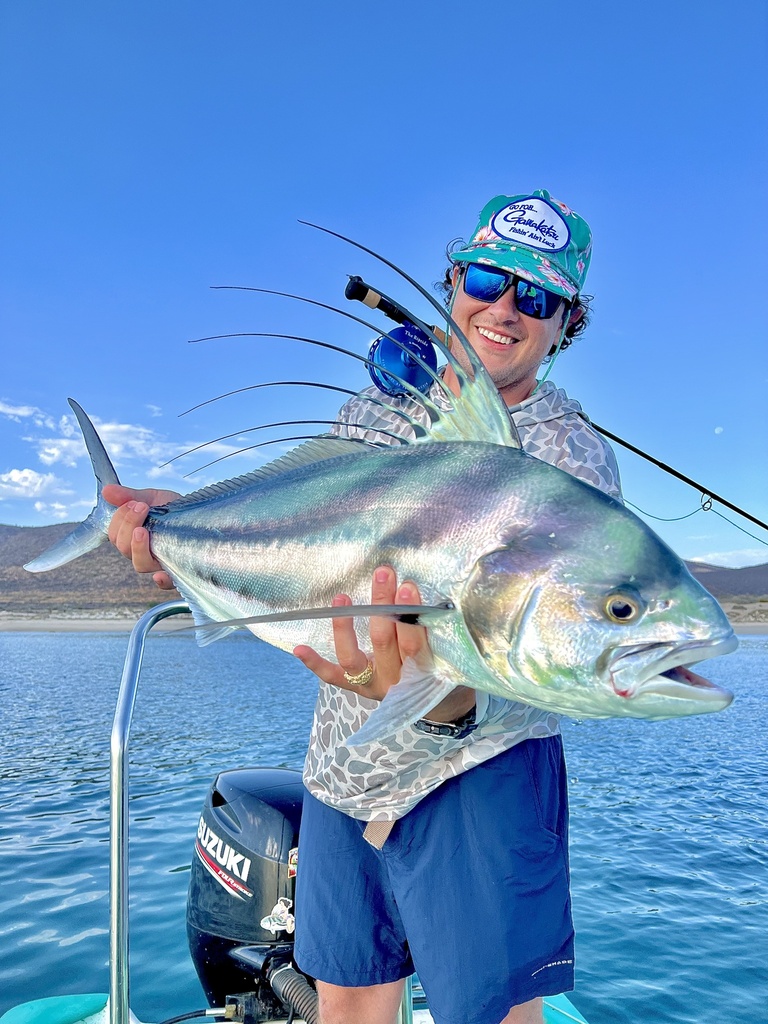
Roosterfish
Nematistius pectoralis · Nematistiidae
Roosterfish is a large inshore gamefish of the eastern Pacific, from San Clemente in southern California down to Peru and around the Galapagos. It is named for the row of long spines at the front of the dorsal fin, which stands up like a comb and gives the fish its rooster profile. Adults reach 163 cm FL and 51.7 kg. It is a subtropical fish, and no depth band is recorded for it.
- Family
- Nematistiidae
- Max length
- 163 cm FL
- Max weight
- 51.7 kg
- IUCN
- LC
- Climate
- Subtropical
Roosterfish (Nematistius pectoralis) is a fish of the family Nematistiidae. FishBase gives its range as: Eastern Pacific: San Clemente in southern California, USA to Peru, including the Galapagos Islands; rare north of Baja California, Mexico. The rooster comb is the identification: seven very long spines at the front of the dorsal fin. It is recorded in subtropical water. The recorded maxima are 163 cm FL, 51.7 kg. IUCN status: Least Concern (LC). Chinese name: .
Seasonality
Other MX regulations
Same jurisdictionBefore you keep a fish
- Read the recorded value. It is copied from the notice; if the number and the notice disagree, the notice wins.
- Check the area. Federal, state and local waters can set different limits for the same fish.
- Check the date. Seasons, quotas and closures change; confirm the current notice before you go.
Common questions
- What is the bag limit for Roosterfish in Mexico?
- 2 fish per angler per day across sábalo, dorado, roosterfish and baya · counts as 5 against the 10-fish limit
- Where does this regulation apply?
- Mexican federal waters
- When was it checked?
- 2026-11-18, against NORMA Oficial Mexicana NOM-017-PESC-1994 (FONMAR reproduction).